Last updated: November 17, 2026
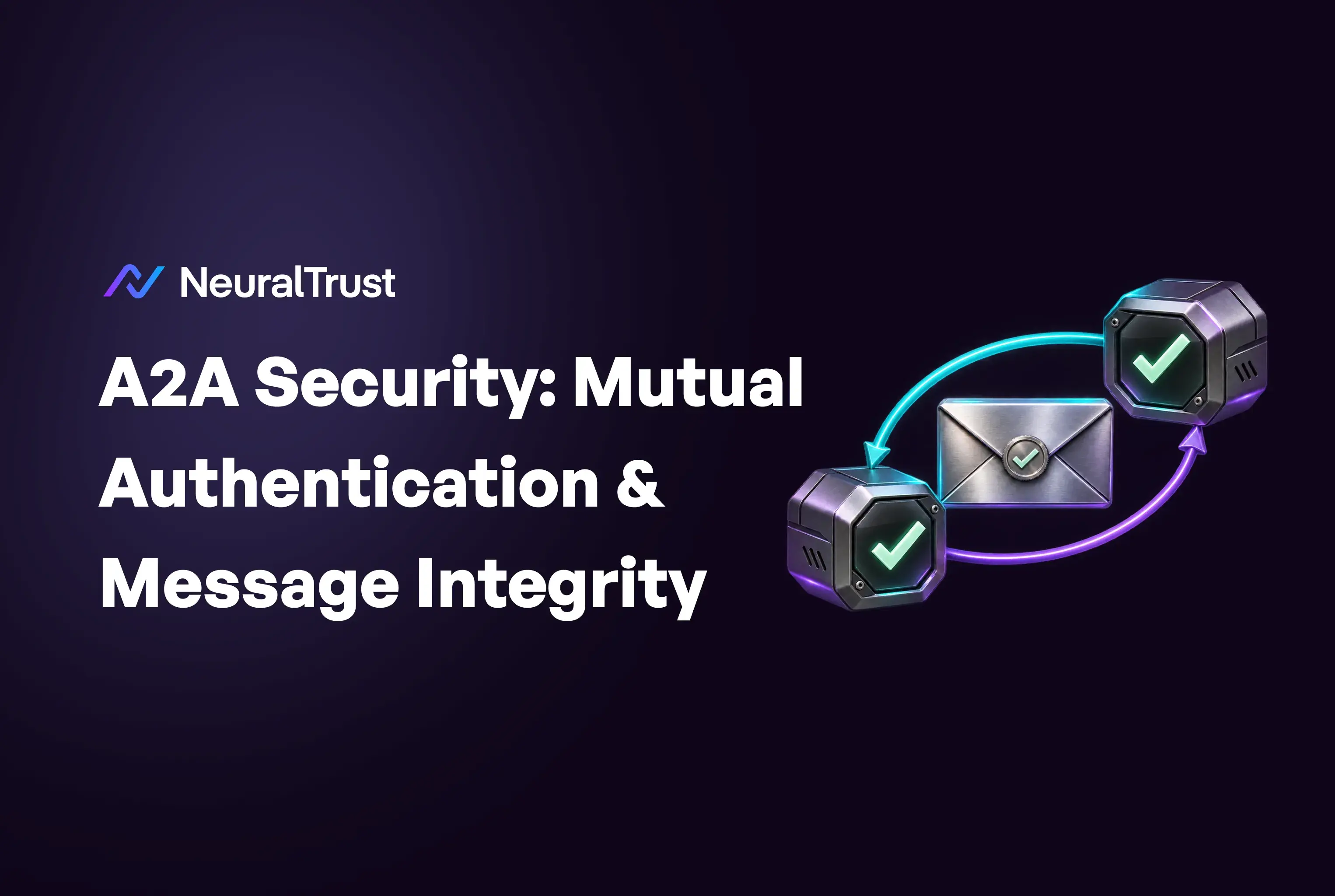
The A2A specification makes HTTPS mandatory in production, yet it leaves signed Agent Cards optional. That contrast sums up the protocol: it ships the parts for trust between agents and leaves the assembly to you. So what does A2A security take in practice? Mutual authentication, so each agent proves who it is, integrity checks on cards and messages, and authorization on every skill call.
TL;DR: Key Takeaways
- Transport is non-negotiable: A2A v1.0 says production deployments MUST use HTTPS or TLS, with TLS 1.3 or later recommended (A2A Project, 2026).
- Five ways to prove identity: each security scheme is exactly one of API key, HTTP auth, OAuth 2.0, OpenID Connect, or mutual TLS (A2A Project, 2026).
- Card signatures are opt-in: Agent Cards MAY be signed with JWS (RFC 7515) after JCS canonicalization (RFC 8785) (A2A Project, 2026).
- Broad backing: Google launched A2A on April 9, 2025, with more than 50 technology partners (Google, 2025).
- Neutral governance: A2A joined the Agentic AI Foundation on August 27, 2026, as a Growth Stage project (A2A Project, 2026).
- A named risk: OWASP lists insecure inter-agent communication as ASI07 in its Top 10 for Agentic Applications 2026 (OWASP, 2025).
At a glance: A2A security controls
Quick Answer
What is A2A security?
A2A security is the set of controls that let AI agents talk over the Agent2Agent protocol without impersonation, tampering, or overreach. It covers TLS on every hop, authentication of both client and server agents, signed Agent Cards, per-skill authorization, safe credential handling during delegation, and hardened push notification webhooks.
| Threat | What A2A v1.0 specifies | What you still add |
|---|---|---|
| Fake server agent | TLS certificate validation, optional card signatures | Require signatures and pin keys |
| Fake client agent | Schemes including mTLS, OAuth 2.0, and OIDC | One identity per agent, no shared keys |
| Tampered Agent Card | JWS signature over a JCS-canonical card | Reject unsigned cards from partners |
| Message tampering | Mandatory HTTPS or TLS per hop | Integrity checks across intermediaries |
| Over-broad access | Server MUST authenticate every request | Skill-level scopes and least privilege |
| Credential relay | Bind in-band credentials to the requesting agent | Sender-constrained tokens |
| Webhook abuse | SHOULD block private IP ranges | Egress allowlists you enforce |
How we compared
We read the A2A v1.0 specification and its enterprise guidance, then mapped each MUST and SHOULD to threats from OWASP's agentic Top 10 and a MAESTRO-based analysis of A2A. Where the spec leaves a choice to implementers, we say so plainly.
How A2A security works in v1.0
A2A treats each remote agent like a standard HTTP application. Identity lives at the transport layer, not inside JSON-RPC payloads. A server advertises its accepted authentication schemes in its Agent Card, clients obtain credentials out of band, and the server must authenticate every single request before it does anything.
The A2A Project's Enterprise Implementation guide (2026) states that A2A payloads "don't carry user or client identity information directly". That design choice is sound, because it reuses the identity stack you already run. It also means a weak gateway, proxy, or token policy weakens every agent behind it.
Discovery is the first trust decision. Clients find cards at a well-known URI, /.well-known/agent-card.json, through curated registries, or through direct configuration. An extended Agent Card can expose extra skills, but the spec says fetching it MUST require authentication, and it SHOULD NOT contain internal URLs or credentials.
Mutual authentication between agents
Mutual authentication means both sides prove identity. The client agent checks the server through its TLS certificate and, ideally, a signed Agent Card. The server agent checks the client through a declared scheme. A2A v1.0 lists mutual TLS as a first-class option next to OAuth 2.0 and OpenID Connect.
| Scheme | What it proves | Strength | Watch out for |
|---|---|---|---|
| Mutual TLS | The workload holds a private key | Strong, no bearer secret on the wire | Certificate issuance and rotation |
| OAuth 2.0 client credentials | The agent is a registered client | Scopes map well to skills | Bearer tokens can be replayed |
| OpenID Connect | A user or workload identity | Fits enterprise SSO | Token audience must match |
| API key | Possession of a shared secret | Simple | Shared, long-lived, hard to attribute |
For internal agent traffic, mTLS with workload identities is the cleanest pattern. Across organizations, OAuth 2.0 works better, ideally with certificate-bound access tokens. According to IETF (2020), RFC 8705 binds an access token to the client's TLS certificate, so a stolen token is useless without the matching key.
Message integrity: what TLS covers and what it misses
TLS protects each hop against eavesdropping and tampering. A2A defines signatures for Agent Cards, but not for individual messages or artifacts. If a message passes through a proxy, queue, or orchestrator that terminates TLS, that component can read and change content without either agent noticing.
That gap matters in multi-agent chains. Keep the number of TLS termination points small and limit them to components you control, such as your gateway. Log a hash of each message and artifact at that gateway, so investigators can prove what was sent. For high-value outputs such as payment instructions, sign the payload at the application layer.
The spec also asks for basic hygiene. Agents MUST validate all input parameters, and file references inside messages MUST be validated to prevent server-side request forgery. Treat every message from another agent as untrusted input, even when the sender is authenticated.
Signed Agent Cards and key trust
A signed Agent Card proves that a card came from the claimed provider and was not altered. A2A v1.0 canonicalizes the card with JCS, signs it with JWS, and requires clients that verify to reject expired or revoked keys. Signing stays optional, so your policy decides whether unsigned cards are acceptable.
The protected header must include alg, typ, and kid, and it may include jku, a URL to the signer's key set. Treat jku with care: if a client fetches keys from any URL a card names, an attacker can sign a forged card with their own key. A trusted key store for known providers, which the spec allows, closes that hole.
According to Habler and colleagues (2025), their MAESTRO-based threat model of A2A focused on Agent Card management, task execution integrity, and authentication. Rotation matters too. The spec allows multiple signatures, so you can roll keys without breaking clients.
Security and governance: A2A traffic in the enterprise
Authenticated agents can still do damage. A trusted partner agent can relay prompt injection from a poisoned document, leak data through an artifact, or trigger tool misuse by delegating a task your agent should refuse. Security has to cover what flows between agents as well as who connects.
OWASP (2025) called insecure inter-agent communication out as ASI07 in its agentic Top 10. The A2A spec adds concrete duties: servers MUST scope task results to the caller's authorization, and receiving a credential MUST NOT be assumed to authorize later messages. Agents SHOULD also validate webhook URLs and reject private IP ranges to prevent SSRF.
NeuralTrust approaches this at the gateway and at runtime. Agent Gateway (TrustGate) covers LLM, MCP, and A2A traffic. Through it, every agent handoff is traced, end-user identity is forwarded through every hop, and access is set per agent and per tool. With Agent Runtime Security (TrustGuard), you inspect prompts, responses, and tool calls in real time.
Which should you choose?
Choose your A2A security pattern by trust boundary. Agents inside one cluster need different controls than agents that cross into a partner's systems or act for an end user. The table below matches common scenarios to a baseline. Treat it as a starting point you adapt to your own risk appetite, not a fixed standard.
| Scenario | Authentication | Integrity | Authorization |
|---|---|---|---|
| Internal agents, same platform | mTLS with workload identity | TLS, gateway message hashes | Skill allowlists per agent |
| Partner agents across companies | OAuth 2.0 with certificate-bound tokens | Signed cards, pinned keys | Scoped tokens per skill |
| Agents acting for a user | OIDC plus user consent | TLS, signed high-value payloads | In-task authorization, fresh scope |
| Public or marketplace agents | OAuth 2.0, strict rate limits | Signed cards required | Minimal skills, sandboxed tools |
Conclusion
A2A security is mostly a configuration job. The protocol mandates TLS and server-side authentication, offers mutual TLS and OAuth 2.0, and specifies how to sign Agent Cards. It does not force signatures, define message-level integrity, or decide what each agent may do. Close those gaps on purpose: require signed cards from partners, pin keys, bind tokens to their holders, hash messages at a gateway you control, and authorize every skill call.
Secure A2A Traffic in Production with NeuralTrust
Trace every agent handoff and control access through TrustGate, with real-time inspection on NeuralTrust.
Related Comparisons
- How To Prevent Infinite Loops in Multi-Agent Systems
- Multi-Agent Systems Security (MASS)
- Cryptographic Identity for AI Agents
- OWASP Top 10 for Agentic Apps 2026
FAQs about A2A Security
1. What is A2A security?
A2A security covers the controls that keep Agent2Agent traffic trustworthy: TLS on every hop, authentication of both agents, signed Agent Cards, per-skill authorization, and safe handling of credentials during delegation. The protocol supplies the building blocks, but most choices, such as requiring signatures or binding tokens, belong to the teams that deploy agents.
2. What is the A2A protocol?
The Agent2Agent (A2A) protocol is an open standard that lets AI agents built on different frameworks discover each other, delegate tasks, and exchange messages and artifacts. Google launched it in April 2025, and it joined the Agentic AI Foundation in August 2026. The Linux Foundation (2025) reported support from more than 100 companies when it began hosting A2A.
3. Is A2A secure?
A2A can be deployed securely, but it is not secure by default in every respect. It mandates TLS in production and requires servers to authenticate every request. Agent Card signatures are optional, message-level integrity is not defined, and authorization logic is up to each implementer. Your configuration decides the outcome.
4. How does A2A authentication work?
The server lists accepted schemes in its Agent Card: API key, HTTP auth, OAuth 2.0, OpenID Connect, or mutual TLS. The client obtains credentials outside the protocol, for example through an OAuth flow, and sends them in standard headers with every request. The server rejects missing or invalid credentials with the right error.
5. What is an Agent Card in A2A?
An Agent Card is a JSON document that describes an agent's identity, endpoints, skills, and accepted authentication schemes. Clients usually fetch it from /.well-known/agent-card.json. Cards can carry JWS signatures so clients can verify the publisher, and an authenticated extended card can expose extra skills to approved clients.
6. What is the difference between MCP and A2A?
MCP connects an agent to tools, data, and resources. A2A connects agents to other agents that may be opaque, built by different teams or vendors. The A2A specification describes the two as complementary. Many enterprise systems use both, so security teams need consistent identity and logging across MCP and A2A traffic.
About the Author
Roger Howroyd is Head of Global SEO and AI at NeuralTrust, where he leads the company's search strategy across SEO, AEO, GEO, and LLM optimization. He specializes in AI-powered search, content strategy, and SEM. Connect on LinkedIn.
NeuralTrust is the leading platform for securing and scaling AI agents. Named a Pioneer in the Gartner Emerging Market Quadrant for AI Application Security 2026, recognized across four Gartner Hype Cycle reports in 2026, and featured in the Gartner Market Guide for Guardian Agents 2026, the Gartner Market Guide for AI Gateways 2025 and the KuppingerCole Leadership Compass for Generative AI Defense 2025. Headquartered in Barcelona with offices in London and New York. ISO 27001 certified.
Sources
- A2A Project, "Agent2Agent (A2A) Protocol Specification," version 1.0.0, accessed November 17, 2026. https://a2a-protocol.org/latest/specification/
- A2A Project, "Enterprise Implementation of A2A," accessed November 17, 2026. https://a2a-protocol.org/latest/topics/enterprise-ready/
- Google Developers Blog, "Announcing the Agent2Agent Protocol (A2A)," April 9, 2025. https://developers.googleblog.com/en/a2a-a-new-era-of-agent-interoperability/
- The Linux Foundation, "Linux Foundation Launches the Agent2Agent Protocol Project," June 23, 2025. https://www.linuxfoundation.org/press/linux-foundation-launches-the-agent2agent-protocol-project-to-enable-secure-intelligent-communication-between-ai-agents
- A2A Project, "A New Chapter for A2A: Joining the Agentic AI Foundation," August 27, 2026. https://a2a-protocol.org/latest/blog/2026/08/27/a-new-chapter-for-a2a-joining-the-agentic-ai-foundation/
- OWASP GenAI Security Project, "OWASP Top 10 for Agentic Applications for 2026," December 9, 2025. https://genai.owasp.org/2025/12/09/owasp-top-10-for-agentic-applications-the-benchmark-for-agentic-security-in-the-age-of-autonomous-ai/
- Habler, Huang, Narajala, and Kulkarni, "Building A Secure Agentic AI Application Leveraging A2A Protocol," arXiv:2504.16902, April 2025. https://arxiv.org/abs/2504.16902
- IETF, "RFC 8705: OAuth 2.0 Mutual-TLS Client Authentication and Certificate-Bound Access Tokens," February 2020. https://www.rfc-editor.org/rfc/rfc8705