Last updated: October 21, 2026
What does an AI gateway for agentic AI actually do? It sits between your agents and everything they call (models, tools, MCP servers and other agents) and enforces identity, policy, logging and budgets on every request. Without one, each agent carries its own credentials, and nobody can see or stop a chain of calls once it starts.
TL;DR: Key Takeaways
- According to Gartner (2025), over 40% of agentic AI projects will be canceled by the end of 2027, citing cost, unclear value and weak risk controls.
- MCP authorization is optional in the specification, and a July 2026 study found about 92% of 414 tested public MCP servers had no OAuth.
- Anthropic (2025) measured multi-agent systems at about 15 times the tokens of a chat, so budgets belong on each agent.
- The OWASP agentic Top 10 lists ten risks, including goal hijack and insecure inter-agent communication, and all of them cross a gateway.
- Gartner's Market Guide for AI Gateways (2025) describes three vendor archetypes and separates AI gateways from API management and model routers.
| Control layer | Question it answers | Anchor |
|---|---|---|
| Identity and access | Which agent may call which tool, for whom? | MCP authorization, OAuth 2.1 |
| Tool and agent policy | What may it do with that tool? | OWASP LLM06, ASI02 |
| Inter-agent trust | Who is the other agent? | A2A Agent Cards |
| Observability | What happened, and in what order? | OpenTelemetry GenAI |
| Cost | How much may this chain spend? | OWASP LLM10 |
| Runtime protection | Is this content safe to act on? | OWASP LLM01 |
Why do multi-agent workflows outgrow a traditional gateway?
Because one user request becomes dozens of machine decisions. A planner agent calls a model, the model picks a tool, the tool returns text that another agent reads, and every hop can spend money or touch data. A classic API gateway sees isolated requests and cannot tell which workflow they belong to.
According to Gartner (2025), escalating costs, unclear business value and inadequate risk controls will cancel more than 40% of agentic AI projects by the end of 2027. Two of those three causes are gateway problems.
Cost is measurable. Anthropic (2025) reports that agents use about four times the tokens of a chat and multi-agent systems about 15 times. In its evaluation, token usage alone explained roughly 80% of performance variance, so spend and quality move together.
Gartner's Market Guide for AI Gateways (2025) draws a clear line between true AI gateways and API management platforms, model routers and LLM observability tools. It also names MCP and A2A as standards shaping architecture decisions.
What traffic does an AI gateway for agentic AI control?
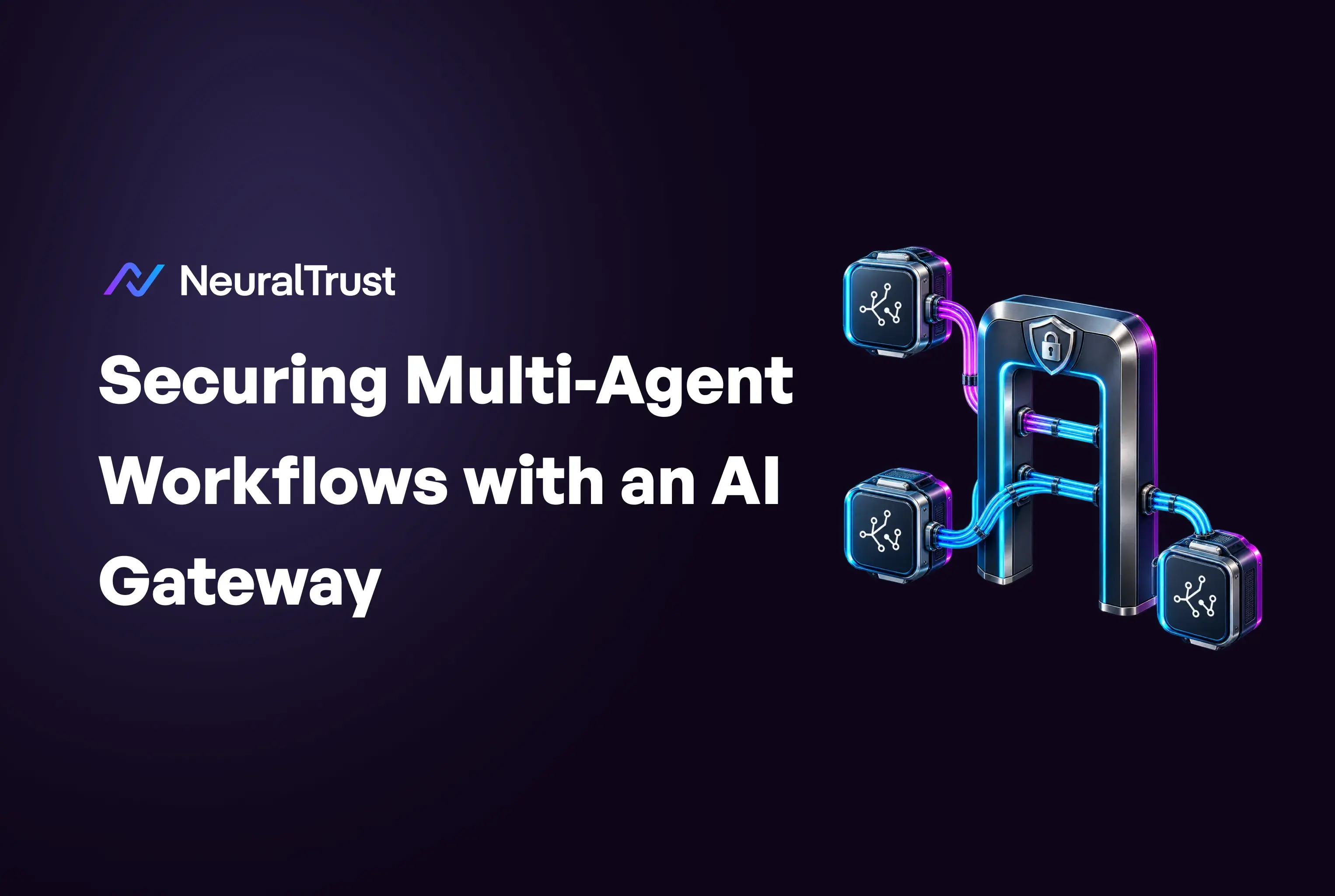
An AI gateway for agentic AI governs three kinds of traffic: calls to models, calls to tools and MCP servers, and calls between agents. Each needs the same four checks: who is calling, what they may do, what happened and what it cost.
| Traffic | Example | Gateway control |
|---|---|---|
| Agent to model | A planner asks a model for the next step | Provider routing, prompt and response guards, token limits |
| Agent to tool | An agent calls a CRM or ticketing MCP server | Per-agent identity, tool allow-lists, argument checks |
| Agent to agent | An orchestrator delegates to a research agent | Mutual authentication, scoped delegation, trace propagation |
The A2A specification guidance places identity at the HTTP layer and has servers advertise their authentication schemes in an Agent Card. It also recommends API management for agents exposed across organizational boundaries, which means a policy point your team controls.
Keep the gateway as the single egress path. If an agent can reach a tool without passing through it, the policy exists only on paper.
How we assessed these controls
We mapped each control to a public standard (the MCP and A2A specifications, the OWASP lists and OpenTelemetry) and kept only claims with a dated, linked source. Single-author and vendor-reported figures are labeled as such.
How do you control identity and tool access across agents?
Give every agent its own identity, then authorize each tool call against that identity and the user behind it. Shared API keys make all agents look alike in the logs and let one compromised agent use every tool.
The MCP specification (2026-07-28) makes authorization optional. When an HTTP server supports it, the server acts as an OAuth 2.1 resource server. It validates that each token was issued for it as the audience, and it must not accept or pass through tokens meant for other resources. It also defines a 403 insufficient scope response, so clients can request narrower, step-up permissions.
Optional controls tend to stay off. A July 2026 study of 414 internet-facing MCP servers found about 92% had no OAuth, and 687 tool instances exposed shell execution without access controls. It is a single-author study of public HTTP servers, so read the figures as a signal, not a census. Our guide to MCP authentication walks through the flow, and what is an MCP server covers the basics.
A gateway closes the gap. It terminates authentication once, maps each agent to scoped roles and refuses calls outside its allow-list, even when the downstream server has no auth of its own.
How do you get observability and cost control across agent chains?
Trace every workflow end to end and attach a budget to every agent. Logs from separate services cannot explain why an agent chose a tool, and a monthly invoice cannot say which loop caused it.
OpenTelemetry publishes GenAI semantic conventions that include agent and framework spans, and the A2A guidance asks clients and servers to propagate trace context. One trace ID from the first prompt to the last tool call turns an incident review into a query.
| Signal | Why it matters | How the gateway captures it |
|---|---|---|
| Trace per workflow | Reconstructs the decision path | One trace ID across model, tool and agent calls |
| Tokens per agent | Finds runaway loops (OWASP LLM10) | Counters and hard limits per agent and per run |
| Tool calls per run | Shows tool misuse early | Rate limits and anomaly alerts |
| Denied calls | Measures policy coverage | Logged with reason and agent identity |
Set limits at three levels: per call, per run and per agent per day. When a planner loops, the run limit stops it in minutes instead of the daily limit stopping it in hours.
Security and governance: what can go wrong between agents and tools?
Most agent failures happen in the connections, not in the model. The OWASP Top 10 for Agentic Applications (December 2025) names ten risks. Among them are goal hijack (ASI01), tool misuse (ASI02), identity and privilege abuse (ASI03), insecure inter-agent communication (ASI07) and cascading failures (ASI08). The OWASP Top 10 for LLM Applications (2025) adds prompt injection (LLM01), excessive agency (LLM06) and unbounded consumption (LLM10).
A gateway is the natural enforcement point, because every request passes through it. Indirect prompt injection is the clearest case: instructions hidden in a tool result or document reach an agent that trusts the text. Scanning tool output before it reaches the agent, and blocking calls the agent was never granted, reduces the blast radius.
| Risk | Where it enters | Gateway control |
|---|---|---|
| Tool misuse (ASI02, LLM06) | An agent holds more tool access than its task needs | Per-agent allow-lists and argument validation |
| Identity abuse (ASI03) | Shared keys let one agent act as another | Scoped, short-lived credentials per agent |
| Prompt injection (LLM01) | Hidden instructions in a document or tool result | Input and output scanning before the agent acts |
| Runaway consumption (LLM10) | A looping agent keeps calling models and tools | Token and call limits per run |
NeuralTrust builds this into its Agent Gateway (TrustGate), part of the Runtime Security Mesh platform alongside Agent Runtime Security (TrustGuard). TrustGate ships 200+ pre-built MCP servers behind one authenticated endpoint and applies guard policies to prompts, responses and tool results. It runs either self-hosted in your own infrastructure or as a managed service in the EU or US. The AI Gateway now has a free tier, so you can test policies on a real workflow first.
Governance needs evidence as well as controls. Keep denied calls, approvals and policy versions in the log, and pair high-impact actions with human-in-the-loop approval.
Which setup fits your team?
| Team | Start with | Add next |
|---|---|---|
| Solo builder or startup | A hosted gateway with a free tier and one identity per agent | Token budgets and tracing |
| Platform team with regulated data | A self-hosted gateway in your own environment and tool allow-lists | Approval workflows and audit export |
| Security team with many MCP servers | A central MCP catalog behind OAuth 2.1 | Output scanning and anomaly alerts |
Conclusion
An AI gateway for agentic AI is the point where identity, tool policy, tracing and budgets meet. Gartner expects many agentic projects to fail on cost and risk, and the MCP and A2A specifications leave key controls to you. Put one gateway on the only path agents can use, give each agent an identity, and watch denied calls, tokens and traces from day one.
Secure Multi-Agent Workflows in Production with NeuralTrust
Put identity, policy and budgets in front of every agent call. Start free with the AI Gateway and connect your first MCP server today.
Related Comparisons
FAQs about AI Gateway for Agentic AI
1. What is an AI gateway for agentic AI?
It is a control point between agents and the models, tools, MCP servers and other agents they call. It authenticates each agent, enforces tool policy, logs every call and applies token budgets, so a multi-agent workflow stays visible and bounded from the first request to the last.
2. How is it different from an API gateway?
An API gateway authorizes requests to a service and treats each one alone. An AI gateway for agents authorizes access per tool, tracks the workflow across steps, scans prompts and tool results, and counts tokens. Gartner's 2025 guide treats the two as distinct categories.
3. Do I need a separate MCP gateway?
Not necessarily. MCP gateway functions, such as central authentication, a tool catalog and allow-lists, can live in the same gateway that routes model calls. One policy plane is easier to audit than two. Separate products make sense only when different teams own each traffic type.
4. Does an AI gateway stop prompt injection?
It reduces the risk but does not remove it. Scanning inputs and tool results catches many attacks, and least-privilege tool access limits the damage of the rest. OWASP ranks prompt injection first (LLM01), so combine the gateway with human approval for high-impact actions.
5. Can I self-host an AI gateway?
Yes. Many teams keep the gateway inside their own network to control data residency and audit logs. NeuralTrust's TrustGate runs self-hosted in your infrastructure or as a managed service in the EU or US, so you can start hosted and move later.
6. How should I budget tokens for multi-agent workflows?
Plan for about 15 times the tokens of a chat, as Anthropic measured in 2025, then enforce limits per call, per run and per agent per day. Alert on runs that hit their limit, because a loop that stops early is cheaper than one that finishes.
About the Author
Roger Howroyd is Head of Global SEO and AI at NeuralTrust, where he leads the company's search strategy across SEO, AEO, GEO, and LLM optimization. He specializes in AI-powered search, content strategy, and SEM. Connect on LinkedIn.
NeuralTrust is the leading platform for securing and scaling AI agents. Named a Pioneer in the Gartner Emerging Market Quadrant for AI Application Security 2026, recognized across four Gartner Hype Cycle reports in 2026, and featured in the Gartner Market Guide for Guardian Agents 2026, the Gartner Market Guide for AI Gateways 2025 and the KuppingerCole Leadership Compass for Generative AI Defense 2025. Headquartered in Barcelona with offices in London and New York. ISO 27001 certified.
Sources
- Gartner, Predicts Over 40% of Agentic AI Projects Will Be Canceled by End of 2027 (June 25, 2025)
- Gartner, Market Guide for AI Gateways (October 13, 2025)
- Model Context Protocol, Authorization specification (version 2026-07-28)
- N. Padilla, Exposed by Design: A Dynamic Security Assessment of Internet-Facing MCP Servers at Scale (July 31, 2026)
- Anthropic, How we built our multi-agent research system (June 13, 2025)
- OWASP GenAI Security Project, Top 10 for Agentic Applications (December 9, 2025)
- OWASP GenAI Security Project, Top 10 for LLM Applications 2025
- A2A Protocol, Enterprise-ready features
- OpenTelemetry, Semantic conventions for GenAI agent and framework spans