)
Most enterprise AI security incidents don't start with a sophisticated attack. They start with an AI agent that has access to sensitive data, no runtime monitoring, and no controls on what it can do autonomously. Research predicts that 25% of enterprise generative AI apps will experience at least five minor security incidents each year, up from 9% just a few years earlier. From goal hijacking and tool misuse to cascading failures and identity abuse, these risks exploit the very autonomy that makes agentic AI useful. An agent that can read emails, execute code, and call APIs on your behalf can just as easily be manipulated into doing the same for an attacker.
Today’s enterprises are working with dedicated AI security companies to manage these risks. Why? Traditional security tools weren’t designed to monitor for these modern threats in real time. They lack visibility into autonomous agent behavior and prompt-level attacks. Meanwhile, AI security platforms are designed specifically to secure AI systems and AI agents in production environments.
In this guide, we compare the best AI security platforms for AI agent security, model evaluation, runtime monitoring, and enterprise governance.
Key takeaways
- AI security platforms now focus heavily on securing AI agents, LLM applications, MCP environments, and autonomous workflows during runtime.
- Runtime protection, prompt inspection, AI gateways, and agent monitoring have become core features for enterprise AI security platforms.
- Many organizations now need visibility into AI behavior, tool access, prompts, outputs, and sensitive data exposure across production AI environments.
- AI security vendors vary widely. Some focus on governance and compliance, while others specialize in runtime defense, red teaming, or AI threat detection.
Best AI security companies: Quick review
We evaluated the AI security companies below based on their focus areas, runtime protection capabilities, AI agent security features, governance support, threat detection coverage, deployment flexibility, and integrations with enterprise environments.
We also reviewed vendor documentation, product capabilities, analyst recognition, customer adoption signals, compliance support, and AI-specific protections. Additionally, we assessed prompt injection defense, AI gateways, runtime monitoring, red teaming, and AI security posture management.
The list includes vendors focused on AI-native runtime security, AI governance, AI observability, AI-SPM, AI threat detection, and broader AI-powered cybersecurity operations.
| Company | Best for | Type of AI security | Prompt injection defense | AI agent security | Runtime monitoring | AI red teaming | Compliance support |
|---|---|---|---|---|---|---|---|
| NeuralTrust | Securing AI agents and LLMs | AI-native runtime security | Yes | Yes | Yes | Yes | EU AI Act, NIST AI RMF, ISO/IEC 42001 |
| Pangea | AI application guardrails | Runtime AI protection | Yes | Yes | Yes | Yes | SOC 2, ISO 27001, ISO 27701 |
| TrojAI | AI runtime defense | AI runtime security | Yes | Yes | Yes | Yes | OWASP, NIST, MITRE |
| Enkrypt AI | AI red teaming | AI governance + runtime protection | Yes | Yes | Yes | Yes | Governance and compliance workflows |
| Darktrace | AI activity monitoring | AI-powered cybersecurity | Limited | Yes | Yes | Limited | ISO 42001 |
| Mindgard | Offensive AI security testing | AI attack surface security | Yes | Yes | Yes | Yes | AI risk reporting support |
| Lasso Security | Intent-based AI security | AI-SPM + runtime enforcement | Yes | Yes | Yes | Yes | NIST, MITRE, OWASP |
| GuardionAI | MCP security | AI gateway security | Yes | Yes | Yes | Limited | SOC 2, GDPR, HIPAA |
| Vectra AI | AI-driven threat detection | AI-powered cybersecurity | Limited | Limited | Yes | No | Compliance monitoring support |
| Wiz | Cloud and AI security posture | AI-SPM + cloud security | Yes | Yes | Yes | Limited | CSPM and cloud compliance support |
What makes AI security different?
Traditional cybersecurity is built around predictable systems. A firewall blocks known traffic, an endpoint agent flags known malware, while a SIEM correlates known patterns. The same input produces the same output. That predictability is what makes conventional security controls work.
AI security systems operate differently. Large language models are probabilistic by design. Outputs vary based on prompt structure, retrieved context, model updates, and tool interactions. The security controls built for deterministic systems don’t transfer.
Agents compound this problem. An AI agent isn't just generating text: it's calling APIs, reading filesystems, executing workflows, and making decisions with limited human review. Research from the Cloud Security Alliance found that 82% of enterprises have unknown AI agents running in their IT infrastructure, with no visibility into what those agents are doing or accessing.
The incident data reflects this gap. According to CSA's 2026 State of AI Cybersecurity report, 65% of organizations experienced at least one security incident caused by AI agents in the past 12 months. The top reported impact was sensitive data exposure, cited by 61% of affected organizations.
The attack surface is also different in structure. In traditional environments, threats originate from compromised users or infrastructure. In agentic environments, threats arrive through prompts, external data sources, tool interactions, or autonomous agent behavior. Indirect prompt injection is particularly difficult to defend against because the payload arrives embedded in content the agent retrieves from a source it already trusts (a document, a database record, a web page) rather than directly from the user.
Standard monitoring tools don't capture what matters here. A SIEM sees discrete events. It does not see the reasoning chain, the tool invocations, the delegated identity, or the sequence of autonomous decisions that preceded a data exposure. Those signals require purpose-built observability.
AI security vs. traditional cybersecurity: Key differences
| Area | Traditional cybersecurity | AI security |
|---|---|---|
| Primary focus | Protects endpoints, networks, cloud systems, and identities | Protects AI models, agents, prompts, retrieval pipelines, and generated outputs |
| System behavior | Focuses on deterministic systems with predictable behavior | Focuses on probabilistic systems where outputs can vary based on context |
| Common threats | Malware, phishing, credential theft, and ransomware | Prompt injection, jailbreaks, model manipulation, data leakage, and agent hijacking |
| Security controls | Access management, endpoint protection, and network monitoring | Runtime monitoring, policy enforcement, observability, and model evaluation |
| Attack surface | Risks typically originate from compromised users or infrastructure | Risks can also emerge through prompts, external data sources, tool interactions, or autonomous agent behavior |
| Testing approach | Testing is often performed before deployment and through scheduled assessments | Continuous runtime protection is critical because threats evolve after deployment |
| Governance and compliance | Focuses on IT, data, and infrastructure compliance | Includes model behavior, auditability, AI safety, and frameworks such as the EU AI Act |
Types of AI security companies
The use of AI security platforms is growing, and Gartner predicts more than 50% of enterprises will deploy them to mitigate risks associated with using third-party AI services and custom-built AI apps. These companies can be classified into three broad categories:
-
AI-powered cybersecurity: These vendors use AI and machine learning to improve traditional cybersecurity operations such as threat detection, alert prioritization, malware analysis, and incident response. In this model, AI acts as a security tool rather than the system being secured. Endpoint security, SIEM, XDR, and network detection platforms embedded with AI capabilities fall into this category.
-
AI governance and compliance platforms: These platforms help organizations enforce governance policies across AI systems by documenting model usage, monitoring governance controls, and maintaining audit trails. Their primary focus is AI risk management, auditability, and alignment with frameworks such as the EU AI Act and NIST AI RMF.
-
AI-native security platforms: AI-native security vendors focus specifically on protecting AI systems, agents, and LLM applications. Their capabilities typically include prompt injection defense, runtime monitoring, agent observability, red teaming, policy enforcement, and model security testing.
What to look for in an AI security vendor
Choosing an AI security platform requires more than comparing feature lists. Security teams need to evaluate how well a platform can protect production AI systems, integrate with existing security workflows, support governance requirements, and scale across complex enterprise environments.
The sections below outline the core capabilities enterprises should evaluate before deploying AI systems at scale:
AI-specific threat coverage (prompt injection, model attacks, agent hijacking)
Production AI environments face threats that don't exist in traditional software: prompt injection, jailbreaks, unsafe tool execution, data leakage, and agent hijacking. These risks become more acute when AI agents retrieve enterprise data or trigger downstream workflows autonomously, because the blast radius of a single compromised interaction extends across every system the agent can reach.
Pre-deployment testing alone is not sufficient. Attackers manipulate live prompts and poison retrieval data during active interactions. The platform needs to enforce policies at runtime, not just validate models before they ship.
Structured compliance and regulatory framework support
Static documentation is no longer sufficient for demonstrating compliance under most modern regulations. Security and compliance teams need visibility into how AI systems process data, generate outputs, make decisions, and interact with external tools, not just a record that the infrastructure passed an audit.
Look for capabilities that operationalize AI governance requirements under frameworks such as the EU AI Act, NIST AI RMF, and ISO/IEC 42001, while also supporting broader regulatory requirements such as GDPR, HIPAA, PCI DSS, and industry-specific compliance controls. These capabilities include audit logging, policy management, access controls, model traceability, and reporting workflows that help security and compliance teams maintain oversight of production AI systems.
Deployment flexibility and scalability
Large enterprises often deploy models across public clouds, private infrastructure, internal applications, and third-party AI services simultaneously. If you’re an enterprise company, look for an AI security platform that offers deployment models for hybrid environments without introducing operational bottlenecks or excessive latency.
Scalability at the policy layer matters as well. Controls need to be applied consistently across multiple models, agents, business units, and geographic regions from a centralized management layer. That requirement grows harder to meet as organizations move from isolated pilots to production AI at scale.
Integration with your existing security stacks
AI security tooling that operates in isolation creates blind spots. Platforms need to integrate with existing SIEM, IAM, cloud security, observability, and incident response systems so that AI-related alerts surface alongside other enterprise threats rather than in a separate workflow that security teams have to monitor independently.
Best AI security companies
Below, we discuss the top AI security platforms available in the market. We evaluated them based on various factors, including AI-specific threat coverage, runtime monitoring capabilities, deployment flexibility, governance support, and more. Pick one that best fits your security and governance needs.
1. NeuralTrust: Best for securing AI agents
)
NeuralTrust is a centralized platform designed to help enterprises discover and secure AI agents across production environments. The platform supports multilingual AI threat detection, runtime security, observability, AI gateway controls, and automated testing capabilities across large, complex AI deployments. These capabilities help security teams detect and control risks such as hallucinations and prompt attacks in production AI systems.
The platform combines security, evaluation, and observability in a centralized system instead of offering separate tools. It focuses on real-time protection rather than offline-only testing, while its AI gateway architecture operates at the infrastructure layer to provide centralized control across AI agents and LLM applications.
NeuralTrust was the first company to launch Guardian Agents, AI agents designed to monitor and control the behavior of other autonomous agents. These agents help you maintain oversight of AI systems operating across production environments. In fact, Gartner has recognized NeuralTrust as a Representative Vendor in Market Guides for AI Gateways and Guardian Agents.
It also supports split-plane deployment architectures, allowing you to deploy the data plane in private cloud or on-premises environments. This is particularly relevant for regulated industries, such as banking or healthcare, that require stricter data sovereignty and infrastructure controls. It also emphasizes low-latency enforcement for production AI environments, with average latency under 10ms during runtime security inspection.
The platform includes governance and compliance capabilities designed to help enterprises manage AI risk and oversight requirements aligned with frameworks such as the EU AI Act, NIST AI RMF, and ISO/IEC 42001. The company has also received support from the European Innovation Council (EIC), reflecting its focus on AI security and data sovereignty.
Key features:
-
AI Gateway: For centralized control over LLM traffic and runtime policy enforcement
-
Automated red teaming and AI threat detection: Designed to identify vulnerabilities, hallucinations, jailbreaks, and unsafe model behavior before deployment
-
Observability: Logs AI application behavior to support debugging, compliance, and investigation workflows
-
Active alerting for AI systems: Provides real-time alerts on anomalous AI behavior, prompt attacks, policy violations, latency spikes, and potential security risks across production AI systems
-
Runtime policy enforcement: Helps organizations block unsafe prompts, restrict agent behavior, and apply security controls during live AI interactions
Technical limitation: Designed primarily for large enterprises deploying AI systems and agents at scale., so not the best fit for smaller startups Focused on generative AI and LLM-based systems, not classical ML models
User testimonial: “NeuralTrust enabled us to integrate generative AI securely, cut hallucinations and data leaks, and deliver real value to our teams and passengers.” User review
Book a demo to see how NeuralTrust supports runtime protection, observability, and governance for enterprise AI systems.
2. Pangea: Best for AI application guardrails and runtime policy enforcement
)
Pangea combines AI detection and response, runtime guardrails, prompt injection protection, sensitive data controls, AI gateways, and AI red teaming into a centralized security layer for enterprise AI environments. Pangea also supports AI governance and auditability through runtime monitoring, policy enforcement, traceable AI activity logs, and integrations across cloud, browser, gateway, and application environments.
Key features:
- AI detection and response: Monitors AI activity and detects threats across enterprise AI environments
- AI application guardrails: Protects AI applications against prompt injection, model abuse, and adversarial inputs
- Sensitive data masking: Detects and masks PII, financial data, and confidential information in prompts and outputs
- AI gateway: Applies centralized policies and guardrails across AI models, applications, and users
Technical limitation: Pangea secures autonomous agents using API proxies and I/O guardrails to detect and help prevent malicious inputs and data exfiltration at the perimeter. This approach prioritizes low-latency, practical agent security over monitoring internal model reasoning or interpretability-based tracing, which remains challenging to operationalize and scale in enterprise environments.
User testimonial: No user testimonial available
3. Troj.AI: Best for AI agent runtime protection and adversarial testing
)
TrojAI is an AI security platform that secures AI agents, models, and applications throughout development and runtime. It combines AI firewall protections, runtime threat detection, adversarial testing, prompt injection defense, compliance monitoring, and agent security controls to help organizations identify vulnerabilities and govern AI behavior across enterprise environments.
Key features:
- TrojAI detect: Identifies vulnerabilities and weaknesses in AI models before deployment
- TrojAI defend: Protects AI applications and agents against runtime threats and unsafe behavior
- Prompt injection protection: Detects and blocks prompt injection, jailbreaks, and adversarial attacks
- Agent behavior monitoring: Monitors AI agent actions, tool usage, and autonomous decisions during runtime
Technical limitation: TrojAI’s runtime firewall evaluates payloads within the immediate prompt-response cycle, which may fail to detect sophisticated, incremental context-shifting attacks that unfold over the course of a long conversation.
User testimonial:
“TroAI offers useful functionality, but the overall experience was mixed due to occasional limitations and areas for improvement.
User review
4. Enkryptai: Best for AI compliance and risk management
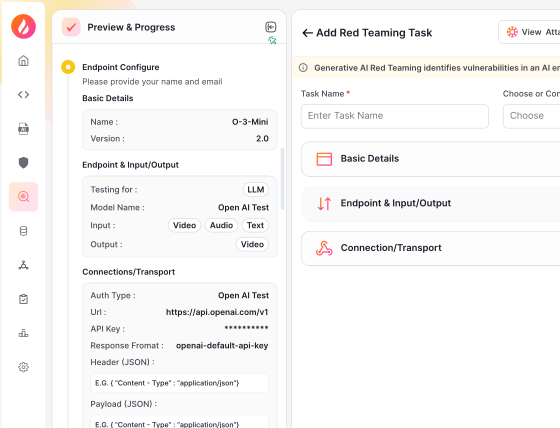
Enkrypt AI is an AI security and governance company built for organizations deploying AI agents, LLM applications, and customer-facing AI systems. It focuses on reducing the risks that come with running AI in production, especially when AI systems interact with sensitive data, business tools, and enterprise workflows. Companies use Enkrypt AI to evaluate how their AI systems behave, identify security gaps, and maintain oversight as AI deployments scale across the business.
Key features:
- Agent red teaming: Simulates attacks and continuously tests AI systems for vulnerabilities and unsafe behavior
- Agent guardrails: Protects AI applications and agents against prompt injection, jailbreaks, and adversarial inputs
- Agent policy engine: Enforces runtime policies across AI agents, tools, and workflows
- AI compliance monitoring: Tracks AI risks and supports governance and audit requirements
Technical limitation: Enkrypt AI cannot natively manage core API infrastructure tasks like load-balancing traffic between different model endpoints, enforcing rate-limiting at the network edge, or orchestrating automatic failovers when a primary AI provider goes down.
User testimonial: No user testimonial available
5. Darktrace: Best for AI-powered enterprise threat detection
)
Darktrace is a cybersecurity company that uses AI to monitor activity across networks, cloud environments, identities, email systems, SaaS applications, and enterprise infrastructure. Its AI security capabilities focus on giving security teams visibility into how AI tools and AI-driven activity appear across the organization, alongside broader cyber threats and suspicious behavior. Companies use Darktrace to detect unusual activity, investigate threats across connected environments, and monitor risks tied to growing AI adoption across the business.
Key features:
- Secure AI monitoring: Monitors AI interactions, prompts, and AI agent activity across enterprise environments
- Behavioral threat detection: Detects abnormal or risky behavior across networks, cloud systems, identities, and AI workflows
- Shadow AI visibility: Identifies unsanctioned AI usage and unmanaged AI applications across the organization
- AI agent monitoring: Tracks AI agent identities, tool access, and cross-system interactions in real time
Technical limitation: Darktrace operates at the integration boundaries, allowing it to flag anomalous tool outputs or external API calls, but it misses structural compromises hidden deep within an agent's internal reasoning loops, multi-step planning sequences, or vector memory storage.
User testimonial:
“The main challenge I've encountered is the initial learning period, where the AI system generates numerous alerts while it's still understanding our network's normal behavior patterns. This requires significant time investment from our security team to properly tune and validate alerts during the first few months of deployment.”
User review
6. Mindgard: Best for AI attack surface discovery
)
Mindgard is an AI security company focused on finding and testing vulnerabilities across AI systems, agents, and connected infrastructure. It approaches AI security from an attacker’s perspective, helping organizations understand how AI models, prompts, tools, APIs, and workflows could be exploited in real-world environments.
Key features:
- AI discovery & recon: Maps AI systems, tools, APIs, and connected infrastructure across enterprise environments
- AI attack surface enumeration: Identifies exposed AI components, agent behaviors, and exploitable attack paths
- AI red teaming: Simulates adversarial attacks against AI models, agents, and applications
- Runtime AI protection: Detects and blocks unsafe behavior, malicious inputs, and exploitation attempts during runtime
Technical limitation: Mindgard does not provide an infrastructural LLM gateway, meaning it cannot natively manage low-level network load-balancing, rate-limiting at the API edge, or automated multi-provider failover routing.
User testimonial: “Mindgard provides comprehensive protection to our machine learning systems against all types of vulnerabilities such as malware attacks, ransomware attacks, and many other related cyber threats.” User review
7. Lasso Security: Best for AI agent discovery and intent-based runtime security
)
Lasso Security is an AI security company focused on helping enterprises discover, monitor, and govern AI agents and AI applications across the organization. It gives security teams visibility into how AI systems interact with data, tools, prompts, and business workflows, while helping organizations manage AI risk as adoption scales.
Key features:
- AI agent discovery: Inventories AI agents, MCP servers, models, tools, and connected resources across enterprise environments
- AI security posture management (AI-SPM): Assesses AI risks, permissions, attack surfaces, and policy exposure
- Runtime enforcement: Detects and blocks unsafe agent behavior, policy violations, and AI threats during runtime
- AI detection & response: Monitors AI interactions and responds to suspicious or malicious activity across AI systems
Technical limitation: Lasso routes traffic through proprietary classification models hosted on its own inference servers, adding a benchmarked latency overhead of 70–200 ms despite architectural optimizations.
User testimonial: No user testimonial available
8. GuardionAI: Best for AI action monitoring and policy enforcement
)
GuardionAI is an AI security company focused on protecting AI agents, MCP servers, and tool-connected AI systems during runtime. It sits between AI applications, models, tools, APIs, and data sources to inspect agent behavior, monitor tool usage, and block unsafe actions before they happen.
Key features:
- AI agent security gateway: Inspects, logs, and governs AI agent activity during runtime
- MCP security controls: Detects malicious MCP tools, unauthorized access, and scope escalation attempts
- Prompt injection protection: Detects and blocks attempts to manipulate agent behavior or override system instructions
- Agent action tracing: Tracks tool calls, API requests, autonomous decisions, and AI workflows in real time
Technical limitation: GuardionAI is a security gateway and runtime guardrail solution without native network-layer capabilities, including API-edge load balancing, global rate limiting, or automatic backend failover orchestration.
User testimonial: No user testimonial available
9. Vectra AI: Best for AI-driven network detection and hybrid environment visibility
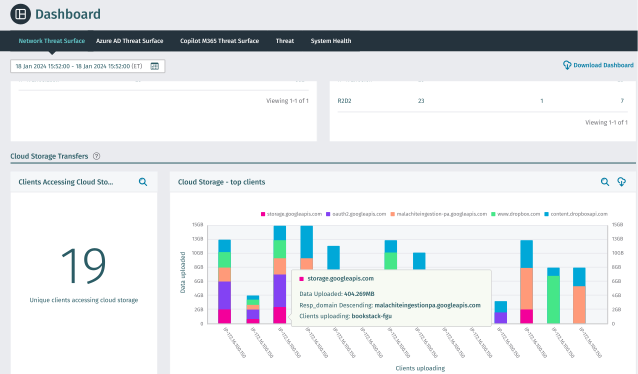
Vectra AI provides an AI-native cybersecurity platform focused on network detection and response, hybrid environment observability, identity monitoring, and AI-driven threat detection across enterprise environments. The platform helps security teams monitor on-premises networks, multicloud infrastructure, identities, M365 environments, IoT/OT systems, and AI activity through continuous behavioral analysis and threat correlation.
Key features:
- Hybrid network observability: Monitors on-premises, multicloud, identity, IoT/OT, and SaaS environments in real time
- Behavioral threat detection: Detects attacker behavior, lateral movement, credential misuse, and suspicious activity across enterprise systems
- AI-driven signal analysis: Prioritizes high-risk threats and reduces alert noise through behavioral correlation
- Threat detection & response: Identifies and investigates attacks across networks, cloud systems, and identities
Technical limitation: Vectra AI lacks pre-production capabilities, including benchmarking custom models or agents for LLM-specific risks such as hallucinations, logic flaws, toxic outputs, or model extraction.
User testimonial:
“Initial setup required some reading and calls to support. Cost may be a limitation for some.”
User reviews
10. Wiz: Best for cloud and AI security posture management
)
Wiz is a cloud and AI security company that helps organizations understand risk across cloud infrastructure, AI workloads, applications, identities, and runtime environments. It connects cloud, code, runtime, and AI context into a single view so security teams can identify exposed systems, understand attack paths, and prioritize the risks that matter most.
Key features:
- AI application protection platform (AI-APP): Secures AI applications, infrastructure, models, data, and runtime environments from code to deployment
- AI security posture management (AI-SPM): Identifies AI risks, exposure paths, and security gaps across cloud and AI environments
- Runtime protection: Detects and responds to prompt injection, rogue agents, malicious AI behavior, and runtime threats
- Security graph analysis: Connects cloud, identity, infrastructure, data, and AI context into a unified attack path model
Technical limitation: Wiz is not a line-rate network proxy and does not support inline traffic handling, edge payload rate limiting, or automated LLM backend failover.
User testimonial:
“Price might be a roadblock for some organizations, although Wiz was very flexible on their cost, allowing us to proceed with the purchase even without a specific budget allocation.”
User review
AI security market map
)
Find the right AI security vendor for your enterprise
The right AI security platform depends on what your AI environment actually looks like. Enterprises running AI agents across regulated industries, private infrastructure, or customer-facing applications have different requirements than those running isolated LLM experiments.
A few questions worth asking before you evaluate: Do you have visibility into every AI agent running in your environment today? Do your current tools capture what an agent does after a prompt, including tool calls, API requests, and data access? Can you enforce runtime policies without routing sensitive data through a third-party cloud?
If those gaps are present, the platform you choose needs to close them, not just add a compliance checkbox to an existing security stack.
NeuralTrust is designed for enterprises that require centralized control across complex AI environments. It combines AI gateway capabilities, runtime protection, observability, governance controls, and automated red teaming within a unified platform for production AI systems.
Book a demo today to learn more and see how NeuralTrust can make your AI systems more secure.
AI security companies FAQs
What is an AI security company?
An AI security company builds tools to help organizations secure AI systems, including AI agents, co-pilots, large language models, and applications. These tools monitor AI behavior, protect sensitive data, enforce security policies, and reduce risks tied to prompts, model outputs, tool access, and autonomous agent actions.
Many AI security platforms also help companies govern how AI systems are deployed and used across the business. Common capabilities include runtime protection, prompt inspection, agent monitoring, AI gateways, observability, compliance support, and automated red teaming.
How can your team use AI securely across your company?
To ensure AI security, you must establish security controls that extend across the full AI lifecycle, including model access, prompt handling, tool usage, retrieval pipelines, and runtime monitoring. For that, you need a platform specifically designed for AI security that can help you apply centralized access control across AI agents and enterprise AI workflows. Traditional application security controls alone are typically insufficient for managing AI-specific risks.
Who is the best-reviewed AI security company for agentic security?
The best AI security company for agentic security depends on your environment, how your AI agents operate, and the level of runtime control and governance your organization needs. For enterprises deploying AI agents with access to internal systems, APIs, sensitive data, or customer-facing workflows, the core requirements are runtime monitoring, prompt inspection, agent behavior controls, and governance support under frameworks including the EU AI Act and NIST AI RMF. Platforms that only test models pre-deployment miss the threats that emerge after the agent is in production.
NeuralTrust focuses specifically on AI agent security for large enterprises. The platform includes an AI gateway, runtime protection, Guardian Agents for autonomous oversight, observability, automated red teaming, and split-plane deployment for regulated environments.
)
)
)
)
)