Last updated: October 22, 2026
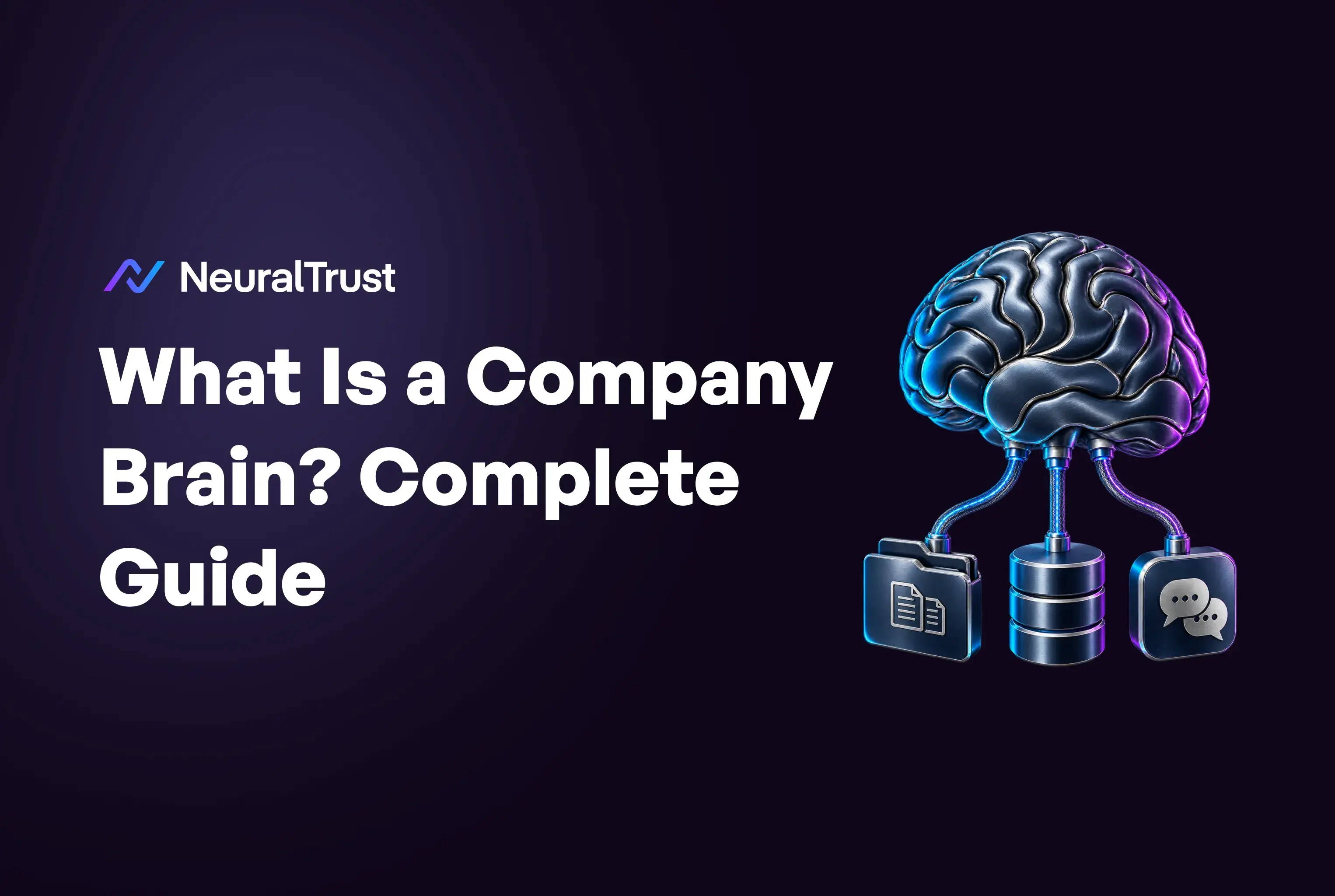
What is a company brain? A company brain is one shared memory that your whole team and its AI agents can ask, built from the meetings, documents, calendar events and chats where your know-how already lives. Every answer should point back to the source it came from. Think of it as the team version of a second brain.
TL;DR: Key Takeaways
- A 2018 Panopto survey of 1,001 U.S. workers found that knowledge workers lose 5.3 hours a week waiting for information or rebuilding what already exists.
- The same survey estimates that 42% of institutional knowledge is unique to one person and not shared with coworkers.
- Median tenure with a current employer was 3.9 years in January 2024, so know-how walks out often.
- ChatGPT memory is managed per user, and Claude memory is individual, so neither gives a team one shared memory.
- The OWASP Top 10 for LLM Applications lists sensitive information disclosure as LLM02 and vector and embedding weaknesses as LLM08, both relevant to any shared memory.
- A 2025 research paper shows an attacker can plant false memories through ordinary queries, with no direct access to the memory store.
At a Glance: How Team Memory Approaches Compare
| Approach | What it holds | Who it serves | Main limit |
|---|---|---|---|
| Company brain | What was said, decided and written, from many sources | People and AI agents, in plain language | Needs permissions and review from day one |
| Wiki | Pages someone took time to write | People browsing | Stays out of date unless edited by hand |
| Data lake | Raw structured and unstructured data | Analysts and engineers | Not built for plain-language questions |
| RAG over a drive | Passages from indexed files | A chatbot or app | Meetings and chats never reach the drive |
| ChatGPT or Claude memory | Details about one person | That person | Not shared with the team |
Why Does Your Team Need a Company Brain?
Because the know-how that runs your business lives where nobody can search it together: meeting recordings, private chats, personal notebooks and each person's AI assistant. When someone leaves or changes tools, that context goes with them.
According to Panopto (2018), U.S. knowledge workers spend 5.3 hours a week waiting for colleagues or recreating knowledge that already exists, and 42% of institutional knowledge is unique to the person who holds it. The U.S. Bureau of Labor Statistics (2024) put median tenure at 3.9 years, the lowest since 2002.
Now add AI. Most people on your team talk to ChatGPT or Claude every day, and what those assistants learn about your company stays in each person's own account. You cannot see it as a team, and you cannot hand it to the next hire.
Wiki or Data Lake: What Is the Difference?
A wiki holds what someone had time to write down, and a data lake holds raw data for analysts. A company brain holds what was said and decided, even when nobody wrote it up, and it answers in plain language instead of making you search.
Picture a Tuesday call where your team agreed on pricing. The wiki never gets that page, and the data lake has no table for it. A company brain picks up the meeting notes and calendar event, so someone can later ask what you decided and get an answer with a link to that call.
A wiki is still useful as one source feeding the brain. The two work together; the brain just stops depending on people to copy decisions into pages.

RAG or Built-In AI Memory: What Is the Difference?
RAG is a technique, built-in memory is a feature, and a company brain is the shared product around them. RAG fetches passages before a model answers, and ChatGPT and Claude memory remember details for one person. A company brain adds team sharing, sources and permissions.
Patrick Lewis and colleagues introduced retrieval-augmented generation at NeurIPS in 2020, pairing a text generator with a retriever over an external index. RAG over a shared drive works well for files. It cannot answer from a conversation that was never saved as a file.
OpenAI's Memory FAQ says memory is managed per user, with controls to review, correct and delete entries, and that logs of deleted saved memories may be kept for up to 30 days. Anthropic's help center says Claude memory is individual and that Team and Enterprise owners cannot view or edit a member's memories.
How We Compared
We read vendor documentation and primary sources on October 22, 2026. We did not test any product, and plan details change, so check your own settings before you decide.
What Should a Good Company Brain Do?
A good company brain answers from your own material, shows where each answer came from, respects who may see what, and is easy to feed and share. If one of those is missing, people stop trusting the answers.
| Need | What it looks like | Why it matters |
|---|---|---|
| Answers from your memories only | If nothing in memory covers the question, it says so | Fewer invented answers |
| Clickable sources | Each answer links to the meeting, doc or note | You can check before you act |
| Permissions | Private notes stay private; team memory is shared on purpose | Limits accidental leaks |
| Easy ingestion | Connectors and drag and drop for meetings, docs, calendar and chat exports | Nobody maintains a second system by hand |
| Simple invites | One link to bring in a teammate | Adoption decides whether it holds real knowledge |
NeuralTrust, the Barcelona-based AI agent security company, is launching TrustBrain, an AI memory product built around these needs. Its landing page lists connectors for Granola, Fathom, Google Calendar, Notion, Google Drive and ChatGPT and Claude history exports, with Slack, Gmail and Outlook marked as coming soon.
A company brain is not only for people. An agent connected over MCP should get the same exact context, so it stops asking questions your team already answered.
Security and Governance: What Can Go Wrong With a Shared AI Memory?
A shared memory concentrates risk. Whoever can read it sees everything inside, and whoever can write to it can change what every agent believes. Four risks matter most: access, leakage, poisoning and vendor retention.
OWASP's 2025 list names sensitive information disclosure as LLM02, data and model poisoning as LLM04 and vector and embedding weaknesses as LLM08. OWASP's agentic list covers memory and context poisoning as ASI06, where corrupted memory skews later reasoning and can persist across sessions, according to Teleport's summary.
The research is concrete. The authors of the MINJA paper, first posted in March 2025, show records planted through ordinary queries that a different user's later question can retrieve.
| Risk | What happens | Reference | Question to ask any vendor |
|---|---|---|---|
| Access | A teammate reads a note meant to be private | OWASP LLM02 | Are permissions applied when a question is asked? |
| Leakage | An answer exposes confidential data | OWASP LLM02 | Can I see which source fed each answer? |
| Poisoning | A false record changes later answers | OWASP LLM04, ASI06 | Who and what can write to memory, and can I review it? |
| Embedding weaknesses | Stored vectors are abused or inverted | OWASP LLM08 | How is stored data separated and classified? |
| Vendor retention | Deleted memory lingers | Vendor docs | What happens to deleted memories, and can I export mine? |
NeuralTrust works on the security side of agents and explains the attack in its post on memory and context poisoning.
Which Should You Choose: Personal or Team Memory?
Start personal if you mostly need your own context across tools, and go company when answers depend on what other people know. Many people end up with both: private notes that stay theirs and a shared layer for the team.
| Situation | Start with | Why |
|---|---|---|
| Solo founder juggling clients | Second brain | All the context is yours, and there are no permissions to design |
| Team asking the same questions in chat | Company brain | One answer with a source replaces repeated pings |
| Team lead using Claude and ChatGPT daily | Both | Private notes stay yours and shared decisions go to the team |
| Company with strict data rules | Company brain, after the vendor questions above | Permissions and retention come first |
Conclusion
A company brain is a shared, searchable memory for your team and its agents, built from the places where decisions actually happen and answered with sources you can check. It is not a wiki, a data lake or a chat assistant with better memory. Start with one team and a few sources, ask the vendor the questions above, and judge it after a few weeks of real use.
Want to Talk About Shared Memory for Your Team?
TrustBrain is not open yet. If you want to talk about shared AI memory for your team, book a demo with us.
FAQs about Company Brain
1. What is a company brain?
A company brain is a shared memory that people and AI agents on a team can ask in plain language. It pulls from meetings, documents, calendar events and chats, and it answers with links back to the source. It is the team version of a second brain.
2. Is a company brain the same as a knowledge base or wiki?
No. A wiki holds pages that people write by hand. A company brain also captures what was said and decided in places nobody documented, and it answers questions directly. Your wiki can still be one of its sources.
3. How is a company brain different from ChatGPT or Claude memory?
Built-in memory remembers details for one person. OpenAI says ChatGPT memory is managed per user, and Anthropic says Claude memory is individual. A company brain is shared on purpose, so a whole team and its agents can draw from the same context.
4. What sources can feed a company brain?
Typical sources are meeting notes and recordings, calendar events, documents, notes apps and exported AI chat history. TrustBrain's landing page lists Granola, Fathom, Google Calendar, Notion, Google Drive and ChatGPT and Claude exports, with Slack, Gmail and Outlook coming soon.
5. Is a shared AI memory safe?
It can be, but only with controls. OWASP flags sensitive information disclosure, poisoning and vector weaknesses as risks. Ask any vendor about query-time permissions, who can write to memory, source visibility, deletion and export before you connect company data.
6. What is the difference between a second brain and a company brain?
A second brain is personal: your notes, chats and meetings in one place you control. A company brain is shared across a team, so permissions, invites and review matter more. You can run both, with private notes and shared decisions kept apart.
About the Author
Roger Howroyd is Head of Global SEO and AI at NeuralTrust, where he leads the company's search strategy across SEO, AEO, GEO, and LLM optimization. He specializes in AI-powered search, content strategy, and SEM. Connect on LinkedIn.
NeuralTrust is the leading platform for securing and scaling AI agents. Named a Pioneer in the Gartner Emerging Market Quadrant for AI Application Security 2026, recognized across four Gartner Hype Cycle reports in 2026, and featured in the Gartner Market Guide for Guardian Agents 2026, the Gartner Market Guide for AI Gateways 2025 and the KuppingerCole Leadership Compass for Generative AI Defense 2025. Headquartered in Barcelona with offices in London and New York. ISO 27001 certified.
Sources
- Panopto, "Inefficient Knowledge Sharing Costs Large Businesses $47 Million Per Year," July 17, 2018
- U.S. Bureau of Labor Statistics, "Median tenure with current employer was 3.9 years in January 2024," October 11, 2024
- OpenAI Help Center, Memory FAQ, accessed October 22, 2026
- Anthropic Help Center, chat search and memory, accessed October 22, 2026
- OWASP, Top 10 for LLM Applications 2025
- Teleport, summary of the OWASP Top 10 for Agentic Applications, December 15, 2025
- Lewis et al., "Retrieval-Augmented Generation for Knowledge-Intensive NLP Tasks," NeurIPS 2020
- Memory Injection Attacks on LLM Agents via Query-Only Interaction (MINJA), arXiv, March 5, 2025, revised February 12, 2026