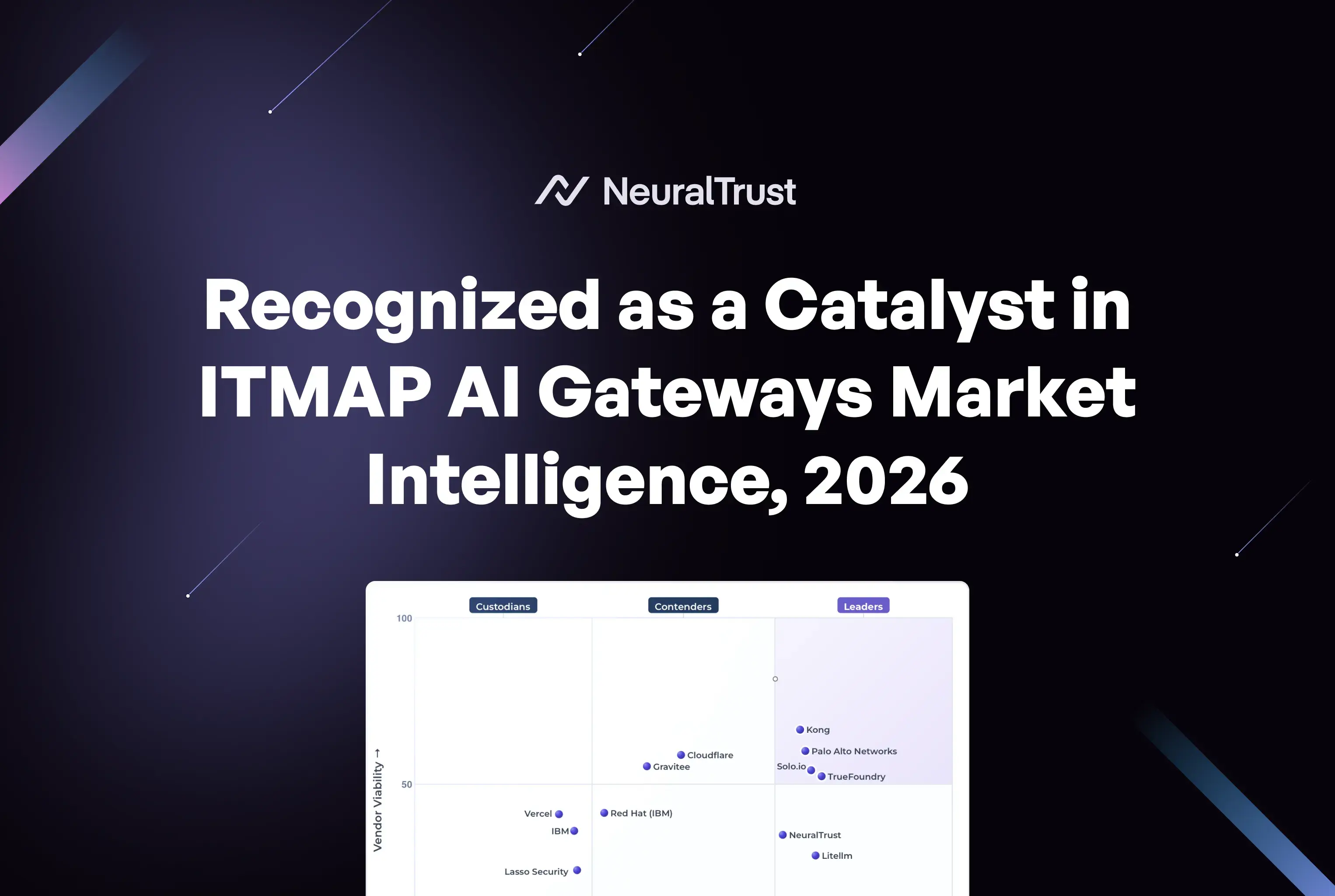
ITMAP, an independent AI-powered vendor intelligence platform, has positioned NeuralTrust in the Catalysts quadrant of its ITMAP for AI Gateways market map, recognising strong Product Strategy and Execution among 12 vendors evaluated as of October 2026.
Independent market recognition carries a different weight than research commissioned or influenced by vendors. ITMAP was built by enterprise IT practitioners who, in their own words, were "tired of paying for research that had already been paid for by the vendors they were supposed to be evaluating." The premise of being unbiased and offering real-time vendor intelligence shapes how the platform evaluates the AI Gateway market.
In ITMAP's current AI Gateways market map, NeuralTrust is positioned in the Catalysts quadrant: the segment defined by strong Product Strategy and Execution scores. The product evaluated is the NeuralTrust AI Gateway, which ITMAP tracks alongside 11 other vendors in a market that includes infrastructure providers, API management platforms, and dedicated AI security vendors.
TL;DR: Key Takeaways
- ITMAP, an independent practitioner-led vendor intelligence platform, has positioned NeuralTrust in the Catalysts quadrant of its AI Gateways market map as of October 2026
- The Catalysts quadrant reflects strong Product Strategy and Execution: the dimension that matters most for enterprise teams evaluating whether a gateway can actually deliver
- ITMAP evaluates the market across two dimensions: Product Strategy and Execution (X axis) and Vendor Viability (Y axis), tracking 12 vendors in total
- The NeuralTrust AI Gateway is the product ITMAP evaluated: NeuralTrust's enterprise-grade AI gateway built for security, policy enforcement, and production observability
- ITMAP markets have been tracked continuously since April 2026, providing a historical view of how vendor positioning evolves in real time
- Unlike traditional analyst reports, ITMAP is not funded by the vendors it evaluates
What Is ITMAP?
ITMAP is an AI-powered vendor intelligence platform built by enterprise IT practitioners as an alternative to traditional analyst firms. Its positioning is explicit: it was created to address the conflict of interest inherent in research models where the vendors being evaluated fund the research that evaluates them.
ITMAP's methodology maps markets continuously across two independent dimensions: Product Strategy and Execution, and Vendor Viability, producing a real-time historically trackable view of how the competitive landscape shifts. Unlike point-in-time analyst reports, ITMAP markets are updated on a rolling basis, and the platform shows how vendor positions have moved over time.
The AI Gateways market has been tracked since April 2026. The current view reflects six months of continuous evaluation across 12 vendors.
What Is the AI Gateway Market?
ITMAP defines the AI Gateway (or LLM Gateway) market as "a network-resident control plane that sits between enterprise applications and multiple AI model providers." The market exists because traditional API management platforms were never designed for the characteristics that define LLM traffic: token-based pricing, streaming responses, non-deterministic outputs, and traffic distributed across competing third-party providers such as OpenAI, Anthropic, Google Vertex, AWS Bedrock, Azure OpenAI, Mistral, Cohere, and self-hosted open-source models.
AI Gateways consolidate that fragmented traffic at a single enforcement point where engineering and security teams can apply unified policies across all model providers. The core capabilities the market covers include cost control, rate limiting, semantic caching, routing and failover, authentication and RBAC, guardrails, and observability.
ITMAP classifies this market under Data, Analytics and AI, and currently tracks 12 vendors offering products that cover the category.
What the Catalysts Quadrant Means
ITMAP's matrix uses two axes. Vendor Viability (Y axis) reflects company stability, market presence, and the confidence that the vendor will continue to invest in the product category. Product Strategy and Execution (X axis) reflects the strength of the vendor's product vision, roadmap, and ability to deliver against it.
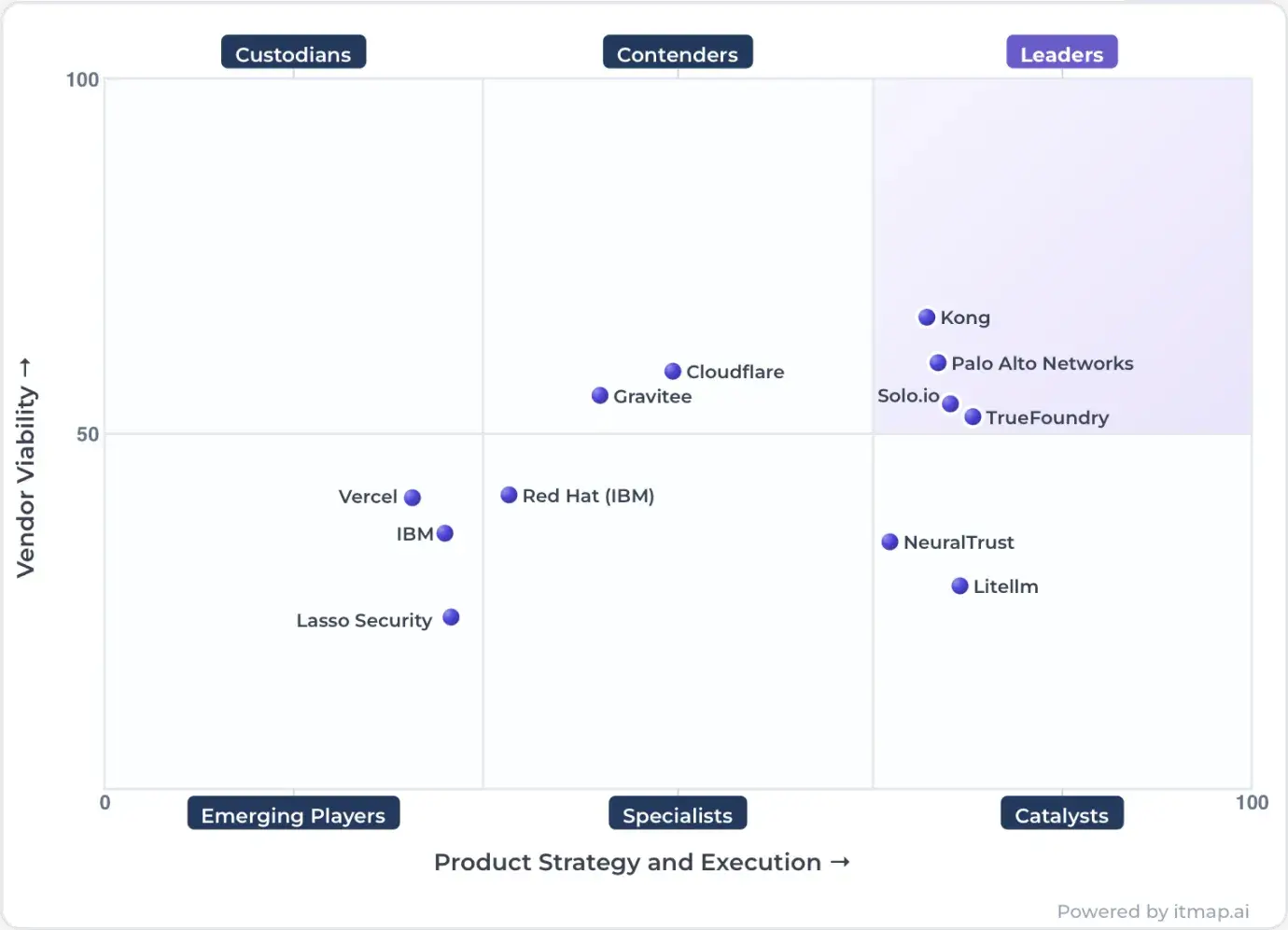
The Catalysts quadrant is defined by high scores on Product Strategy and Execution. It is where vendors with strong product capability and clear roadmap direction are positioned, independent of their current market scale. For enterprise buyers, Catalysts represent the vendors most likely to shape where the market goes: the ones building the product architecture that others will eventually follow.
For a category as new and rapidly evolving as AI Gateways, Catalysts positioning is particularly meaningful. The AI Gateway market is still in early formation, and the vendors with the strongest product execution today are the ones best positioned to lead it as enterprise adoption accelerates.
The NeuralTrust AI Gateway
The product ITMAP evaluated is NeuralTrust's AI Gateway, the product NeuralTrust markets as TrustGate. It was designed from the ground up around enterprise security requirements, not retrofitted onto existing API management infrastructure.
Where general-purpose AI gateways focus primarily on routing, cost optimisation, and basic rate limiting, the NeuralTrust AI Gateway adds a layer of semantic security enforcement. It controls which models, tools, and external APIs are accessible to AI agents and applications, enforces policy at the infrastructure level before requests reach models, and provides the audit trail that enterprise security and compliance teams require.
The key capabilities of NeuralTrust 's AI Gateway include:
- Unified model access control: across all connected providers and self-hosted models, with RBAC and authentication policies enforced at the gateway layer before requests are forwarded.
- Policy enforcement at the infrastructure level: that intercepts and evaluates requests against custom rules before they reach any model: blocking, redirecting, or alerting based on configured policies.
- Cost governance and usage attribution: that tracks spend per model, per application, per team, and per project, giving organisations the visibility needed to manage AI budgets at scale.
- Semantic caching: that reduces token spend by serving cached responses to semantically equivalent prompts rather than forwarding every request to a model provider.
- Production observability: with full request and response logging, latency tracking, and the audit records that security teams need for incident response and regulatory compliance.
The NeuralTrust AI Gateway integrates with TrustGuard (AI Runtime Defense), TrustLens (agent posture management), and TrustTest (AI red teaming) to provide security coverage across the full AI deployment lifecycle.
Why Security-First Matters in the AI Gateway Category
The AI Gateway market is at an inflection point. Early gateway deployments focused on the infrastructure problem: how do you route traffic across multiple model providers without managing a separate integration for each? That problem is largely solved.
The problem enterprises are now confronting is different: how do you enforce security policy, compliance requirements, and governance controls across AI traffic at scale? Traditional API gateways were not built for this. They lack the ability to inspect the semantic content of requests, enforce intent-based policies, or detect adversarial patterns in natural language.
NeuralTrust's positioning in the Catalysts quadrant reflects a product approach built around that second-generation problem. Security is not a feature added to a routing platform, it is the architectural foundation on which the gateway is built.
For enterprise security and platform engineering teams evaluating AI gateways, the practical implication is straightforward: a gateway that handles routing but lacks semantic security controls will require a parallel investment in a separate runtime defense layer. A gateway built with security at the core consolidates both functions.
What This Means for Enterprise Buyers
ITMAP's AI Gateways market map provides a practitioner-developed reference point for enterprise teams at the beginning of an AI gateway evaluation. The Catalysts quadrant specifically signals vendors where product execution is ahead of market scale, which in a new category often means the vendor's engineering is moving faster than the market's awareness of it.
For security and platform engineering teams, several considerations follow from NeuralTrust's Catalysts positioning:
Evaluate for future requirements, not just current ones. AI Gateway requirements are evolving quickly. A vendor strong in Product Strategy and Execution is better positioned to ship the capabilities that will matter in 12 months, not just the ones that matter today.
Consider the convergence of gateway and runtime defense. As enterprise AI deployments mature, the separation between AI gateway (infrastructure control) and AI runtime defense (semantic security) is collapsing. Evaluating both together now avoids a point-solution architecture that requires consolidation later.
Factor in independence of the intelligence source. ITMAP's methodology is designed to exclude vendor funding bias from the evaluation. For enterprise IT teams building a business case, that independence is relevant to how the research is used internally.
FAQs about the ITMAP for AI Gateways
1. What is ITMAP and how is it different from Gartner or Forrester?
ITMAP is an independent AI-powered vendor intelligence platform built by enterprise IT practitioners. Unlike traditional analyst firms, ITMAP does not accept funding from the vendors it evaluates. Its market maps are updated continuously rather than published annually, and the platform shows how vendor positioning has changed over time. ITMAP positions itself as a real-time, unbiased alternative to traditional analyst research.
2. What does the Catalysts quadrant mean in ITMAP's methodology?
ITMAP maps vendors across two axes: Product Strategy and Execution (X) and Vendor Viability (Y). The Catalysts quadrant represents vendors with high scores on Product Strategy and Execution. It identifies vendors whose product capability and roadmap execution are strong, independent of their current scale. In a new and fast-moving market like AI Gateways, Catalysts are typically the vendors shaping where the category is heading.
3. What product did ITMAP evaluate for NeuralTrust?
ITMAP evaluated NeuralTrust's AI Gateway, the product NeuralTrust offers as TrustGate. It is an enterprise AI gateway built for security, policy enforcement, and production observability, designed to sit between enterprise applications and AI model providers.
4. How many vendors does ITMAP track in the AI Gateways market?
ITMAP currently tracks 12 vendors in the AI Gateways market as of October 2026. The market has been tracked continuously since April 2026, providing a six-month historical view of how vendor positioning has evolved.
5. How does the NeuralTrust AI Gateway differ from a standard AI gateway?
Most AI gateways focus on routing, cost optimisation, rate limiting, and basic authentication. The NeuralTrust AI Gateway adds semantic security enforcement: it applies intent-based policies at the infrastructure level, controls model and tool access at the gateway layer, and provides the observability and audit trails that enterprise security and compliance teams require. It also integrates directly with NeuralTrust's runtime defense, agent posture management, and red teaming products for full lifecycle coverage.
About NeuralTrust
NeuralTrust is an AI security company built to address the security challenges that emerge when organisations deploy large language models and AI agents in production. The platform covers runtime defense, gateway enforcement, agent posture management, and adversarial red teaming. NeuralTrust works with enterprise security teams across financial services, healthcare, retail, and technology sectors.
*Source: ITMAP for AI Gateways, October 2026.