)
AI safety becomes harder once a system can act. Access to customer records, APIs, workflows, or other agents creates risks that endpoint and network controls can’t fully interpret. That’s why NIST now treats the combination of model outputs and software capabilities as a distinct security problem, particularly for agentic systems.
The consequences of AI-related risks are already visible. IBM’s 2025 Cost of a Data Breach Report found that 13% of organizations had experienced a breach involving an AI model or application. Of those organizations, 97% lacked proper AI access controls.
Dedicated AI safety software helps close that gap. It tests AI systems before deployment and enforces policies at runtime, giving security teams visibility into model interactions, tool access, agent behavior, and policy violations. As enterprises adopt autonomous workflows, AI safety software is becoming part of the production security architecture.
This guide compares the leading AI safety platforms for runtime protection, security testing, model monitoring, and enterprise governance. Take a look at each one to understand which one fits your needs.
TL;DR - Key Takeaways
- AI safety software extends the existing security stack by analyzing prompts, model responses, retrieved context, tool calls, and agent actions that traditional controls may not understand.
- Runtime protection is the most important capability for production AI because it evaluates live interactions and enforces policies before unsafe outputs or actions reach users and connected systems.
- The market includes platforms focused on runtime enforcement, adversarial testing, model monitoring, and governance. You should choose based on the risks your AI systems create in practice.
- The strongest enterprise platforms combine broad AI-specific coverage with flexible deployment, low-latency enforcement, regulatory support, and visibility across the full AI lifecycle.
)
Best AI safety software tools: Quick review
| Software | Primary focus | Best for | Standout features |
|---|---|---|---|
| NeuralTrust | AI agent security | End-to-end AI agent security and governance | Runtime protection, AI Gateway, AI-SPM, Guardian Agents |
| Guardrails AI | Runtime guardrails | Open-source runtime validation and input/output guardrails | Open-source framework, custom validators, 65+ guardrails |
| Lasso Security | AI agent security | Securing open-source MCP server integrations | Intent-based detection, AI-SPM, continuous red teaming |
| Alinia | AI compliance | AI compliance and regulatory guardrails | Compliance guardrails, AI monitoring, automated red teaming |
| CalypsoAI (F5) | AI security testing | AI inference security and adversarial testing | Adversarial testing, runtime inference protection |
| Preamble | AI security assessments | AI threat validation security | AI red teaming, security assessments, prompt injection defense |
| Prompt Security | AI application security | Browser-enforced visibility into employee Shadow AI | Extension-based runtime protection, AI red teaming, MCP security |
| Arthur AI | AI governance | Enterprise model risk management and governance | Continuous evaluations, agent observability, production monitoring |
| HiddenLayer | AI model security | Non-invasive machine learning file and artifact scanning | AI discovery, supply chain security, attack simulation |
| Robust Intelligence (Cisco) | AI model validation | Automated pre-deployment testing and compliance validation | AI firewall, algorithmic red teaming, model validation |
AI safety software covers several categories because protecting AI systems requires more than one layer of defense. Some platforms focus on runtime protection and guardrails, while others specialize in security testing, AI evaluations, or model monitoring. In this guide, we have grouped the products by their primary strengths to help you compare solutions based on your organization's AI deployment stage and security requirements.
We selected these platforms based on analyst recognition, enterprise customer adoption, depth of AI-specific capabilities, deployment flexibility, compliance support, and G2 reviews where available.
What is AI safety software?
AI safety software helps organizations identify and control risks created by AI models and applications, including copilots and autonomous agents.
Before deployment, these tools support red teaming and model validation. In production, they provide runtime monitoring and policy enforcement. They can also detect prompt injection and sensitive data exposure, while restricting unsafe outputs and unauthorized agent actions.
As AI adoption accelerates, these risks are becoming more common and more consequential. Stanford’s 2026 AI Index recorded 362 documented AI incidents in 2025, compared with 233 in 2024. As a result, AI safety software has become an essential part of enterprise technology stacks for organizations deploying AI applications and agents that connect to internal systems.
Key features of AI safety software
Here’s an overview of key features of AI safety software:
- Runtime security: Inspects prompts, model responses, retrieved context, and tool calls as they move through the inference path. Full-context analysis helps identify agent traps hidden in external content, as well as indirect injection attempts that may appear harmless when messages are reviewed in isolation. The primary use case is protecting production AI applications relying on the model to police itself.
- Agent action controls and governance: Enforces permissions when an agent attempts to access data or invoke a tool. Behavioral threat detection can also flag actions that deviate from that agent’s intended role, while orchestration-agnostic enforcement keeps controls consistent across different models and agent frameworks. The primary use case is preventing excessive access and unauthorized execution.
- Adaptive red teaming: Generates and refines adversarial inputs based on how the application responds. This helps your security team uncover jailbreaks, injection paths, unsafe agent behavior, and signs of alignment faking. The primary use case is validating defenses as models, prompts, integrations, and workflows change.
AI safety software vs. legacy security systems: Why enterprises need dedicated AI protection
Traditional security tools remain essential, but they were designed to protect deterministic software, infrastructure, identities, and network traffic.
AI systems behave differently. Their outputs can change context, and their risk extends beyond code vulnerabilities to prompts, model responses, retrieved data, and agent actions.
AI safety software addresses this gap by analyzing AI interactions in context and enforcing controls at runtime. It helps security teams detect unsafe behavior that conventional tools may miss, even when AI systems are functioning as intended.
Here’s an overview of how AI safety software differs from traditional security:
| Feature | AI safety software | Traditional security |
|---|---|---|
| Foundation | Built around probabilistic models, natural-language inputs, and autonomous agent workflows | Built around deterministic applications, infrastructure, endpoints, and network activity |
| Threat focus | Prompt injection, data leakage, unsafe outputs, and unauthorized agent actions | Malware, credential theft, software vulnerabilities, and network intrusion |
| Response | Evaluates context and enforces policies during each AI interaction | Blocks activity using signatures, rules, access controls, or known indicators |
| Core concern | Whether the AI system behaves safely and stays within its intended role | Whether systems and users are compromised or accessed without authorization |
| Testing methods | Adversarial prompting, model evaluation, behavioral testing, and continuous red teaming | Vulnerability scanning, penetration testing, static analysis, and configuration audits |
Best AI safety software for runtime protection and guardrails
Runtime protection is the most important layer for production AI because it inspects every prompt, tool call, retrieved context, and model response in real time. These tools sit in the inference path to enforce safety policies, block prompt injection, prevent data leaks, and stop unsafe agent actions before execution.
1. NeuralTrust: Best for end-to-end AI Agent and runtime security
)
NeuralTrust is a centralized AI Agent Security platform built for large enterprises. It enables organizations to discover, secure, and govern AI agents across their full lifecycle, from pre-deployment testing to production.
Unlike first-generation AI firewalls that primarily inspect prompts and responses, NeuralTrust is designed to detect sophisticated, multi-turn semantic attacks against AI agents. This focus on semantic attack detection led the NeuralTrust team to discover the Echo Chamber attack, which bypasses LLM safety guardrails without requiring explicit malicious prompts.
Its split-plane architecture separates the control and data planes, allowing organizations to enforce local security policies while maintaining complete data sovereignty. Inline protection operates with average latency below 100 ms, enabling real-time enforcement without disrupting production workloads.
NeuralTrust is purpose-built for AI Agent Security, protecting systems that access enterprise data, invoke tools, make decisions, and perform actions autonomously. Gartner has recognized this broader architectural approach by naming NeuralTrust a Representative Vendor in both AI Gateways and Guardian Agents.
Key features:
- TrustGuard: Inspects every request and response across gateways, SDKs, browsers, and agent platforms. It tracks context across multiple turns and can allow, block, transform, or flag an interaction based on the organization’s policies.
- TrustGate: Provides a central control point between AI agents and the models or tools they use. Teams can manage routing and access from one layer while maintaining a record of model calls, tool use, and agent-to-agent handoffs.
- TrustLens: Discovers approved and shadow agents, then maps their relationships with models, tools, data sources, and identities. It combines configuration data with observed behavior to surface risks and prioritize remediation.
- TrustTest: Generates adversarial tests for models and agents, runs algorithmic attacks, evaluates the responses, and produces traceable results. Teams can also add these tests to CI pipelines and use the results to gate releases.
User testimonial: “With NeuralTrust, we implemented LYS, ISDIN’s first AI agent, cutting hallucinations and data leaks, preventing unverified diagnoses, and ensuring regulatory compliance.” - Carlos Cañizares Vazquez, Head of Artificial Intelligence, ISDIN
Book a demo to learn more about how NeuralTrust can help secure your AI systems before deployment and throughout production.
2. Guardrail AI: Best for open-source runtime validation and input/output guardrails
)
Guardrails AI is an open-source framework that helps teams enforce safety and reliability policies across AI applications. It allows teams to define custom validation rules, apply them across different LLMs, and prevent responses that violate security, privacy, or compliance requirements before users receive them. Supporting cloud, hybrid, and on-premises deployments, it is suitable for organizations with different infrastructure requirements.
Key features:
- Runtime validation: Inspects prompts and model responses to detect hallucinations, jailbreak attempts, PII exposure, and other policy violations before outputs reach users.
- Custom policy enforcement: Lets teams define validation rules for security, compliance, formatting, and content requirements across AI applications.
- Open-source guardrails library: Provides more than 65 community-built guardrails that organizations can deploy or customize for different AI risks.
- Multi-model support: Applies consistent safety policies across different LLMs without requiring changes to the underlying application logic.
3. Lasso Security: Best for securing desktop AI assistants, IDE agents, and local MCP server connections
)
Lasso Security is an AI agent security platform that helps organizations discover, assess, and protect AI agents across their lifecycle. It analyzes the intent behind user requests and agent actions to detect prompt injection, goal manipulation, and other attacks that traditional rule-based controls may miss.
Key features:
- Intent-based threat detection: Analyzes the purpose behind user requests and agent actions to identify prompt injection, goal manipulation, and behavioral anomalies.
- Runtime policy enforcement: Monitors AI interactions in real time and blocks unauthorized tool calls, policy violations, and malicious agent behavior before execution.
- AI security posture management: Assesses AI agents against security frameworks and identifies exploitable risks, excessive permissions, and configuration weaknesses.
- Continuous AI red teaming: Simulates adversarial attacks throughout development to uncover vulnerabilities and update runtime protections before deployment.
User testimonial: “They have a good focus on AI, security vault, and touch on some of the key areas for our business.” - User review
4. Alinia: Best for AI compliance and regulatory guardrails
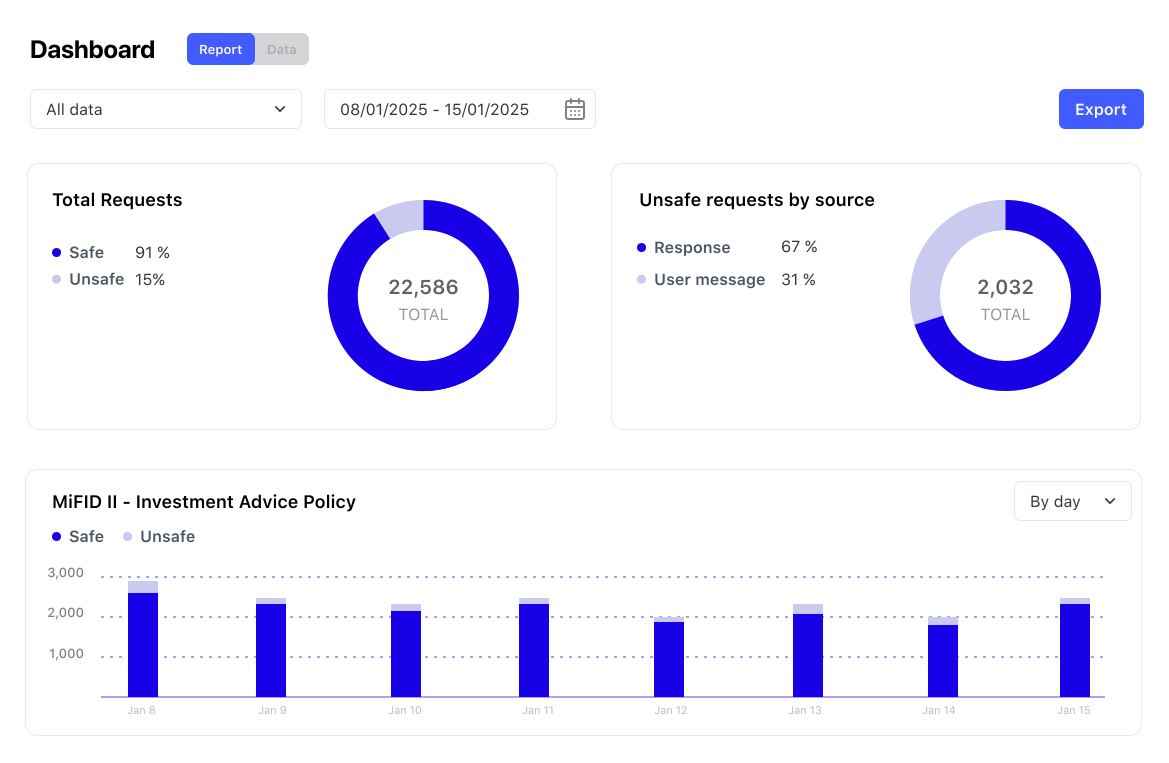
Alinia is an AI safety and compliance platform that helps organizations deploy AI systems within defined business and regulatory boundaries. Organizations can validate AI behavior against company policies, prevent unsafe outputs, and generate evidence for audits and compliance reporting.
Key features:
- Compliance guardrails: Enforces business and regulatory policies by flagging, blocking, redacting, or reporting AI outputs that violate defined rules.
- Real-time AI monitoring: Tracks AI assistant activity, policy violations, and compliance events to support governance, audits, and ongoing risk management.
- Automated AI red teaming: Tests AI applications against business-specific scenarios and regulatory requirements using customizable evaluation datasets and scorecards.
- Hallucination and safety protection: Detects hallucinations, prompt injection, jailbreak attempts, and harmful content to improve output reliability.
Best AI safety software for security testing and assessment
Security testing and assessment tools help teams identify vulnerabilities before AI applications reach production. The platforms below focus on evaluating AI behavior and validating security controls, though they may not provide unified runtime protection and observability.
1. CalypsoAI: Best for AI inference security and adversarial testing
)
CalypsoAI, acquired by F5 in 2025, is an AI inference security platform for securing AI models and applications throughout deployment. It combines adversarial testing with runtime guardrails to identify vulnerabilities, prevent sensitive data exposure, and enforce security policies as AI systems process requests.
Key features:
- Adversarial testing: Simulates thousands of AI attacks to identify prompt injection, jailbreaks, and other exploitable vulnerabilities before deployment.
- Runtime inference protection: Detects sensitive data exposure and policy violations as AI models process prompts and generate responses.
- Centralized AI governance: Applies security policies and records audit logs across cloud, on-premises, and hybrid AI environments.
- Model-agnostic protection: Secures AI applications across different foundation models without locking organizations to a single provider.
User testimonial: “Model evaluation could be faster using the Red-Team platform. It will help a lot if the process is much faster.” - User review
2. Preamble: Best for AI threat validation security.
)
Preamble is an AI security platform that enables organizations to identify and reduce risks across AI agents, copilots, RAG applications, and LLM integrations. By combining adversarial testing with security assessments, the platform uncovers vulnerabilities, evaluates AI workflows, and strengthens defenses before production.
Key features:
- AI red teaming: Simulates prompt injection, jailbreaks, agent takeovers, and data exfiltration attacks to identify exploitable AI vulnerabilities.
- AI security assessments: Evaluates AI agents, permissions, integrations, and workflows to uncover deployment risks and security gaps.
- Prompt injection defense: Applies patented detection technology to identify and block prompt injection attacks before they reach AI models.
- Runtime guardrails: Monitors AI interactions and blocks or redacts unsafe requests that violate security or compliance policies.
3. Prompt Security: Best for browser-enforced extension visibility into employee shadow AI tool usage
)
Prompt Security is an AI security platform that secures AI applications throughout development and production. It enables organizations to identify AI-specific risks before deployment, validate security controls through continuous red teaming, and enforce protections as applications move into production.
Key features:
- Automated AI red teaming: Simulates prompt injection, jailbreaks, data exposure, unsafe agent behavior, and other AI-specific attacks before deployment.
- Unified AI visibility: Consolidates security insights across AI applications, AI agents, code assistants, and employee AI usage.
- Runtime AI protection: Inspects AI requests and responses to block prompt injection, data leakage, and unsafe model outputs.
- Agentic AI security: Monitors MCP interactions, discovers AI agents, applies risk scores, and enforces security policies in real time.
User testimonial: “The reporting dashboard could offer a few more customization options for large enterprises, but it’s still very intuitive.” - User review
Best AI safety software for AI model monitoring and validation
AI model monitoring and validation platforms help organizations monitor AI behavior, detect model drift, and measure output quality in production. The platforms below focus on evaluation and observability rather than unified runtime protection and governance.
1. Arthur AI: Best for enterprise model risk management and governance
)
Arthur AI is an AI governance platform that enables organizations to discover, evaluate, and monitor AI agents throughout their lifecycle. It also provides visibility into prompts, decisions, and outcomes to help teams identify failures, enforce organizational policies, and improve agent reliability over time.
Key features:
- Continuous AI evaluations: Measures agent reliability with automated and custom evaluations throughout development and production.
- Production monitoring: Tracks prompts, tool calls, decisions, and outcomes to identify failures and performance degradation in real time.
- Policy enforcement: Applies organizational policies to reduce off-brand responses, protect sensitive data, and govern AI behavior.
- Agent observability: Connects operational metrics with business KPIs through configurable dashboards and alerts.
User testimonial: “It's too costly to purchase.” - User review
2. HiddenLayer: Best for non-invasive machine learning file and artifact scanning
)
HiddenLayer is an AI security platform that gives organizations visibility into AI systems running across their enterprise. Security teams can understand where AI is being used, identify systems that require additional oversight, and reduce security blind spots as AI adoption grows. Key features:
- AI discovery: Scans cloud environments, repositories, endpoints, and pipelines to identify AI models, agents, APIs, and workflows.
- AI supply chain security: Detects vulnerabilities in third-party and proprietary AI models before they enter production.
- AI attack simulation: Tests AI applications against adversarial attacks to validate security controls and identify exploitable weaknesses.
- Runtime AI protection: Detects model manipulation, prompt injection, data leakage, and other AI threats during production inference.
User testimonial: “AI/ML security is not fully standardized, meaning the definition of cybersecurity attacks can be complex. The integration is very hard to deploy and requires a large team of ML and infrastructure engineers to maintain.” - User review
3. Robust Intelligence (Cisco): Best for automated pre-deployment testing and compliance validation.
)
Robust Intelligence, now part of Cisco, is an AI security platform for validating and protecting AI models before and during deployment. It enables organizations to identify model weaknesses, strengthen AI reliability, and reduce security risks before AI applications reach production. Its technology now forms part of Cisco AI Defense and Cisco Foundation AI, extending AI security across enterprise environments.
Key features:
- Algorithmic AI red teaming: Tests AI models against adversarial attacks to identify vulnerabilities before deployment.
- AI firewall: Inspects AI inputs and outputs to detect prompt injection, jailbreaks, and other unsafe model interactions.
- Model validation: Evaluates AI reliability, safety, and security before models are released into production.
- Runtime AI protection: Applies security controls during inference to reduce model misuse and policy violations.
User testimonial: “It is kind of difficult to use for new users.” - User review
The future of AI safety software
AI safety software is shifting from model-level testing to continuous control over complete AI systems. As AI applications and agents move into production, organizations need controls that extend beyond one-time evaluations. The capabilities below show how modern platforms provide runtime enforcement, identity-aware controls, continuous monitoring, and audit-ready governance.
- Agent-native security architectures: Current controls often protect individual interactions or agents. Future architectures will need an agentic AI security framework that maintains context across identities, memory, tool access, and delegated authority. Enforcement will need to follow agents across different models and orchestration frameworks without creating policy gaps. NIST’s AI Agent Standards Initiative reflects the growing need for agent systems that are both secure and interoperable.
- Real-time behavioral analytics at scale: Behavioral monitoring will move beyond flagging suspicious prompts or isolated tool calls. Platforms will need to reconstruct complete execution paths, detect goal deviation, differentiate between malicious behavior and legitimate variation, and intervene before a risky action completes. NIST’s 2026 monitoring report underscores why real-time behavioral analytics remains a future priority. Deployed AI systems are still difficult to observe under dynamic, real-world conditions, which limits the accuracy of behavioral detection and timely enforcement.
- Regulatory convergence: AI safety platforms will produce more structured evidence for compliance teams and auditors. This includes mapping policies to regulatory requirements, recording how controls were enforced, preserving evidence from testing, and documenting production behavior. That capability will become more important as the EU AI Act becomes broadly applicable on August 2, 2026, with staggered deadlines for some provisions. As more regulations become applicable, vendors will need to translate technical controls into audit-ready evidence that shows not only what policies exist but also how they operate in practice.
- Integration with traditional security stacks: Most enterprise platforms can already export alerts, but the next step is coordinated enforcement across SIEM, SOAR, identity, and cloud security systems. NIST’s proposed SP 800-53 overlays support this shift by mapping AI-specific risks to controls security teams already use. That makes it easier to route AI incidents into established workflows and respond through the tools and escalation paths used elsewhere in the enterprise.
- Democratized AI security for smaller teams: Standardized threat models, managed policy libraries, automated testing, and deployment templates will reduce the expertise required to establish baseline controls. OWASP’s agentic security guidance is already helping create a more consistent foundation for these capabilities. That will make AI safety software easier to adopt, but it will not remove the need for human judgment. Smaller teams will still need experienced oversight when setting architecture-level controls or responding to high-impact incidents.
Choose the right AI safety software for your enterprise AI strategy
Start with the risks your AI systems create in practice. Map which models and agents are in production, what data they can access, which tools they can invoke, and what actions they are allowed to take. Then shortlist platforms based on the controls you actually need, whether that means runtime enforcement, continuous testing, model validation, governance, or a combination of these capabilities.
Before committing, run a controlled pilot against a real production workflow. Test detection accuracy, false positives, latency, deployment fit, and integration with your existing security stack.
For enterprises that need centralized protection across the AI lifecycle, NeuralTrust combines security, evaluation, observability, and governance in one platform. Book a demo to assess how it would fit your environment.
AI safety software FAQs
1. What are the four types of AI risk?
There’s no universally accepted four-part taxonomy used across every framework. For enterprise risk management, AI risks can be grouped into four broad categories:
- Model and operational risk, including hallucinations, unreliable outputs, and performance drift
- Security risk, including prompt injection, data poisoning, model theft, and unauthorized agent actions
- Data and privacy risk, including sensitive data exposure, excessive collection, and improper data use
- Legal and ethical risk, including harmful bias, inadequate transparency, regulatory violations, and weak accountability
2. What is the difference between AI safety and AI security software?
The difference between AI security and AI safety largely comes down to intent. AI security software protects AI systems from deliberate threats, such as prompt injection, model theft, data leakage, unauthorized access, and agent privilege escalation. AI safety software ensures AI systems behave as intended and reduces the risk of unintended failures, including hallucinations, harmful outputs, goal misalignment, and unreliable behavior.
3. How does AI safety software work?
AI safety software adds controls across the AI lifecycle. It discovers models and agents, tests them against adversarial scenarios, inspects live interactions, and enforces policies when unsafe behavior is detected.
At runtime, the software can analyze prompts, responses, retrieved context, and tool calls. Depending on the policy, it may block the request, redact sensitive information, restrict an agent's actions, or send the event for human review. It also logs testing and production activity so teams can investigate incidents and verify controls as systems evolve.
4. Is AI safety software required for compliance?
Most regulations don’t require you to purchase a product specifically labeled “AI safety software.” They do require companies to achieve and document particular outcomes. For example, the EU AI Act requires providers of high-risk systems to address risk management, record-keeping, human oversight, and accuracy, robustness, and cybersecurity.
AI safety software can help implement these controls and produce supporting evidence, but using a platform doesn’t establish compliance by itself. You still need appropriate AI governance tools, legal review, documentation, and human accountability.
About the author
Roger Howroyd is Head of Global SEO and AI at NeuralTrust, where he leads the company's search strategy across SEO, AEO, GEO, and LLM optimization. He specializes in AI-powered search, content strategy, backlink development, and SEM. Connect on LinkedIn.
NeuralTrust is an AI agent security platform, recognized in the Gartner Hype Cycle for Application Security 2026, the Gartner Hype Cycle for Infrastructure Security 2026, the Gartner 2025 Market Guide for AI Gateways and Guardian Agents, and the KuppingerCole 2025 Leadership Compass for Generative AI Defense. ISO 27001 certified. Headquartered in Barcelona.
)
)
)
)