)
Runtime security for AI agents is decided by what happens when the agent acts, not by what a scanner found before it shipped. Agents do not just answer, they execute. They call tools, trigger workflows, and take real actions, and the attacks that matter arrive inside the action itself. The question is whether your security enforces inline across the agent's execution path, or whether it inventories, tests, and scores that agent before deployment and then watches the output at the end. Those are two different jobs, and only one of them stops an unsafe tool call in flight.
TrustGuard is NeuralTrust's AI runtime security, and it is the first runtime security built to extend across every AI agent, without a custom integration rebuilt for each tool or framework. Mend.io comes from the opposite side of the lifecycle. It is an application security platform, and its AI platform, Mend AI, extends that heritage to the AI layer with component discovery, an AI-BOM, red teaming, and governance, plus a runtime guardrail that filters what a model says back to a user. This comparison covers both on the terms that decide AI runtime security: whether protection enforces across the agent's execution path, how far it reaches, and whether the agent is treated as an identity and an action rather than an asset to catalog and test.
TL;DR
- NeuralTrust is runtime security across the whole agent execution path. TrustGuard enforces inline on tool calls, tool responses, and identity before an action executes. Mend.io is an application security platform whose runtime layer filters model output between the user and the model.
- NeuralTrust ships a native AI gateway with enforcement inline. Mend.io has no gateway. Its AI work centers on discovery, an AI-BOM, and pre-deployment red teaming.
- NeuralTrust protects every agent surface with one policy model. Mend.io discovers and tests agents before they ship, but does not enforce across every agent surface at runtime.
- NeuralTrust authenticates the agent to the tool at runtime. Mend.io inventories agent frameworks and their tools and red-teams them, but does not authenticate the agent's identity to the tool.
NeuralTrust vs Mend.io: AI Runtime Security at a Glance
| Capability | NeuralTrust | Mend.io |
|---|---|---|
| Flexible deployment (private, cloud) | ✅ | ✅ |
| Secures every AI agent | ✅ | ❌ |
| Native AI gateway integrated | ✅ | ❌ |
| First-party inline enforcement | ✅ | ❌ |
| Agent-to-tool authentication | ✅ | ❌ |
| Federated control plane across regions | ✅ | ❌ |
NeuralTrust vs. Mend.io: Platform Overview
What is NeuralTrust TrustGuard?
)
TrustGuard is NeuralTrust's AI runtime security. It inspects every interaction and stops attacks at the moment of execution, on every surface where your agents run: gateways, SDKs, browsers, and platforms. It was built for that job, and it enforces the way agents actually behave.
The design rests on one policy model that covers every threat class at once: injections, sensitive data, unsafe actions, and behavioral attacks. Collectors pull agent traffic from gateways, SDKs, browsers, sidecars, and log streams, protocol-typed policies run detection on every request and response, and the decision is enforced in-flight. Allow, block, or transform, before the action reaches your system. TrustGuard reads the session, the identity, and the protocol together, so it catches the indirect prompt injection hidden in a poisoned tool result, the agent reaching for a tool it should never touch, the automated loop burning through tool calls, and the exfiltration buried in a tool input, and it acts before any of it executes.
Because enforcement is first-party and inline across the agent's execution path, TrustGuard protects the tool call itself, not just the sentence a model returns to a user. It integrates natively with TrustGate, NeuralTrust's own AI gateway, and it extends across SDKs, browsers, and platforms with the same policy model. That is what makes it the first runtime security built to reach every AI agent without a new integration for each one, and it is why one control plane can govern every deployment across every region.
)
What is Mend.io?
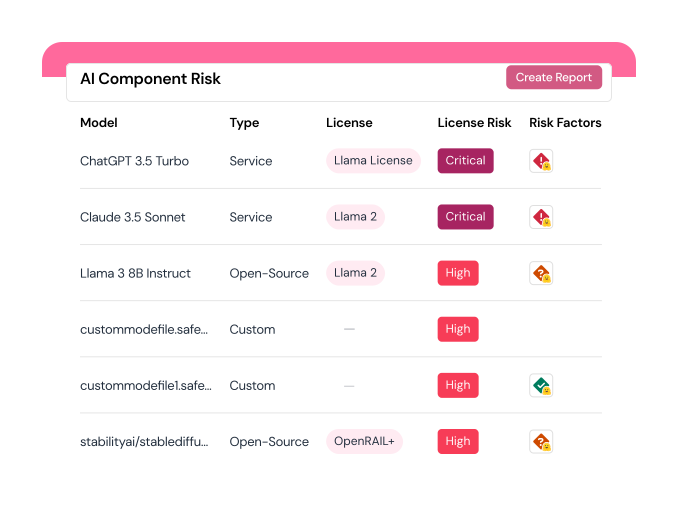
Mend.io is an application security platform, known for software composition analysis, static analysis, and container security. Its AI platform, Mend AI, extends that platform to the AI layer, and it is shaped by that origin. Its center of gravity is the pre-deployment and governance side of the lifecycle, not runtime enforcement on the agent.
Mend.io discovers AI components and builds an AI-BOM, a continuously updated inventory of models, frameworks, agents, RAG pipelines, and MCP servers, including shadow AI, exported in SPDX and CycloneDX for compliance. It hardens system prompts with weakness scoring, runs automated red teaming across a set of attack vectors in the CI/CD pipeline before a build ships, and applies governance policies and approval workflows. Its runtime piece is an in-app guardrail that sits between users and models in production, monitoring live interactions and filtering unsafe output before it reaches a user. That is discovery, testing, and governance for the AI you build, with a guardrail on model output at the end, rather than inline enforcement across the agent's execution path.
Secures Every AI Agent: Runtime Enforcement Everywhere vs Discovery and Testing
Agents run behind gateways, inside SDKs, in browsers, and on agent platforms, and new ones arrive constantly. Runtime security has to enforce wherever the agent acts, not just know that the agent exists.
TrustGuard reaches every surface with a single policy model. The same rules on injections, sensitive data, unsafe actions, and behavioral attacks apply whether the agent calls a tool through a gateway, an SDK, or a browser. This is the core of NeuralTrust's position. It is the first runtime security built to extend across every AI agent, without a custom integration rebuilt for each tool. You write policy once and it protects every agent, including the ones your teams have not deployed yet.
Mend.io relates to agents mainly as things to inventory and test. It discovers agent frameworks and the tools they call, records them in an AI-BOM, and red-teams them before they ship, and its runtime guardrail watches model output to users. That is useful knowledge about your agents, but it is not runtime enforcement across every surface where those agents act. Knowing an agent exists and having stress-tested it in the pipeline does not stop the unsafe tool call it makes in production. TrustGuard enforces on that call, on every surface, from one policy model.
Native AI Gateway Integration: Enforcement Inline vs No Gateway
Where runtime enforcement runs decides what it can stop. On the live traffic path, it blocks an action before it executes. In a scanner or a pipeline, it reports on something that has not run yet.
TrustGuard integrates natively with TrustGate, NeuralTrust's own AI gateway, so runtime enforcement runs inline on the actual path that LLM and MCP traffic already travels. The decision to block, transform, or allow a tool call is made in-flight, on infrastructure NeuralTrust controls end to end. Enforcement is part of the road the traffic drives on.
Mend.io has no gateway. Its AI work lives in the pipeline and the portal: discovery, an AI-BOM, red teaming, and governance, with a guardrail on model output at the edge of the application. There is no first-party AI gateway underneath it carrying agent traffic with enforcement inline on the same path, and no routing, failover, or tool governance living where the enforcement decision is made. TrustGuard owns the gateway and the enforcement in one product, so control over the agent's traffic is built in rather than absent.
First-Party Inline Enforcement: The Agent Execution Path vs User-to-Model Output Filtering
The scope of enforcement decides which attacks it can reach. If protection only inspects what a model says back to a user, everything the agent does with tools happens outside its view.
TrustGuard enforces first-party and inline across the agent's execution path. Its collectors, policy engine, and enforcement point are all NeuralTrust's, and they act on the tool call, the tool response, the tool input, and the identity behind the request, in-flight, before execution. The dangerous moments in an agent workflow live in those tool interactions, and that is exactly where TrustGuard sits.
Mend.io's runtime enforcement is a guardrail between users and models. It monitors live interactions and blocks unsafe output before it reaches a user, which is output filtering on the model's response, not enforcement on the agent's tool calls. An indirect injection arriving through a tool response, an agent authenticating to a tool it should not use, a loop of tool calls, or data leaving through a tool input all happen on the execution path that a user-to-model guardrail does not sit on. Filtering the final answer is not the same as controlling the actions that produced it. TrustGuard controls those actions where they happen.
Agent-to-Tool Authentication: Identity at Runtime vs Inventory and Red Teaming
Least-privilege for agents starts with a question a catalog cannot answer: is this really the agent it claims to be, and is it entitled to use this tool right now? Listing an agent's tools is not the same as verifying who is calling one.
TrustGuard controls how an agent authenticates to MCP tools at runtime. It ties the tool call to the agent's identity and enforces authentication and authorization together at the moment of execution, so an agent reaches only the tools it is entitled to, as the identity it actually is. Identity and permission are verified inline, in the same step as the action.
Mend.io inventories agent frameworks and the tools they call, evaluates the risk of each step, and red-teams for agent tool misuse before deployment. That is discovery and testing of the tool relationship, not authentication of the agent to the tool at runtime. A pre-deployment risk rating and an inventory entry do not establish who the agent is when it reaches for a tool in production. TrustGuard closes that gap by making authentication part of the runtime decision, not a finding in a report.
Federated Control Plane Across Regions: One Place vs Scattered Enforcement
Enterprises run agents across many environments at once. Different regions, different clouds, on-premises, and air-gapped networks. The operational question is whether all of that runtime security is governed from one place or scattered across the pipeline and every application edge.
TrustGuard is governed by a single federated control plane. One control plane reaches every TrustGuard deployment across regions and environments, so policy, visibility, and enforcement stay consistent everywhere your agents run. You set a rule once and it holds in every region, and you see what happened across all of them without stitching consoles together. That is how you run agent runtime security at enterprise scale.
Mend.io does not offer an equivalent runtime control plane over the agent. Its enforcement footprint at runtime is the in-app guardrail deployed inside each application, while the rest of its value is delivered through pipeline scans and portal governance. There is no single control plane sitting over inline agent enforcement across every region and environment, because inline agent enforcement is not what the product is built around. For an enterprise running agents across many environments, TrustGuard provides the unified runtime control that Mend.io's pipeline-and-guardrail model does not.
Final Verdict
AI runtime security is decided inside the action, and inside the identity behind it. Security built to enforce on the agent's execution path behaves differently from a platform built to inventory, test, and govern AI before it ships and filter the output at the end.
NeuralTrust built TrustGuard as runtime security from the start. It is the first runtime security built to extend across every AI agent, without a custom integration for each one. It enforces first-party and inline across the agent's execution path, it ships a native AI gateway with enforcement on the live traffic path, it authenticates the agent to the tool at runtime, and it governs every deployment from a single federated control plane across every region. NeuralTrust is focused on AI runtime security, and TrustGuard is the product, not a runtime add-on at the edge of an application security suite.
Mend.io approaches the problem from application security. It discovers AI components, builds an AI-BOM, red-teams before deployment, and governs, with a runtime guardrail that filters model output to users. That is valuable work on the pre-deployment and governance side, but it is not runtime enforcement across the agent's execution path. It has no gateway of its own, its runtime layer sits between users and models rather than on tool calls, and it inventories and tests the agent-to-tool relationship rather than authenticating it.
Both can run in private and cloud environments, so deployment flexibility is not the deciding factor. The decision is whether you want runtime security that enforces on the agent's actions, or an application security platform that catalogs and tests those agents and watches their output. If you are building on agents and you want protection that spans every one of them, enforces first-party and inline on the tool call, and verifies the identity behind it, NeuralTrust is built for exactly that.
Frequently Asked Questions about NeuralTrust vs. Mend.io
1. What is the main difference between NeuralTrust and Mend.io?
NeuralTrust TrustGuard is AI runtime security that enforces inline across the agent's execution path and extends across every agent surface with one policy model. Mend.io is an application security platform that discovers AI components, builds an AI-BOM, red-teams before deployment, and governs, with a runtime guardrail that filters model output to users. One enforces on the agent's actions, the other catalogs and tests the agent and watches its output.
2. Does Mend.io have its own AI gateway?
No. Mend.io works through the CI/CD pipeline and a portal for discovery, red teaming, and governance, with an in-app guardrail on model output. NeuralTrust ships TrustGate, its own AI gateway, and TrustGuard enforces inline on that traffic path, so enforcement lives in the path the agent's traffic travels.
3. Does Mend.io provide runtime protection on agent tool calls?
Mend.io's runtime layer is a guardrail between users and models that filters unsafe output before it reaches a user. That is output filtering on the model response, not enforcement on the agent's tool calls, tool responses, or tool inputs. NeuralTrust enforces first-party and inline across that execution path, which is where indirect injection, unsafe tool use, and exfiltration actually happen.
4. Does Mend.io authenticate agents to tools the way NeuralTrust does?
No. Mend.io inventories agent frameworks and their tools and red-teams for agent tool misuse before deployment, which is discovery and testing. NeuralTrust authenticates the agent to the tool at runtime, tying the tool call to the agent's identity and enforcing authentication and authorization together, so an agent reaches only the tools it is entitled to as the identity it actually is.
5. Can both products be deployed privately and in the cloud?
Yes. Both NeuralTrust and Mend.io support private and cloud deployment, so deployment flexibility is not the deciding factor. The meaningful differences are architectural: NeuralTrust owns the enforcement path with a native AI gateway, extends across every agent with one policy model, authenticates agents to tools at runtime, and governs every deployment from one federated control plane, while Mend.io centers on pre-deployment discovery, red teaming, and governance with a user-to-model output guardrail.
Related AI Runtime Security Comparisons:
- The 9 Best AI Runtime Security Platforms for Enterprise AI Security in 2026
- NeuralTrust vs. Lakera: AI Runtime Security Comparison 2026
- NeuralTrust vs. Prompt Security: AI Runtime Security Comparison 2026
- NeuralTrust vs. Palo Alto Prisma AIRS: AI Runtime Security Comparison 2026
- NeuralTrust vs. CrowdStrike: AI Runtime Security Comparison 2026
- NeuralTrust vs. Zscaler: AI Runtime Security Comparison 2026
- NeuralTrust vs. Netskope: AI Runtime Security Comparison 2026
- NeuralTrust vs. HiddenLayer: AI Runtime Security Comparison 2026
About the Author
Alessandro Pignati is Lead AI Security Researcher at NeuralTrust, where he leads research on AI and agentic security, advancing techniques to evaluate and secure large language models and autonomous AI systems. He specializes in adversarial machine learning, AI red teaming, LLM security, and AI safety, contributing to the development of secure and trustworthy AI.
NeuralTrust is an AI agent security platform, recognized in the Gartner 2025 Market Guide for AI Gateways and Guardian Agents, and the KuppingerCole 2025 Leadership Compass for Generative AI Defense. Headquartered in Barcelona with ISO 27001 certification.
)
)
)
)