Last updated: November 9, 2026
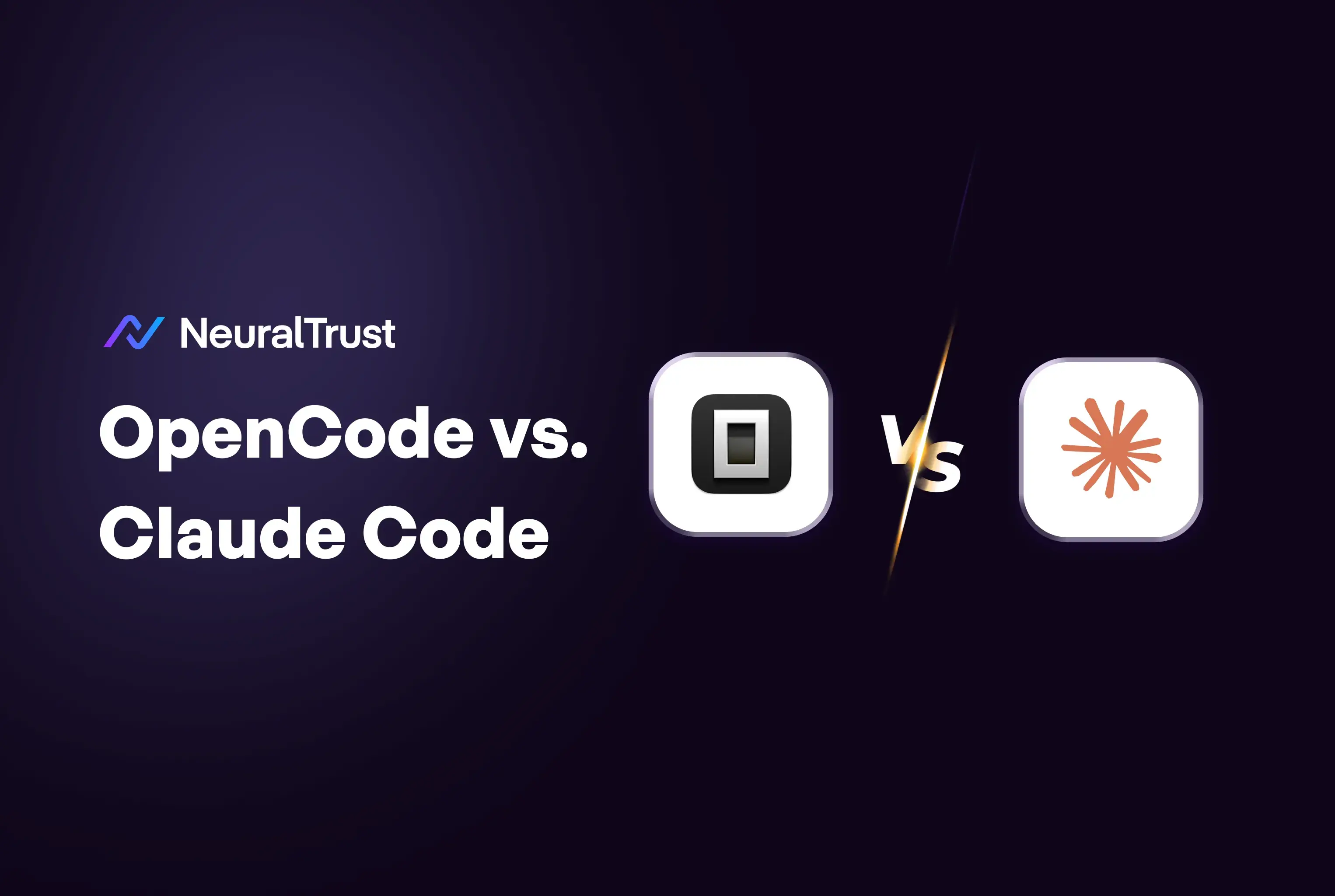
What is the difference between OpenCode and Claude Code? OpenCode is a free, MIT-licensed coding agent that works with many model providers. Claude Code is Anthropic's proprietary coding agent, built around Claude models, a permission system and an optional sandboxed shell. OpenCode vs Claude Code comes down to openness and choice against default safeguards and enterprise controls. Both need guardrails around them.
TL;DR: Key Takeaways
- On the official Terminal-Bench 4.0 leaderboard, Claude Code holds the top two rows: Opus 5.5 at 64.8% and Sonnet 5.5 at 61.8%. OpenCode is not among the listed agents, so we found no current independent head-to-head (Snorkel AI, Terminal-Bench 4.0).
- The only same-model pair we found is older: Opus 4.5 scored 52.1% in Claude Code and 51.7% in OpenCode on Terminal-Bench 2.0, a tie within noise (Terminal-Bench 2.0).
- OpenCode has 225.6k GitHub stars and an MIT license, and its optional Go plans start at $10 per month (OpenCode GitHub, OpenCode Go).
- Claude Code comes with Pro at $20, Max at $100 or Ultra at $200 per month. Anthropic does not let third-party tools route requests through those plan credentials (Claude Help Center, Claude Code legal page).
- OpenCode has 3 published security advisories, including two remote code execution flaws rated 8.8 and 9.4, and a Console breach on October 17, 2026 that hit 1.4% of Console users. Claude Code has 36 advisories (GitHub, BleepingComputer).
- Claude Code's OS-level sandbox exists but is off by default, and OpenCode's default policy allows every action except reading .env files, which asks first (Claude Code docs, OpenCode docs).
At a glance: OpenCode vs Claude Code in 2026
Quick Answer
Which is better, OpenCode or Claude Code?
Choose OpenCode for an open-source agent, any model provider or local models, and low-cost open models. Choose Claude Code for Anthropic's models, a built-in sandbox, managed enterprise settings and the strongest published benchmark results. For regulated teams, the safer default is Claude Code with the sandbox turned on.
| OpenCode | Claude Code | |
|---|---|---|
| License | MIT, open source | Anthropic terms, proprietary |
| Models | Many providers, local models, Claude via API | Claude models, plus Bedrock, Google Cloud, Foundry |
| Pricing | Free software, you pay for models; Go from $10/month | Pro $20, Max $100, Ultra $200 per month, or API billing |
| Default permissions | Allow all except .env reads, which ask | Ask before Bash, edits and web fetch |
| Sandbox | No OS-level sandbox found in the docs we read | Seatbelt or bubblewrap, off by default |
| Enterprise policy | Rule-based policies, some Console-managed | Managed settings that can lock permission rules |
| Security record | 3 advisories and the October 2026 Console breach | 36 advisories, including a sandbox escape |
How we researched
On November 9, 2026 we read the OpenCode and Claude Code docs, both GitHub advisory pages, the Terminal-Bench 4.0 and 2.0 leaderboards, Anthropic's plan pages and coverage of the OpenCode breach. Scores are leaderboard entries, not our own tests, and each verdict follows the cited data.
OpenCode vs Claude Code: What Each Tool Is
OpenCode is an open-source coding agent that runs in a terminal, a desktop app or a web interface, and connects to models through a provider catalog. Claude Code is Anthropic's agentic coding tool for the terminal and IDEs. The key difference is who controls the stack: you with OpenCode, Anthropic with Claude Code.
OpenCode: the open-source, model-agnostic agent
OpenCode's GitHub repository shows an MIT license, 225.6k stars, 30.5k forks and 1,089 contributors on November 9, 2026. You run /connect to add a provider and /models to pick a model. The catalog covers Amazon Bedrock, Google Vertex, Azure and OpenRouter, GitHub Copilot and ChatGPT Plus or Pro sign-in, and local runtimes such as Ollama, LM Studio and vLLM (OpenCode docs).
Claude Code: Anthropic's agentic coding tool
Claude Code runs on a Claude subscription, a Console API key or credentials from Amazon Bedrock, Google Cloud or Microsoft Foundry. According to Anthropic's legal page, the Consumer Terms cover Free, Pro, Max and Ultra users and the Commercial Terms cover Team, Enterprise and API users. The binary is proprietary, and Anthropic says it must not be modified when offered inside other products (Claude Code docs).
For a view of how Claude Code compares with an IDE-first rival and with OpenAI's agent, see our Claude Code vs Cursor benchmark and Codex vs Claude Code benchmark.
OpenCode vs Claude Code Benchmarks: What the Numbers Show
We found no independent benchmark that pits OpenCode against Claude Code on the same model today. The newest official leaderboard lists Claude Code, Codex, Grok Build, mini-SWE-agent and Muse Code as agents, and OpenCode is not on it. The last same-model comparison we found is from Terminal-Bench 2.0 and is a statistical tie.
Terminal-Bench 4.0: Claude Code leads the current board
Terminal-Bench 4.0 runs 66 real terminal tasks through the Harbor framework. On November 9, 2026, the top five entries were all Claude Code or Codex runs.
| Rank | Model | Agent | Resolution rate | Run date |
|---|---|---|---|---|
| 1 | Opus 5.5 (max) | Claude Code | 64.8% ± 3.1 | 2026-09-22 |
| 2 | Sonnet 5.5 (max) | Claude Code | 61.8% ± 2.9 | 2026-09-28 |
| 3 | GPT-6 Astra (max) | Codex | 58.2% ± 2.8 | 2026-09-03 |
| 4 | GPT-6.1 Sol (max) | Codex | 58.2% ± 3.1 | 2026-09-29 |
| 5 | Fable 5.1 (max) | Claude Code | 57.9% ± 3.8 | 2026-09-01 |
Read this with care: entries pair a model with an agent, so they measure both. The full-run cost was $4.7k for Opus 5.5 (8.0B tokens) and $7.3k for Sonnet 5.5 (19.4B tokens), so the higher-scoring run was also the cheaper one (Snorkel AI).
Terminal-Bench 2.0: the last same-model comparison
On Terminal-Bench 2.0, Claude Opus 4.5 appears with several agents, all on November 24, 2025. The spread shows that the agent around a model moves the score as much as the model does.
| Agent (Opus 4.5) | Resolution rate |
|---|---|
| Droid | 63.1% |
| Letta Code | 59.1% |
| Terminus 2 | 57.8% |
| Claude Code | 52.1% ± 2.5 |
| OpenCode | 51.7% (no interval published) |
The same pattern holds for Opus 4.6 on that board, where Claude Code scored 58.0% and other agents scored between 62.9% and 76.4% on runs dated February 5, 2026. So Claude Code leads the newest board, yet it was not the strongest agent for the same model in 2025 and early 2026. OpenCode's 2.0 entry has no published interval, so treat it as a rough indicator.
Our verdict: Claude Code has the stronger published evidence today, and OpenCode has none we can use for a fair comparison. That is a gap in evidence, not proof that OpenCode is slower.
Models, Providers and Pricing
OpenCode software is free and you pay for the models, while Claude Code is included in paid Claude plans or billed through the API. OpenCode gives you more ways to lower cost, including open models and local runtimes. Claude Code gives you predictable plan pricing if you stay inside its usage limits.
| Cost item | OpenCode | Claude Code |
|---|---|---|
| Software | Free, MIT license | Included with a paid plan or API billing |
| Entry plan | OpenCode Go, $10/month | Pro, $20/month (US) |
| Higher tiers | Go Plus $40/month, Go Teams $20 per member | Max $100/month, Ultra $200/month |
| Bring your own model | Any catalog provider, Bedrock, Vertex, Azure, Ollama, vLLM | Bedrock, Google Cloud, Foundry, Console API key |
| Claude subscription | Not usable through third-party tools | Native sign-in |
Two details change the math. First, Anthropic's legal page says third-party developers may not route requests through Free, Pro, Max or Ultra credentials. To use Claude models in OpenCode you need API-billed access, such as a Console key, Bedrock or Vertex. Second, Anthropic's gateway guide says it does not support routing Claude Code to non-Claude models through any gateway (Claude Code docs).
Check data terms too. According to the OpenCode Go page, most listed models are not used for training, but the discounted Muse Spark Contributor models use your prompts and completions for training.
Permissions, Sandboxing and Extensibility
Claude Code asks before it runs shell commands, edits files or fetches web pages, and evaluates rules deny first, then ask, then allow. OpenCode uses an ordered list of allow, ask and deny rules where the last match wins, and its default policy is permissive. Claude Code adds an OS-level sandbox, which is off until you enable it.
How Claude Code controls actions
Per Claude Code's permissions page, a deny rule always beats an allow rule, so a broad deny such as Bash(aws *) cannot be reopened by a narrower allow. Administrators can make managed settings the only source of permission rules. The sandbox uses Seatbelt on macOS and bubblewrap on Linux and WSL2, limits writes to the working directory and routes network access through a domain allowlist. It is off by default, covers shell commands only and does not run on native Windows. File tools, MCP servers and hooks run outside it, and a failed command can be retried unsandboxed unless you enable strict mode (Claude Code docs).
How OpenCode controls actions
OpenCode's V2 permissions are a list of rules with an action, a resource and an effect. The default policy allows everything except reading .env files, which ask, and external directories are not prompted by default. Policies can hard-deny actions, and MCP tools can be denied by name, for example context7_* (OpenCode docs). The docs warn that shell runs with the host user's filesystem, process and network authority, and we found no OS-level sandbox equivalent to Claude Code's in the pages we read.
MCP, plugins and skills
Both tools speak MCP. OpenCode supports local stdio and remote HTTP servers, with OAuth and PKCE for remote ones, and exposes MCP tools through Code Mode by default (OpenCode docs). Claude Code supports MCP servers, hooks and skills too, and its sandbox docs note that hooks and local MCP servers run with your full access. Our Claude Code skills guide covers that extension model, and our MCP security best practices explain how to vet servers.
Security Record: Advisories and the Console Breach
Both tools have had serious flaws, and the OpenCode Console breach is the most recent incident of the two. OpenCode's local server and web UI had remote code execution issues, and Claude Code had a sandbox escape. Advisory counts reflect disclosure volume and user base, so they are not a safety ranking.
| Tool | Issue | Rating and fix |
|---|---|---|
| OpenCode | CVE-2026-22812: unauthenticated local HTTP server allows command execution | CVSS 8.8, fixed in 1.0.216 |
| OpenCode | CVE-2026-22813: XSS in the web UI leads to command execution from a malicious website | CVSS v4 9.4, fixed in 1.1.10 |
| OpenCode | GHSA-632h-h47v-g4x4: cross-site request installs arbitrary packages on opencode serve | High (7.5), fixed in 1.18.22 |
| OpenCode | Console breach: stored provider keys exposed, 1.4% of Console users | Earliest exposure October 17, 2026, 00:30 UTC |
| Claude Code | CVE-2026-55607: sandbox escape through git worktree path confusion | CVSS v4 7.7, fixed in 2.1.163 |
The Claude Code flaw needed a user to clone a malicious repository with prompt injection, while OpenCode's server issues could be triggered from a web page. The Console breach is different in kind: it hit stored keys for linked providers, and users reported charges of around $1,700. The maintainers called it a distillation attack, and we found no public root-cause write-up as of November 9 (BleepingComputer).
Claude Code's 36 advisories include high-severity entries for an Edit tool race that allowed writes outside the workspace and a plugin commit pin bypass (Claude Code advisories). More advisories show a larger audited surface and an active disclosure channel. Keep both tools updated and rotate any key a tool has stored.
Security and Governance: Running Either Agent Safely
Coding agents run commands and call APIs for a developer, so the risk sits where OWASP places it. According to OWASP (2026), Excessive Agency is now LLM03 in the 2026 LLM Top 10, and the agentic list adds ASI02 for tool misuse and ASI03 for identity and privilege abuse (OWASP LLM Top 10 2026, OWASP Agentic Top 10).
Tool choice does not remove that risk, because a permissive OpenCode default and a Claude Code sandbox that is off by default both leave the decision to the developer. Four controls apply to either tool:
- Run agents in a sandbox or container, and enable Claude Code's sandbox with strict mode.
- Deny reads of secrets and credential paths, and keep provider keys out of third-party consoles.
- Pin and review MCP servers, plugins and skills before use.
- Cap spend per key, so a leaked key cannot run up a bill.
NeuralTrust adds one runtime layer across both tools. The Agent Gateway (TrustGate) routes agent traffic to models, MCP servers and APIs through one policy point with identity-based access and budgets, and ships with 200+ pre-built MCP servers. Agent Runtime Security (TrustGuard) inspects prompts, tool calls and responses in real time to block injection, secret leakage and destructive commands before they run. Both tools can send model traffic to a custom endpoint, which is the hook for this layer. NeuralTrust's coding assistants page names Claude Code but not OpenCode, so test that route first. See also our Claude Code security guide, the Claude Code and Cursor MCP security analysis and our guide to AGENTS.md.
Which Should You Choose? OpenCode or Claude Code
Pick by constraint. OpenCode wins on licensing, provider choice, local models and low-cost open models. Claude Code wins on published benchmark evidence, built-in sandboxing, managed policy and one vendor accountable for the stack. If you are unsure, trial both on a non-sensitive repository.
| Your situation | Better fit | Why |
|---|---|---|
| You need open source and the right to audit or fork | OpenCode | MIT license and public repository |
| You want to mix providers or run local models | OpenCode | Provider catalog, Ollama, vLLM, LM Studio |
| You want the lowest model cost | OpenCode | Open models through Go from $10/month |
| You want a built-in OS sandbox and managed policy | Claude Code | Seatbelt or bubblewrap, managed settings |
| You want the best benchmark evidence | Claude Code | Top two rows on Terminal-Bench 4.0 |
| You use a Claude subscription | Claude Code | Third-party use of plan credentials is not allowed |
| You store provider keys in a vendor console | Weigh carefully | The October 2026 breach exposed stored keys |
Many teams run both, which is where a shared policy layer helps. Our OWASP Top 10 for Agentic Applications guide maps these controls to the risk list.
Conclusion
OpenCode vs Claude Code is a trade between openness and built-in safeguards. OpenCode gives you an MIT license, any model provider and cheap open models, but its default policy is permissive and it has had two remote code execution flaws and a Console breach. Claude Code has the strongest benchmark evidence, a sandbox and managed settings, yet it is proprietary, locked to Claude models and had its own sandbox escape. Pick one, then add guardrails.
Secure OpenCode and Claude Code in Production with NeuralTrust
Route coding agent traffic through one policy point with identity-based access, budgets and real-time inspection of prompts and tool calls.
Related Comparisons
- Claude Code vs Cursor (2026): Benchmarks
- Codex vs Claude Code (2026): Benchmarks
- Claude Code Skills: The Complete Guide
- Claude Code Security
FAQs about OpenCode vs Claude Code
1. Is OpenCode better than Claude Code?
It depends on what you need. OpenCode is better for open source, provider choice, local models and lower model cost. Claude Code has stronger published benchmark evidence, a built-in sandbox and managed enterprise settings. We found no independent benchmark that compares the two on the same model today, so test both on your own repository before deciding.
2. Is OpenCode free?
The OpenCode software is free under the MIT license, but the models are not. You pay your provider, use a ChatGPT Plus or Pro sign-in, run local models, or subscribe to OpenCode Go at $10 per month. Go Plus costs $40 per month and Go Teams costs $20 per member per month.
3. Can I use my Claude Pro or Max plan in OpenCode?
No. Anthropic's Claude Code legal page says third-party developers may not route requests through Free, Pro, Max or Ultra plan credentials. To use Claude models in OpenCode, you need API-billed access such as a Console API key, Amazon Bedrock or Google Vertex, and you pay standard usage rates.
4. What happened in the OpenCode breach?
OpenCode disclosed on Saturday, October 17, 2026 that a breach affected 1.4% of Console users who had linked external providers. Their stored provider keys may have been exposed from 00:30 UTC that day, and some users reported unauthorized charges of around $1,700. Rotate any keys you stored and set spend caps.
5. Is Claude Code more secure than OpenCode?
Claude Code has more built-in safeguards: an OS-level sandbox, credential masking and managed settings. But the sandbox is off by default, and Claude Code has 36 advisories, including a sandbox escape fixed in version 2.1.163. OpenCode has 3 advisories and a permissive default policy. Neither is safe without guardrails.
6. Which has better benchmark results?
Claude Code holds the top two rows on the official Terminal-Bench 4.0 leaderboard, with Opus 5.5 at 64.8%. OpenCode is not listed there. On the older Terminal-Bench 2.0, Opus 4.5 scored 52.1% in Claude Code and 51.7% in OpenCode, a tie within noise.
About the Author
Roger Howroyd is Head of Global SEO and AI at NeuralTrust, where he leads the company's search strategy across SEO, AEO, GEO, and LLM optimization. He specializes in AI-powered search, content strategy, and SEM. Connect on LinkedIn.
NeuralTrust is the leading platform for securing and scaling AI agents. Named a Pioneer in the Gartner Emerging Market Quadrant for AI Application Security 2026, recognized across four Gartner Hype Cycle reports in 2026, and featured in the Gartner Market Guide for Guardian Agents 2026, the Gartner Market Guide for AI Gateways 2025 and the KuppingerCole Leadership Compass for Generative AI Defense 2025. Headquartered in Barcelona with offices in London and New York. ISO 27001 certified.
Sources
Accessed on November 9, 2026.
- Snorkel AI, "Terminal-Bench 4.0 Leaderboard", 2026.
- Terminal-Bench, "Terminal-Bench 2.0 leaderboard", 2025 and 2026 runs.
- OpenCode, "Providers", "MCP servers", "Permissions" and "Go" docs, 2026.
- GitHub, "anomalyco/opencode" repository and security advisories, 2026.
- BleepingComputer, "OpenCode hack exposes API keys amid AI distillation attacks", October 19, 2026.
- Claude Code Docs, "Configure the sandboxed Bash tool", 2026.
- Claude Code Docs, "Configure permissions" and "Legal and compliance", 2026.
- Claude Help Center, "What is the Pro plan?", "Max" and "Ultra", 2026.
- GitHub, "anthropics/claude-code security advisories", 2026.
- OWASP GenAI Security Project, "Top 10 for LLM Applications 2026" and "Top 10 for Agentic Applications 2026".