Last updated: October 27, 2026
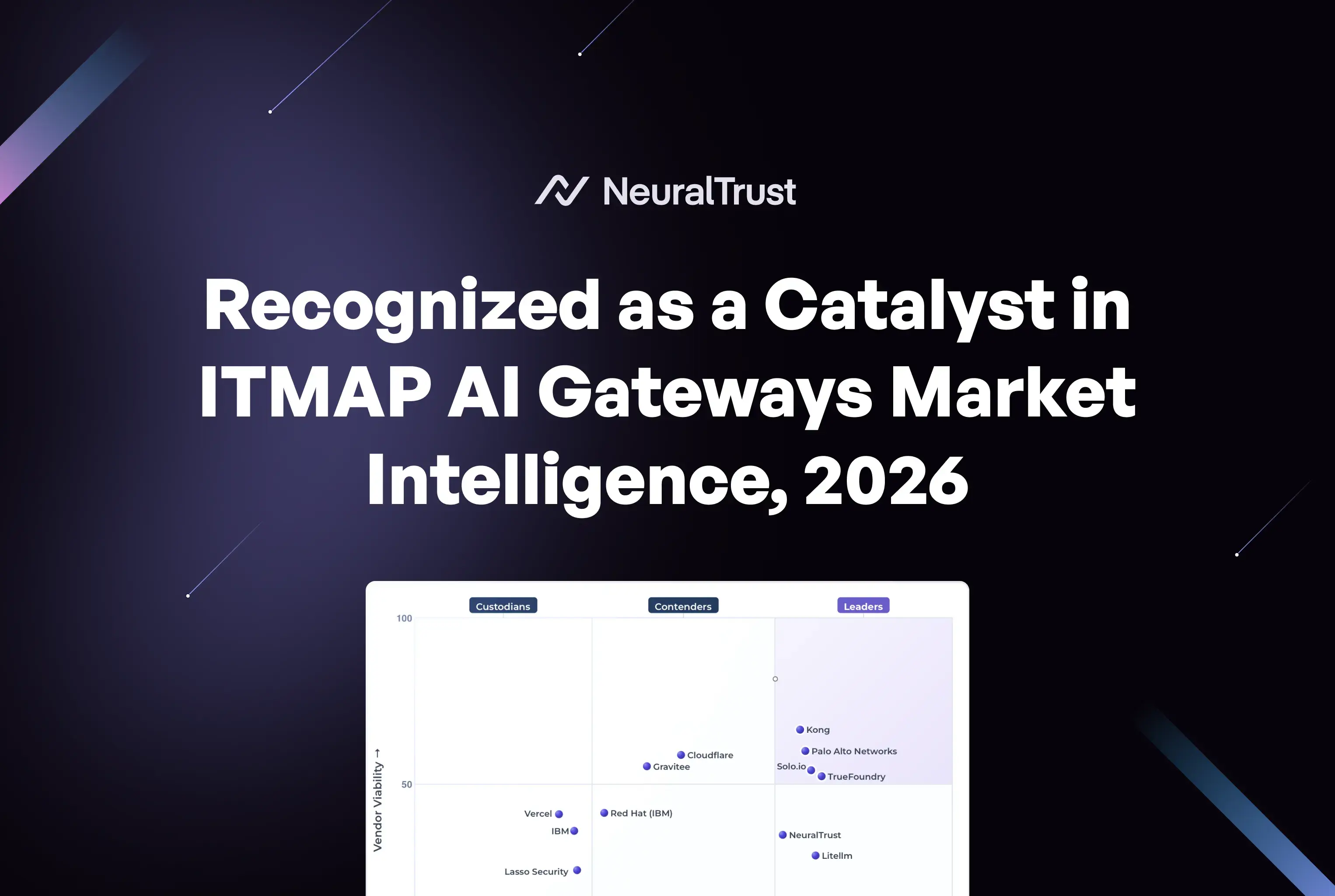
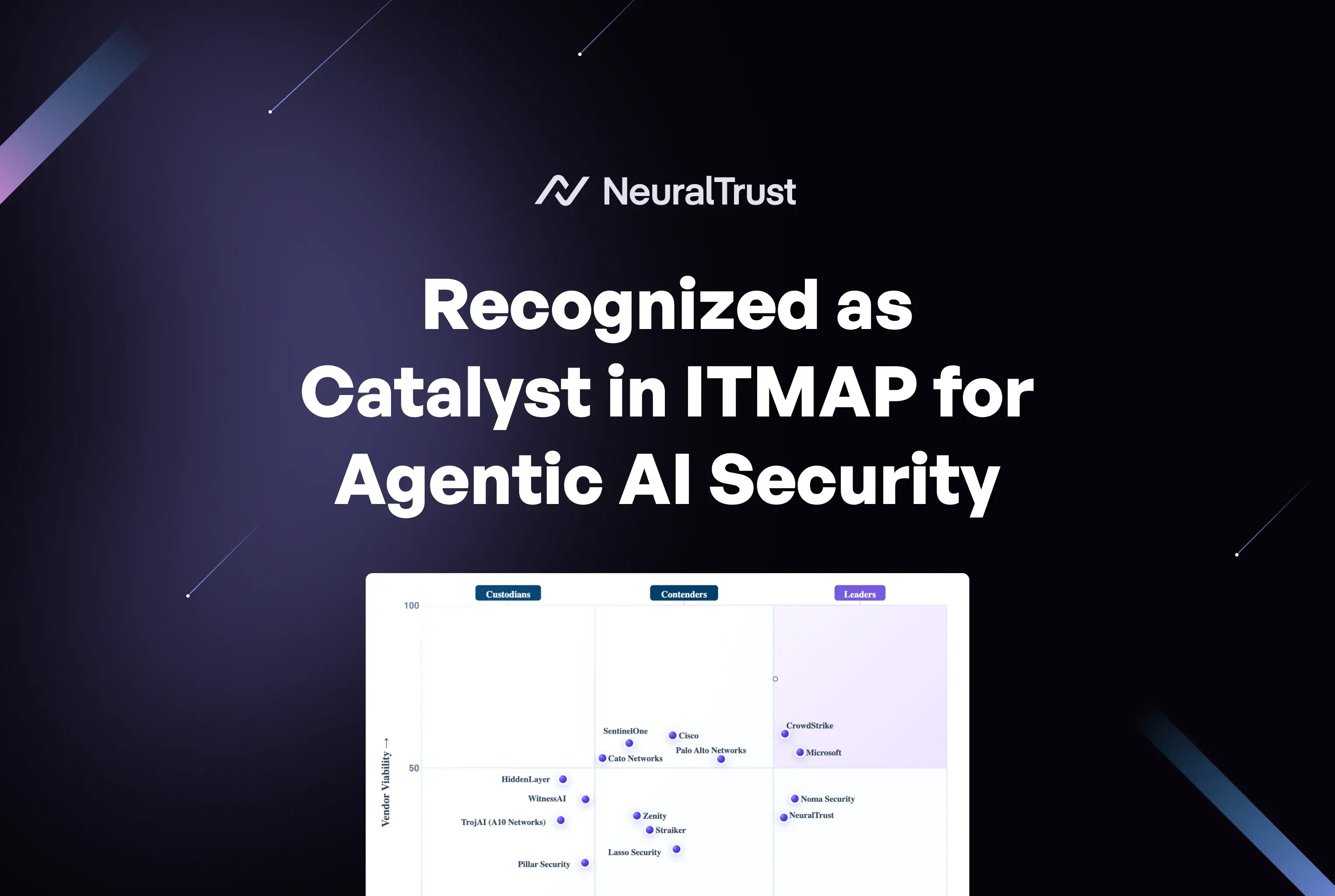
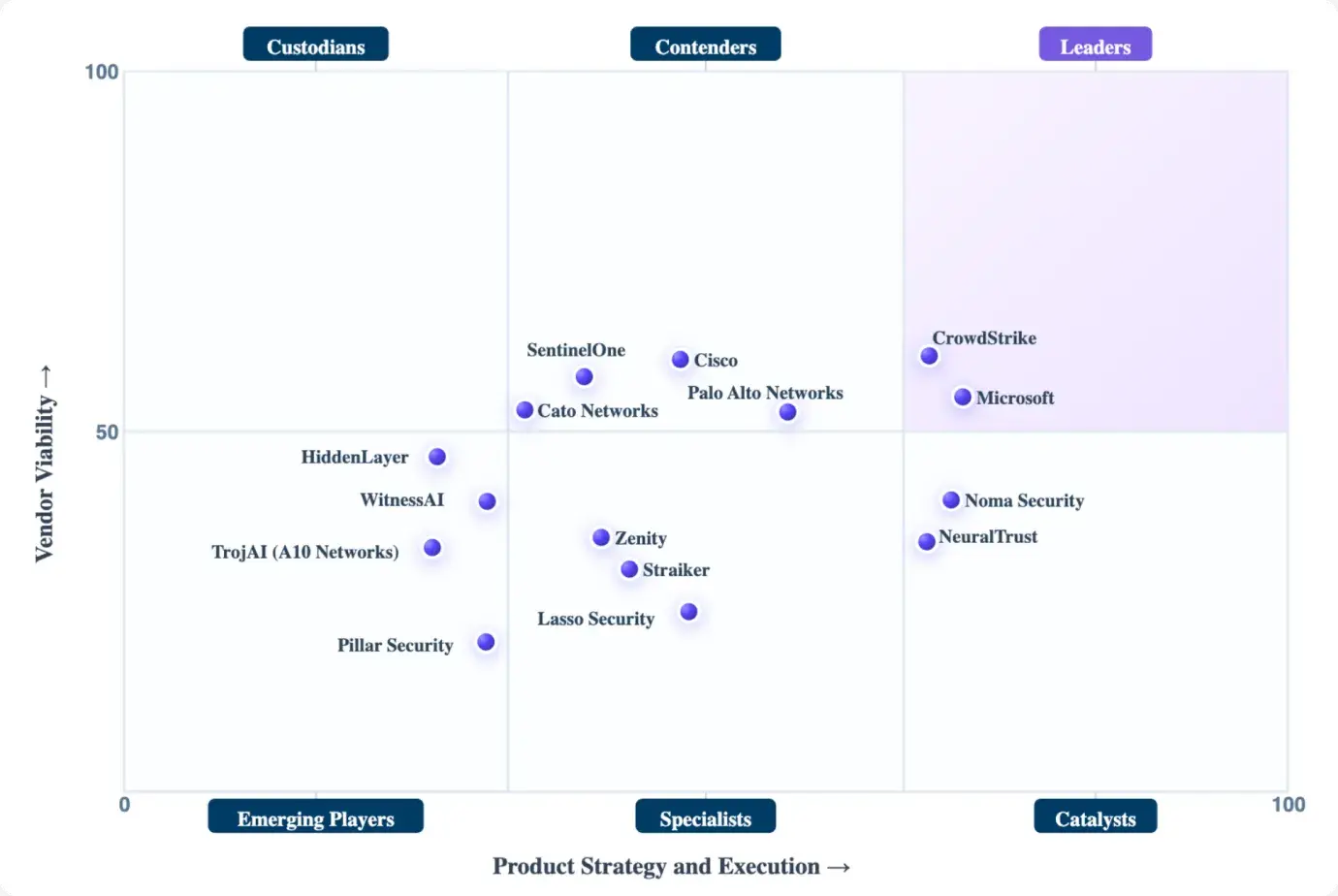
ITMAP, an independent IT vendor intelligence platform, has placed NeuralTrust in the Catalysts quadrant of its Agentic AI Security market map. ITMAP points to strong Product Strategy and Execution, and the map covers 15 vendors as of October 2026.
Independent research matters because it is not shaped by who pays for it. ITMAP was built by enterprise IT practitioners as an alternative to traditional analyst firms, and it says it is not funded by the vendors it evaluates.
ITMAP lists NeuralTrust's platform in this market as the TrustGate gateway plus red teaming. The map compares platform security vendors, network and cloud providers and AI-native specialists on one chart, which gives security teams a practical view of who is building what for agentic AI.
TL;DR: Key Takeaways
- ITMAP placed NeuralTrust in the Catalysts quadrant of its Agentic AI Security market map, as of October 2026.
- The map plots vendors on two axes: Product Strategy and Execution (horizontal) and Vendor Viability (vertical).
- Catalysts sit on the right-hand side of the map, which is where ITMAP places vendors with high Product Strategy and Execution scores.
- ITMAP lists the NeuralTrust Platform, described as the TrustGate gateway plus red teaming. TrustGuard, NeuralTrust's Agent Runtime Security product, adds inline inspection and policy enforcement on agent traffic at the moment of execution.
- The map shows 15 vendors, from platform security companies to AI-native specialists.
- ITMAP says it is independent and is not funded by the vendors it evaluates.
What Is ITMAP?
ITMAP is an AI-powered vendor intelligence platform created by enterprise IT professionals as an alternative to traditional analyst firms. Its aim is to avoid the conflict of interest that appears when vendors fund the research that evaluates them.
The platform updates its market maps continuously instead of once a year, and it scores vendors on two dimensions: Product Strategy and Execution, and Vendor Viability. Because it tracks each vendor over time, buyers can see how a position changes between updates.
That makes a map useful in a specific way. It is a relative view of a market at a point in time, built to help a buyer decide who belongs on a shortlist. It does not replace a proof of concept against your own agents and data.
What Is the Agentic AI Security Market?
ITMAP defines agentic AI security platforms as products that protect autonomous AI agents, and the enterprises deploying them, at runtime. Put simply, it is the category of products that protect AI agents: systems that plan, call tools and take actions on behalf of people and companies. Where a chatbot only answers, an agent can send an email, change a record or run a command, so the damage from a manipulated agent is larger.
The category exists because the older controls were built for different assets. Endpoint, network and identity tools see users and devices. They do not see a prompt injection hidden in a web page, a poisoned tool result or an agent that slowly widens what it does. The OWASP Top 10 for Agentic Applications (December 2025) lists ten risks specific to agents, from goal hijack to rogue agents.
ITMAP lists the core capabilities as agent discovery and inventory, runtime threat protection, policy enforcement, sandboxing, inter-agent traffic inspection and forensic logging. It also notes that platforms differ in emphasis: some are runtime-first, some posture-first and some identity-first. Runtime enforcement is the piece that acts while the agent is working.
The buyers are changing too. Agent security used to be a topic for research teams. In 2026 it sits on the agenda of CISOs, platform leads and risk teams who are putting agents into customer support, internal operations and software delivery, and who need controls that run in production, not only in a review.
What the Catalysts Quadrant Means
ITMAP's map has six named positions. The top row holds Custodians, Contenders and Leaders, and the bottom row holds Emerging Players, Specialists and Catalysts. Product Strategy and Execution runs left to right, and Vendor Viability runs bottom to top.
Catalysts sit in the lower right: strong Product Strategy and Execution, with Vendor Viability below the midline. In ITMAP's reading, that is a vendor whose product direction and delivery are among the strongest on the map. NeuralTrust sits in this quadrant for Agentic AI Security.
The other axis matters too, and the map shows it. Vendor Viability reflects the weight of a company behind its product, and the vendors in the upper half are, on the whole, large platform companies. A Catalyst is the profile of a focused company whose product has moved ahead of its size. Buyers should read both axes and ask how each vendor supports customers in production.
Agent Runtime Security (TrustGuard)
TrustGuard, NeuralTrust's Agent Runtime Security product, is the runtime layer of the platform. It inspects every interaction an agent has and enforces policy inline, at the moment of execution. It collects traffic from agent gateways, SDKs, endpoints, agent platforms, browsers, sidecars and log streams, then detects, enforces and observes. The product is built around the threats that matter once an agent is live: prompt injection, poisoned tool results and rogue agent calls.
- Policy on inputs and outputs. Rules apply to what goes into and out of an agent, with selectable detection types such as injections, jailbreaks, policy violations, sensitive data, unsafe actions and behavioral attacks, all enforced inline.
- Stateful detection. TrustGuard tracks conversation context across turns, so it can catch multi-turn attacks that look harmless one message at a time.
- Contextual detection. Decisions take into account identity, protocol and collector metadata, not just the text of a single request.
- Behavioral detection. It models interaction patterns over time to flag probing and slow escalation.
- Enforcement and observability. Each decision can allow, block, transform in flight or alert only, and findings link back to the full trace in the tools teams already use.
TrustGuard runs as SaaS, as a hybrid with a privately hosted data plane, or on-premises. It works alongside the rest of the Runtime Security Mesh: TrustGate as the AI gateway, TrustLens for agent posture management and TrustTest for AI red teaming.
Why Runtime Enforcement Matters in Agentic AI Security
An agent's risk shows up when it acts, not when it is deployed. A configuration can look safe in a review and still be manipulated by the content it reads later, which is why prompt injection stays at the top of the OWASP Top 10 for LLM Applications 2026 (August 3, 2026) and excessive agency ranks third.
Controls placed before deployment, such as inventories and tests, tell you what an agent could do. Controls placed at runtime decide what it is allowed to do right now. Both are needed, but only the second one can stop an attack that is already in progress.
This is the case for enforcement at the point of execution: inspect the prompt, the tool result and the agent's next action, then allow, block or transform it before the damage is done. It also produces the trace that a security team needs to investigate afterwards.
For teams, the practical effect is that policy stops being a document and becomes behavior. A rule such as "this agent never sends customer data outside the company" is enforced on every request, and each decision can be reviewed later with the context that led to it.
What This Means for Enterprise Buyers
An analyst-style map is a starting point for a shortlist, not a replacement for your own evaluation. Use it to understand the market, then test the products against your agents.
Check where the control sits. Ask whether a product sees prompts, tool results and agent actions inline, or only reviews logs after the fact. Enforcement at runtime and visibility after the event solve different problems.
Test multi-turn and indirect attacks. Single-message checks are easy to pass. Ask vendors to show how they handle attacks spread across several turns and instructions hidden in content the agent retrieves.
Look at deployment and data residency. Agent traffic can carry sensitive data. Confirm whether the product can run in your own environment and where your data is processed.
FAQs about the ITMAP for Agentic AI Security
1. What is ITMAP and how is it different from Gartner or Forrester?
ITMAP is an AI-powered vendor intelligence platform created by enterprise IT practitioners. It says it is not funded by the vendors it evaluates and updates its maps continuously. Traditional analyst firms publish periodic reports, and some of their work is commissioned or sponsored by vendors.
2. What does the Catalysts quadrant mean in ITMAP's methodology?
Catalysts are vendors with high Product Strategy and Execution scores. On the map they sit in the lower right, with Vendor Viability below the midline. It signals strong product direction and delivery rather than the largest or most established company. Buyers should read it together with the Vendor Viability axis and their own proof of concept.
3. Which NeuralTrust product does ITMAP list?
ITMAP lists the NeuralTrust Platform in this market, described as the TrustGate gateway plus red teaming. TrustGuard, NeuralTrust's Agent Runtime Security product, is the runtime layer of the same platform: it inspects agent interactions and enforces policy at runtime, alongside TrustGate, TrustLens and TrustTest in the Runtime Security Mesh.
4. How many vendors does ITMAP show in the Agentic AI Security market?
The map shows 15 vendors as of October 2026. They range from large platform security and network providers to AI-native specialists, which reflects how quickly the category is forming. ITMAP updates the map as the market moves, so the count can change.
5. How does TrustGuard differ from a standard guardrail?
A standard guardrail often checks one prompt or response in isolation. TrustGuard tracks context across turns, takes identity and protocol metadata into account and models behavior over time. It then enforces inline with allow, block, transform or alert decisions, and each finding links back to the full trace so a team can see what happened and why.
About NeuralTrust
NeuralTrust is an AI security company focused on runtime defense, gateway enforcement, agent posture management and adversarial red teaming. Its Runtime Security Mesh brings TrustGuard, TrustGate, TrustLens and TrustTest together. It works with enterprise security teams in financial services, healthcare, retail and technology.
Book a TrustGuard demo or explore Agent Runtime Security.
Source: ITMAP for Agentic AI Security, October 2026.