Last updated: November 19, 2026
What is Gemini 4 Neon? Gemini 4 Neon is Google's mid-sized model in the Gemini 4 family, released on November 18, 2026. It sits between Gemini 4 Carbon and Gemini 4 Hydrogen, offers a 1 million token context window and costs $3 per million input tokens and $15 per million output tokens. Google reports frontier-level results in coding, agents and science, but most of the figures come from Google's own announcement.
TL;DR: Key Takeaways
- Price: Gemini 4 Neon costs $3 per million input tokens and $15 per million output tokens, with cached input at $0.15, according to Google's launch post.
- Cost per task: at its default
highthinking level, Neon costs 32% less per task than Gemini 4 Carbon, Google says. - Intelligence: Artificial Analysis scores Neon 61 on its Intelligence Index at the highest thinking level, third overall, as relayed by AlphaSignal.
- Coding and agents: Neon scores 58.6 on the Artificial Analysis Coding Agent Index and 56.3% on Zapier's AutomationBench, both reported as first place in Google's launch post.
- Security: Google reports 0.0% attack success on Gray Swan's indirect prompt injection benchmark at the highest thinking level, with real-time safeguards on (Google).
- Caveat: independent testing is still thin, and Claude Opus 5.5 scores slightly higher on Terminal-Bench 4.1 and FrontierCode 2.0, according to AlphaSignal.
Gemini 4 Neon at a glance
| Detail | Gemini 4 Neon |
|---|---|
| Vendor | |
| Release date | November 18, 2026 |
| Position in the family | Between Gemini 4 Carbon (hardest long-horizon work) and Gemini 4 Hydrogen (fast everyday work) |
| Context window | 1 million tokens |
| API price | $3 input and $15 output per 1M tokens |
| Cached input | $0.15 per 1M tokens |
| Thinking levels | high (default) and xhigh are named by Google; some outlets report four levels |
| Free API tier | None, paid tier only |
| Open weights | No |
| Where to use it | Gemini API in Google AI Studio, Gemini app (AI Pro and Ultra), Google Antigravity, Gemini for business |
Sources: Google and AI Release Tracker.
Where the model fits in the Gemini 4 family
Gemini 4 Neon is Google's balanced Gemini 4 model for complex coding, analytical reasoning and enterprise workflows. Google positions it between Carbon, built for the hardest long-horizon projects, and Hydrogen, built for fast everyday execution. It arrived on November 18, 2026, six days after Gemini 4 Hydrogen.
The Decoder (2026) counts it as the fourth new Gemini model in a month. In the Gemini app it replaces Argon in the model picker under "Deeper analysis", according to Digital Trends (2026) and 9to5Google (2026).
The family design matters for agents. According to Google's Antigravity team (2026), Neon can plan and set the architecture while Hydrogen subagents handle routine code edits, package updates and test runs. When Hydrogen hits friction, it hands the work back to Neon, which repairs the plan and resumes execution.
Gemini 4 Neon benchmarks
Google reports Gemini 4 Neon at 61 on the Artificial Analysis Intelligence Index, third overall, and first on the Artificial Analysis Coding Agent Index at 58.6. It also reports 70.9% on the Vals Index and 56.3% on AutomationBench. Most other scores in the table come from Google's own runs.
| Benchmark | Gemini 4 Neon | Figure published by |
|---|---|---|
Artificial Analysis Intelligence Index (xhigh) | 61, third overall | Artificial Analysis |
| Artificial Analysis Coding Agent Index | 58.6, first | Artificial Analysis |
| Vals Index | 70.9% | Vals |
| AutomationBench (Zapier) | 56.3% | Zapier |
| Vending-Bench 2 (ending balance) | $16,843, first | Andon Labs |
| Terminal-Bench 4.1 | 65.2% | Google-reported |
FrontierCode 2.0 (high) | 46.2% | Google-reported |
| Terminal-Bench Science | 70.5% | Google-reported |
| RiemannBench | 84.0% | Google-reported |
| HLE-Diamond | 71.3% | Google-reported |
| SWE-sweep, mini-SWE setup | 12.8% | Google-reported |
| SWE-sweep, Google Antigravity | 39.0% | Google-reported |
Sources: Google, AlphaSignal (2026) and AI Release Tracker. Scores are at the xhigh thinking level unless noted.
How we compared
We did not run these benchmarks. We collected the figures from Google's launch post and from press coverage, and we labeled each by who published it. Scores come from different test setups, so a number is only comparable within its own row.
Two details change how to read the table. First, the same model scores 12.8% on SWE-sweep in one setup and 39.0% in another, so the test setup moves results by a wide margin. Second, rankings depend on which models each source counts. Google calls Neon first on AutomationBench, while AI Release Tracker lists it third of 33 tracked models, behind DeepSeek-V4.1-Flash-1017 at 60.5%.
Gemini 4 Neon vs the Gemini 4 family
On Artificial Analysis, Gemini 4 Neon scores 61 on the Intelligence Index at xhigh and 60 at high. That is one point above Gemini 4 Carbon at high, and well above Hydrogen at 54 and Argon at 50. At high, Neon used 123 million output tokens for the full index run, against 205 million for Carbon.
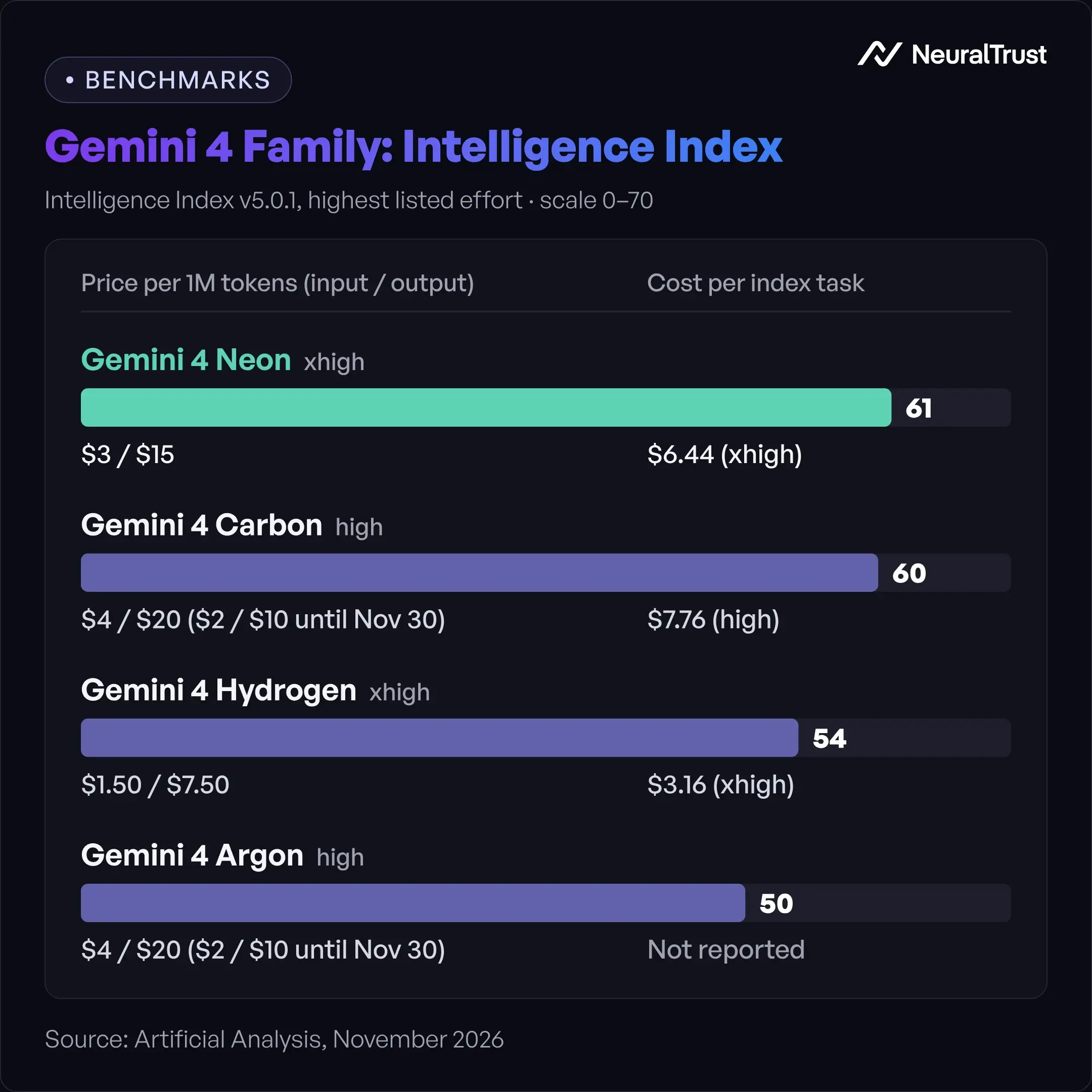
| Model | Intelligence Index | Output tokens, full index run | Price per 1M tokens (input / output) | Cost per index task |
|---|---|---|---|---|
| Gemini 4 Neon | 61 (xhigh), 60 (high, default) | 283M (xhigh), 123M (high) | $3 / $15 | $6.44 (xhigh) |
| Gemini 4 Carbon | 60 (high), 58 (medium, default) | 205M (high) | $4 / $20, or $2 / $10 until Nov 30 | $7.76 (high, standard price) |
| Gemini 4 Hydrogen | 54 (xhigh), 51 (high, default) | 304M (xhigh), 110M (high) | $1.50 / $7.50 | $3.16 (xhigh) |
| Gemini 4 Argon | 50 (high), 48 (medium, default) | 113M (high) | $4 / $20, or $2 / $10 until Nov 30 | Not reported |
Sources: Artificial Analysis (2026) and its model pages for Neon, Carbon, Argon and Hydrogen, index version 5.0.1. Prices come from 9to5Google (2026). Carbon scored 59 in Artificial Analysis's October launch article and 60 on its current model page, and the table uses the model page.
Google's launch tables add task-level scores. Neon leads Carbon on four of the six rows below and trails it on Agents' Last Exam and GraphWalks. It beats Hydrogen on every row where both appear.
| Benchmark | Neon | Carbon | Hydrogen | Argon | Figure from |
|---|---|---|---|---|---|
| Agents' Last Exam v1.1 | 75.8% | 77.4% | 71.6% | 69.0% | |
| AutomationBench | 56.3% | 53.9% | Not reported | 51.3% | Zapier |
| Vals Index | 70.9% | 70.4% | Not reported | 69.2% | Vals |
| Vending-Bench 2 (ending balance) | $16,843 | $16,484 | $14,549 | $13,718 | Andon Labs |
| Terminal-Bench Science | 70.5% | 64.8% | 51.4% | 52.9% | |
| GraphWalks BFS, 256K to 1M tokens | 95.2% | 96.2% | Not reported | 84.2% |
Sources: Google, AI Release Tracker and SmartScope (2026). The figures come from separate launch tables with different comparison targets, and SmartScope warns against lining up numbers from different tables, so treat gaps of a point or two as ties.
Google also says Neon cuts under-service by 43% to 56% and overreach by 15% to 35% against Carbon, depending on the thinking level. For agents with tool access, the overreach figure matters most. In short, Neon is the highest-scoring Gemini 4 model in this comparison and lists below Carbon's standard price. Carbon keeps an edge on long-context graph reasoning, and Hydrogen is the cheapest.
Gemini 4 Neon vs the best models on the market
Claude Fable 5.2 leads the Artificial Analysis Intelligence Index at 65, followed by GPT-6.2 Astra at 62 and Gemini 4 Neon at 61. Neon leads the Coding Agent Index at 59 and lists at a lower price per token than Fable 5.2 and Astra, but token use changes the cost per task.
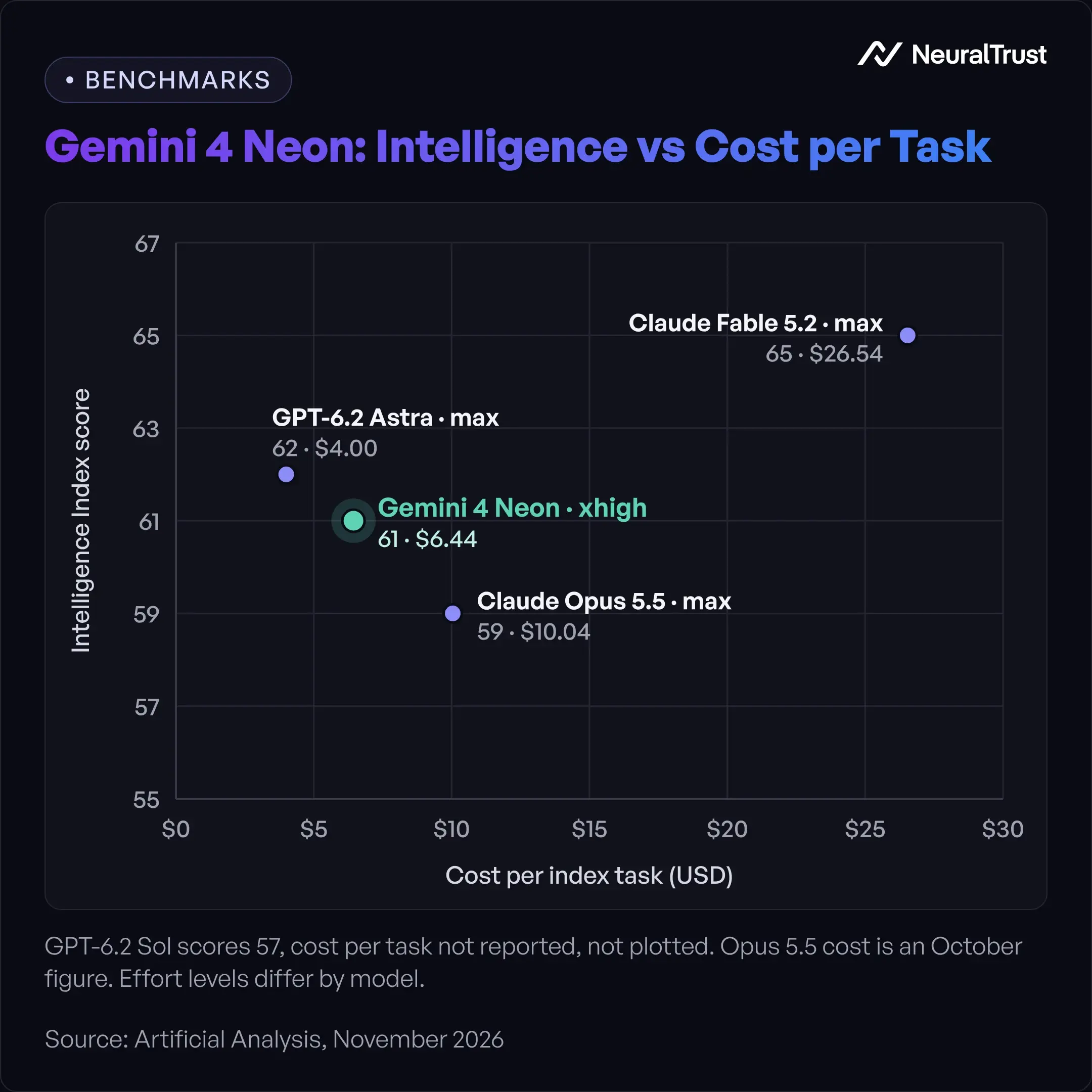
| Model | Intelligence Index | Coding Agent Index | Price per 1M tokens (input / output) | Cost per index task | Output tokens, full index run |
|---|---|---|---|---|---|
| Claude Fable 5.2 | 65 (max) | 58 (xhigh, Claude Code) | $8 / $40 | $26.54 (max) | 275M (max) |
| GPT-6.2 Astra | 62 (max) | Not reported | $8 / $40 | $4.00 (max) | 65.8M (max) |
| Gemini 4 Neon | 61 (xhigh) | 59 (xhigh, Antigravity CLI) | $3 / $15 | $6.44 (xhigh) | 283M (xhigh) |
| Claude Opus 5.5 | 59 (max) | 58 (max, Claude Code) | Not verified | $10.04 (max, October figure) | Not reported |
| GPT-6.2 Sol | 57 | Not reported | $2 / $10 | Not reported | Not reported |
Sources: Artificial Analysis pages for Claude Fable 5.2 and GPT-6.2 Astra, and its articles on Gemini 4 Neon, GPT-6.2 Astra and Sol and Gemini 4 Carbon, the last for the Opus 5.5 cost. The table is not like for like. Each score uses the model's highest listed effort, so Neon runs at xhigh while Fable 5.2 and Astra run at max. Cost per index task is Artificial Analysis's weighted cost for one task of the Intelligence Index. Coding Agent Index runs use each vendor's own agent tooling.
The numbers say three things. Fable 5.2 is the most capable and the most expensive, at $26.54 per index task, roughly four times Neon's $6.44. Astra scores one point above Neon and costs less to run at $4.00 per task. Its list price is $8 and $40, but it used 65.8 million output tokens against Neon's 283 million at xhigh. And Neon's one-point lead on the Coding Agent Index is small enough that you should confirm it on your own repositories.
At its default high setting Neon scores 60 and used 123 million output tokens, but Artificial Analysis does not publish a cost per task for that setting. Rank also depends on the count: Artificial Analysis's launch article places Neon third behind Astra and Fable 5.2, while its Neon model page lists it at #6 of 96 models.
At the task level, AI Release Tracker ranks Neon first on Vending-Bench 2 and RiemannBench and behind the leader on three other benchmarks.
| Benchmark | Gemini 4 Neon | Rank on AI Release Tracker | Top score on the tracker |
|---|---|---|---|
| Vending-Bench 2 (ending balance) | $16,843 | #1 | Gemini 4 Neon |
| RiemannBench | 84.0% | #1 | Gemini 4 Neon |
| FrontierCode 2.0 | 46.2% | #2 of 9 | Claude Fable 5.2, 49.1% |
| AutomationBench | 56.3% | #3 of 33 | DeepSeek-V4.1-Flash-1017, 60.5% |
| Terminal-Bench Science | 70.5% | #4 of 19 | GPT-6.2 Astra, 77.1% |
Source: AI Release Tracker. Rankings only count the models the tracker lists, and Google reports Neon first on AutomationBench.
Where Gemini 4 Neon trails
Neon does not lead everywhere. AlphaSignal (2026) reports that Claude Opus 5.5 scores slightly higher on Terminal-Bench 4.1 and FrontierCode 2.0, and Digital Trends reports GPT-6.2 Sol ahead on Chartography. On the Artificial Analysis Intelligence Index, Neon's 61 sits behind Claude Fable 5.2 at 65 and GPT-6.2 Astra at 62.
The same coverage notes that independent testing remains thin. Treat the launch table as Google's best case and rerun it on your own tasks.
Gemini 4 Neon: pricing and cost per task
Gemini 4 Neon costs $3 per million input tokens and $15 per million output tokens, with cached input at $0.15 per million, a 95% discount. There is no free API tier, and AI Release Tracker reports flat pricing across the full 1,048,576-token window, with no long-context surcharge.
| Model | Input per 1M | Output per 1M | Note |
|---|---|---|---|
| Gemini 4 Neon | $3.00 | $15.00 | Cached input $0.15 |
| Gemini 4 Hydrogen | $1.50 | $7.50 | Half the price of Neon |
| Gemini 4 Carbon and Argon | $2.00, then $4.00 | $10.00, then $20.00 | Introductory rate ends after November 30, 2026 |
Sources: 9to5Google (2026) and AlphaSignal (2026). Once the Carbon rate rises, Neon is 25% cheaper per token than Carbon. Until then it costs 50% more.
Here is what that means per request, using list prices. A request with 20,000 input tokens and 4,000 output tokens costs $0.12: $0.06 for input and $0.06 for output. If 15,000 of the input tokens come from cache, input falls to about $0.017 and the total to about $0.077. Thinking tokens bill as output, so reasoning-heavy requests cost more than this example.
Cost per task
Price per token is only half of the bill. Google says Neon at high costs 32% less per task than Carbon, and 50% to 80% less than leading frontier models on the Vals Index and Agent Arena. At xhigh, it claims at least 36% lower cost than rivals at their highest settings.
These are Google's figures, and the headline savings are measured at high while the top scores come from xhigh. Token use matters as much as list price. AlphaSignal (2026) relays that Artificial Analysis recorded about 200 million output tokens for Carbon in one full index run. The median across tested models was 64 million.
Where to use it and what to change
Neon is available on the paid Gemini API in Google AI Studio, in the Gemini app for AI Pro and Ultra subscribers, in Google Antigravity and through Gemini for business. According to AlphaSignal (2026), migration from Carbon or Argon needs a few changes:
- Use the model ID
gemini-4-neon, which defaults tohighand also supportsxhigh. - Remove
temperature,top_pandtop_k, because out-of-range values return HTTP 400. - Set client timeouts to at least 15 minutes, or use background execution.
- Use native function calling, because raw JSON tool calls can return
MALFORMED_FUNCTION_CALL.
Check these details against Google's API documentation before you change production code, since we could not open that page.
Gemini 4 Neon: security and governance
Google says Gemini 4 Neon keeps Gemini 4 Carbon-level protections against severe misuse and prompt injection, and reports 0.0% attack success on Gray Swan's indirect prompt injection benchmark at the highest thinking level. These are vendor results from one configuration. They do not replace controls around the agents you build on Neon.
| Safety measure | Result reported by Google |
|---|---|
| Gray Swan indirect prompt injection, attack success | 0.0% at the highest thinking level, with safeguards on |
| Agentic safety suite, misaligned action rate | 0.09% |
| Agent honesty evaluation, pass rate | 99.2% |
| Coding tasks where the model took shortcuts | 2.45%, the lowest of any Gemini 4 model |
| Cheating on Terminal-Bench 4.0 | 0.0%, matching Carbon |
| Refused tasks (over-refusal) | 1.98% on Terminal-Bench 4.0, 0% on Terminal-Bench Science |
Source: Google's launch post. We could not open the Gemini 4 Neon model card, so these figures come from the launch post and press coverage only.
Neon for cyber and the Fairwind Program
Google also announced a cyber variant, Neon for cyber, for secure code generation, vulnerability finding, exploit validation and patching. Access goes first to eligible members of the Fairwind Program, a program for trusted defenders, and Google asks interested customers to contact their Cloud account team.
The numbers are strong. Google reports 90.5% on SEC-bench Pro, 76% on the hard tier of AutoBaxBench, 70.7% on Collinear's CWE-bench v2 and 51.26% on WebExploitBench v1.2. AI Release Tracker adds that the SEC-bench Pro result was evaluated with safety filters off. The same skills that help defenders also help attackers, which is why Google limits this variant to vetted members.
What the benchmarks do not cover
According to Help Net Security (2026), the 2026 OWASP Top 10 for LLM Applications keeps Prompt Injection at number one and Sensitive Information Disclosure at number two. Excessive Agency rose to third place. The list drew on 75% expert votes and 25% incident data covering 6,639 real incidents.
That ranking matches how Neon is meant to be used. An orchestrator that directs parallel subagents holds more tools, more data access and more room to act than a chat model. A 0.0% score on one prompt injection benchmark says little about your own tools, your MCP servers or your data. Model-level safeguards are one layer, and enterprises need controls outside the model.
NeuralTrust is a Barcelona-based AI agent security company, and the table maps each risk to a control.
| Risk with a Neon-based agent | Control | NeuralTrust capability |
|---|---|---|
| Unapproved models, tools and MCP servers in use | Know which agents run and what they can reach | Agent Posture Management (TrustLens) |
| Prompt injection and data leakage in live traffic | Apply policy to every request and response | Agent Gateway (TrustGate) |
| Misuse or drift while the agent runs | Monitor agent behavior at runtime | Agent Runtime Security (TrustGuard) |
| Gaps that vendor benchmarks do not test | Test the agent against your own attack cases before launch | AI Red Teaming (TrustTest) |
These capabilities form NeuralTrust's Runtime Security Mesh.
Which should you choose?
Choose by workload and by risk, not by launch-day rank. Neon suits teams that want results close to Carbon at a lower cost per task, Hydrogen suits simple high-volume work, and Carbon suits the hardest projects. Google's figures need confirming on your own tasks first.
| If you are... | Consider | Why |
|---|---|---|
| A platform team running agent workflows at scale | Gemini 4 Neon at high | Google reports 32% lower cost per task than Carbon |
| Working on the hardest long-horizon engineering projects | Test Neon first, then Gemini 4 Carbon | Google positions Carbon for these projects, and reports comparable results from Neon at lower cost |
| Running high-volume, simple tasks or subagents | Gemini 4 Hydrogen | It costs $1.50 input and $7.50 output, half the price of Neon |
| Doing terminal and coding work where rivals lead | Compare Neon with Claude Opus 5.5 | Opus 5.5 scores slightly higher on Terminal-Bench 4.1 and FrontierCode 2.0 |
| Deploying in a regulated or security-sensitive setting | Any model, with controls outside it | A gateway, runtime monitoring and posture checks apply whichever model you pick |
Conclusion
Gemini 4 Neon gives Google a mid-priced Gemini 4 model with a 1 million token context window and strong agent and coding scores. Its price of $3 and $15 per million tokens sits above Hydrogen and, after November 30, below Carbon, and Google's 32% cost-per-task claim is worth testing. Most evidence is vendor-reported, so run your own evaluation. Whichever model you choose, treat its safety results as one layer and add controls around the agent.
Secure Gemini 4 Neon Agents in Production with NeuralTrust
Put policy, monitoring and testing around every agent you build on a new model, from day one.
Related Comparisons
- Gemini 4 Neon vs Claude Opus 5.5: AI gateway routing and fallback
- Gemini 4 Hydrogen: Benchmarks, Pricing and Security
- Claude Opus 5.5 enterprise security: what the built-in safeguards cover
- GPT-6 Astra: what every CISO needs to know
FAQs about Gemini 4 Neon
1. What is Gemini 4 Neon?
Gemini 4 Neon is a Google model released on November 18, 2026. It sits between Gemini 4 Carbon and Gemini 4 Hydrogen and targets complex coding, analytical reasoning and enterprise workflows. It has a 1 million token context window. You can use it through the paid Gemini API, the Gemini app for AI Pro and Ultra subscribers, Google Antigravity and Gemini for business.
2. How much does Gemini 4 Neon cost?
Gemini 4 Neon costs $3 per million input tokens and $15 per million output tokens. Cached input costs $0.15 per million tokens. There is no free API tier, and thinking tokens bill as output. That is twice the price of Gemini 4 Hydrogen and 25% less than Carbon once its introductory rate ends after November 30, 2026.
3. Is Gemini 4 Neon better than Claude Opus 5.5 and GPT-6.2 Sol?
It depends on the task. Google reports Neon at 61 on the Artificial Analysis Intelligence Index, ahead of Opus 5.5 at 59 and GPT-6.2 Sol at 57, according to Digital Trends. Opus 5.5 scores slightly higher on Terminal-Bench 4.1 and FrontierCode 2.0. Most figures are vendor-reported, so test on your own workload.
4. What context window does Gemini 4 Neon have?
Gemini 4 Neon has a context window of 1 million tokens, which AI Release Tracker gives as 1,048,576 tokens. Pricing is flat across the whole window, with no long-context surcharge. The Decoder also reports an output limit of up to one million tokens, a figure we could not confirm in Google's own documentation.
5. Is Gemini 4 Neon secure against prompt injection?
Google reports 0.0% attack success on Gray Swan's indirect prompt injection benchmark at the highest thinking level, with real-time safeguards on. That is one benchmark in one configuration. Your own tools, MCP servers and data create risks the benchmark does not test, so add a gateway and runtime monitoring around the agent.
6. What is the Fairwind Program?
The Fairwind Program is Google's program for trusted defenders. Eligible members receive access to Neon for cyber, a variant for secure code generation, vulnerability finding, exploit validation and patching. Google says members will get access over the following days and asks interested customers to contact their Cloud account team.
7. Can I use Gemini 4 Neon for free?
No. Gemini 4 Neon has no free API tier, so the Gemini API needs the paid tier. Google AI Pro and Ultra subscribers can use it in the Gemini app, Google AI Studio and Google Antigravity. Google has not said whether free Gemini app users will get Neon.
About the Author
Roger Howroyd is Head of Global SEO and AI at NeuralTrust, where he leads the company's search strategy across SEO, AEO, GEO, and LLM optimization. He specializes in AI-powered search, content strategy, and SEM. Connect on LinkedIn.
NeuralTrust is the leading platform for securing and scaling AI agents. Named a Pioneer in the Gartner Emerging Market Quadrant for AI Application Security 2026, recognized across four Gartner Hype Cycle reports in 2026, and featured in the Gartner Market Guide for Guardian Agents 2026, the Gartner Market Guide for AI Gateways 2025 and the KuppingerCole Leadership Compass for Generative AI Defense 2025. Headquartered in Barcelona with offices in London and New York. ISO 27001 certified.
Sources
- Google, "Introducing Gemini 4 Neon," November 18, 2026: https://blog.google/innovation-and-ai/models-and-research/gemini-models/introducing-gemini-4-neon/
- Google Antigravity, "Gemini 4 Neon in Google Antigravity," November 18, 2026: https://antigravity.google/blog/gemini-4-neon-in-google-antigravity/
- AI Release Tracker, "Gemini 4 Neon," accessed November 19, 2026: https://aireleasetracker.com/model/google/gemini-4-neon
- 9to5Google, "Google launches Gemini 4 Neon," November 18, 2026: https://9to5google.com/2026/11/18/gemini-4-neon-announcement/
- Digital Trends, "Google says Gemini 4 Neon can hang with Claude Opus 5.5 and GPT-6.2 Sol for less," November 18, 2026: https://www.digitaltrends.com/computing/google-says-gemini-4-neon-can-hang-with-claude-opus-5-5-and-gpt-6-2-sol-for-less/
- The Decoder, "Google ships Gemini 4 Neon, its fourth new Gemini model in a month," November 18, 2026: https://the-decoder.com/google-ships-gemini-4-neon-its-fourth-new-gemini-model-in-a-month/
- AlphaSignal, "Google DeepMind's Gemini 4 Neon targets complex agent workflows at 61 intelligence score," November 2026: https://alphasignal.ai/news/google-deepmind-s-gemini-4-neon-targets-complex-agent-workflows-at-61
- Artificial Analysis, "Gemini 4 Neon intelligence gain," November 18, 2026, and its model pages for Gemini 4 Neon, Carbon, Argon, Hydrogen, Claude Fable 5.2 and GPT-6.2 Astra: https://artificialanalysis.ai/articles/gemini-4-neon-intelligence-gain
- Help Net Security, "OWASP 2026 LLM Top 10," August 6, 2026: https://www.helpnetsecurity.com/2026/08/06/owasp-2026-llm-top-10-released/
- SmartScope, comparison of Gemini 4 Hydrogen, Argon and Carbon, November 13, 2026: https://smartscope.blog/en/blog/gemini-4-hydrogen-vs-argon-vs-carbon-differences-2026/