Last updated: November 19, 2026
A support agent sends its hardest ticket of the day to Claude Opus 5.5 at max effort, then waits more than five and a half minutes for the first token. So what does Gemini 4 Neon vs Claude Opus 5.5 mean for your routing? Both models are strong enough for serious agent work. The real decisions sit in your gateway: which effort tier gets which request, what a timeout means, and where traffic goes when a model fails.
TL;DR: Key Takeaways
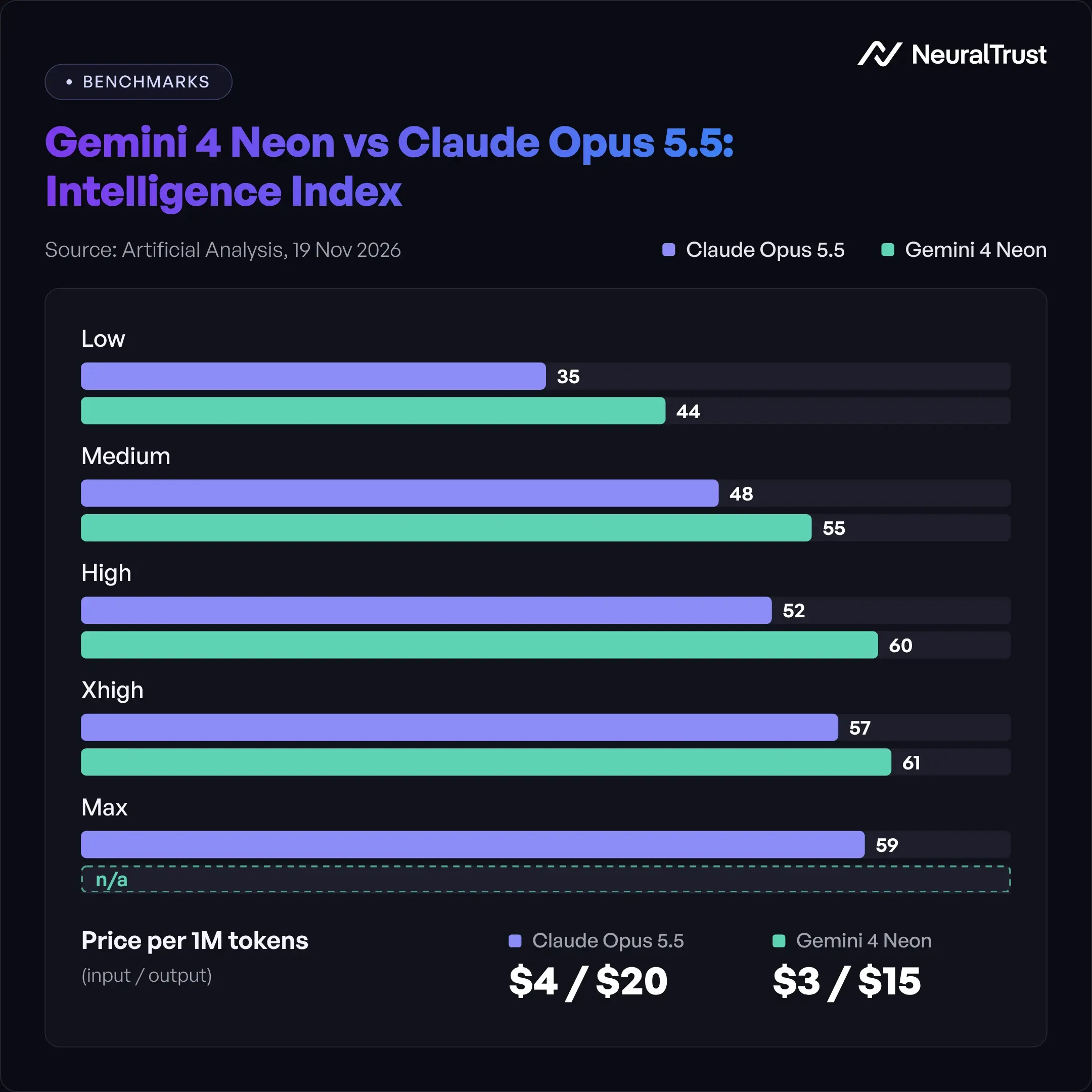
- Intelligence is close: Gemini 4 Neon (xhigh) scores 61 on the Artificial Analysis Intelligence Index, against 59 for Claude Opus 5.5 (max) (Artificial Analysis, 2026).
- Opus 5.5 lists a third higher: Neon costs $3 per 1M input tokens and $15 per 1M output tokens, against $4 and $20 for Opus 5.5 (Artificial Analysis, 2026).
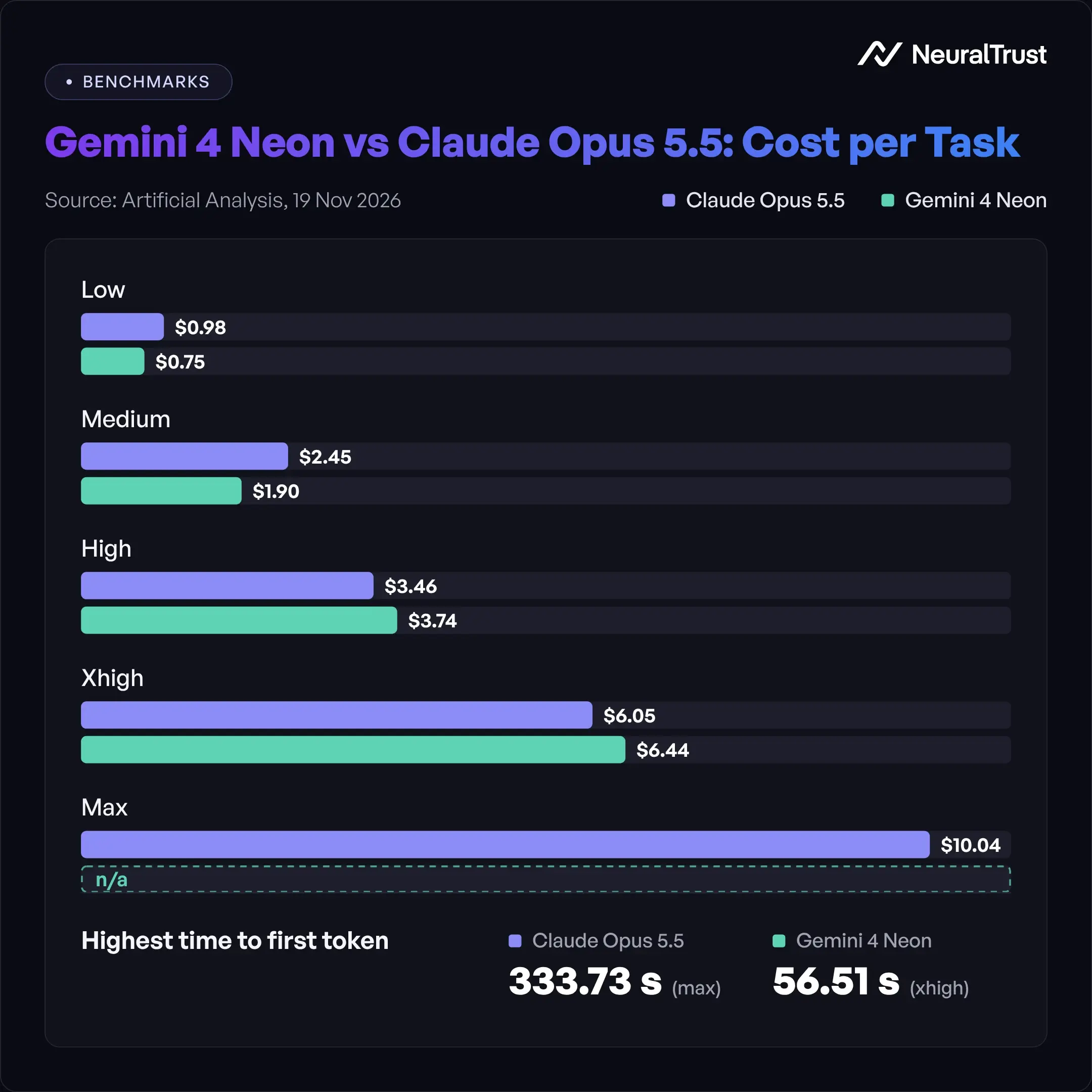
- Latency swings by tier: Opus 5.5 at max effort took 333.73 seconds to first token, while Opus 5.5 at low effort took 4.93 seconds (Artificial Analysis, 2026).
- Inputs are not symmetric: both have a 1M token context window, but only Neon accepts speech and video alongside text and images (Artificial Analysis, 2026).
- More modalities, more injection paths: OWASP's LLM01:2025 lists multimodal injection, such as instructions hidden in an image, as a prompt injection scenario (OWASP, 2025).
At a glance: Gemini 4 Neon vs Claude Opus 5.5 for routing
Quick Answer
What does Gemini 4 Neon vs Claude Opus 5.5 mean for AI gateway routing?
Treat the two releases as nine routing targets, not two models. Neon's tiers cost less per task and reach the top score. Opus 5.5 low answers fastest. Opus 5.5 max is slow to start, so your timeouts and fallback rules need to know which tier they are protecting.
| Metric (Artificial Analysis) | Gemini 4 Neon | Claude Opus 5.5 | What it means for routing |
|---|---|---|---|
| Best Intelligence Index | 61 (xhigh) | 59 (max) | Near tie at the top |
| Input / output per 1M tokens | $3 / $15 | $4 / $20 | Fallback from Neon to Opus raises unit price |
| Lowest time to first token | 13.93 s (low) | 4.93 s (low) | Opus low suits interactive traffic |
| Highest time to first token | 56.51 s (xhigh) | 333.73 s (max) | Timeouts must be set per tier |
| Context window | 1M | 1M | No context-based routing needed |
| Input modalities | Text, image, speech, video | Text, image | Audio and video cannot fall back to Opus |
How we compared
We used only the Artificial Analysis comparison page, read on November 19, 2026. Gemini 4 Neon launched on November 18, 2026, and Claude Opus 5.5 on September 22, 2026. Its speed and latency figures average the past five days of runs, so they will move. Every routing estimate below is our arithmetic from that page.
What the benchmark page actually shows
The page compares four Neon effort tiers with five Opus 5.5 tiers on one index, one cost model, and one latency method. That shared method is what makes it useful for routing, because every tier is measured the same way on one page.
Artificial Analysis builds its Intelligence Index v5.0.1 from nine evaluations, including Terminal-Bench 4.0 and AA-Briefcase v1.1. For vendor-reported tables, see our Gemini 4 Argon vs Claude Opus 5.5 comparison and our Opus 5.5 vs Gemini benchmark review. Here, the tiers matter more than the winner.
| Tier | Intelligence Index | Cost per task | Time per task | Time to first token |
|---|---|---|---|---|
| Neon xhigh | 61 | $6.44 | 21.5 min | 56.51 s |
| Neon high | 60 | $3.74 | 14.8 min | 40.64 s |
| Opus 5.5 max | 59 | $10.04 | 25.2 min | 333.73 s |
| Opus 5.5 xhigh | 57 | $6.05 | 16.2 min | 57.57 s |
| Neon medium | 55 | $1.90 | 8.3 min | 20.14 s |
| Opus 5.5 high | 52 | $3.46 | 9.4 min | 19.45 s |
| Opus 5.5 medium | 48 | $2.45 | 7.0 min | 13.00 s |
| Neon low | 44 | $0.75 | 3.7 min | 13.93 s |
| Opus 5.5 low | 35 | $0.98 | 3.1 min | 4.93 s |
Routing by cost: where each tier earns its slot
Cost-based routing works when you can price a request before you send it. On this page, Neon high scores 60 for $3.74 per task, while Opus 5.5 max scores 59 for $10.04. Neon low costs $0.75 per task, so Neon sets the bulk price floor.
Opus 5.5 still earns a place. Its tiers are close behind on the index, and a second provider matters when the first one degrades. If a request moves from Neon to Opus 5.5, input and output prices both rise by a third at list price. Cache hits rise from $0.15 to $0.20 per 1M tokens.
According to Artificial Analysis (2026), cost per task is a weighted average of input, cache, reasoning, and answer token prices. That makes it a better routing input than the list price alone. Our LLM model routing guide covers how to classify requests before they reach a model.
Routing by latency: time to first token is a policy input
Latency routing decides which tier may serve a user who is waiting. Artificial Analysis (2026) reported that Opus 5.5 low reached the first token in 4.93 seconds and finished tasks in 3.1 minutes, the fastest on the page. Opus 5.5 max took 333.73 seconds to first token. Those two tiers need different timeouts.
This is where fallback rules break quietly. Picture a single 60-second timeout across all tiers. At the measured 333.73 seconds, Opus 5.5 max requests would trip it before the model starts answering, so the gateway would retry or fail over by default. You would pay for the abandoned call and then pay again for the backup. Neon xhigh, at 56.51 seconds, sits just under that line.
Set timeouts per model and per tier, and tag each request with the tier the agent asked for. Route interactive traffic to tiers with short time to first token. Keep max-effort tiers for queued or background jobs.
Fallback rules for Gemini 4 Neon vs Claude Opus 5.5
A fallback rule says where a request goes when its model fails, times out, or hits a limit. With these two models, the backup is not a drop-in copy. Prices, latency, and accepted inputs all differ, so each rule needs a check for cost, modality, and timeout before traffic moves.
| Failure case | Naive fallback | Better rule |
|---|---|---|
| Neon times out on a text request | Send it to Opus 5.5 max | Send it to a tier with a similar time to first token |
| Neon fails on an audio or video request | Send it to Opus 5.5 | Queue it or route it to another speech-capable model |
| Opus 5.5 hits a rate limit | Retry Opus 5.5 at once | Retry with backoff, then move to Neon at a matching tier |
| Budget nearly spent | Keep falling back | Fall back to a cheaper tier or pause the agent |
Modality is the trap most teams miss. Opus 5.5 accepts text and images, while Neon also takes speech and video. A voice agent built on Neon has no like-for-like backup in this pair. Check our guide to Claude outages and fallback for the outage side of the plan.
Security and governance: the multimodal attack surface and per-model traces
Routing changes which model reads a payload, so security cannot live inside one model's safeguards. According to OWASP (2025), multimodal AI "introduces unique prompt injection risks," because attackers can hide instructions in images that accompany benign text. Speech and video add more hiding places.
Three risks rise with multi-model routing:
- Prompt injection that follows the request: a poisoned image or audio clip reaches whichever model the router picks, so inspection has to run before routing.
- Cost abuse: the OWASP GenAI Security Project (2025) states that Denial of Wallet attacks use high request volumes to exploit pay-per-use pricing (LLM10:2025). Fallback loops can do the same damage from the inside.
- The gateway as a target: Amazon Threat Intelligence (2026) reported AI agents hunting exposed LLM gateways and proxies to pull the provider keys they hold (Amazon, 2026).
Traceability closes the loop. When a request fails over, you need to know which model served it, why it switched, and what the agent did next.
NeuralTrust approaches this in layers. Through Agent Gateway (TrustGate), you route by model, cost, latency, or policy, with automatic failover across providers. The AI API failover page notes that every retry and fallback is logged with the original provider, the triggering error, the backup, and the timing. With Agent Runtime Security (TrustGuard), you set rules on inputs and outputs and enforce each decision inline. Agent Posture Management (TrustLens) maps agents, models, tools, and identities, and records every prompt and tool call.
Which should you choose?
Choose by workload, not by leaderboard rank. The scores are two points apart at the top, while cost per task, time to first token, and inputs differ far more. Many teams will use both and let the gateway decide per request.
| Workload | Primary route | Fallback route |
|---|---|---|
| Interactive chat and support | Opus 5.5 low or medium | Neon low |
| Bulk document and back-office tasks | Neon medium | Opus 5.5 high |
| Hardest reasoning, queued jobs | Neon xhigh | Opus 5.5 max, with a long timeout |
| Voice or video agents | Neon | Queue, or another speech-capable model |
| Strict budget caps | Neon low | Pause the agent when the cap hits |
Conclusion
Gemini 4 Neon vs Claude Opus 5.5 is a close race on intelligence and a wide one on price, latency, and inputs. That makes it a routing question more than a model choice. Set timeouts per tier, make fallback rules modality-aware, price every backup path, and inspect inputs before the router picks a model. Then log every switch, so you can see which model handled each request.
Secure Multi-Model Routing in Production with NeuralTrust
Route every model call through TrustGate, inspect it with TrustGuard, and keep tabs on every agent on NeuralTrust.
Related Comparisons
- Gemini 4 Argon vs Claude Opus 5.5
- Claude vs Gemini: Opus 5.5 Benchmarks
- Claude Opus 5.5 vs GPT-6 Sol: Benchmarks
- Gemini 4 Argon vs GPT-6 Astra
FAQs about Gemini 4 Neon vs Claude Opus 5.5
1. Is Gemini 4 Neon better than Claude Opus 5.5?
On the Artificial Analysis Intelligence Index, Gemini 4 Neon at xhigh effort scores 61 and Claude Opus 5.5 at max effort scores 59. Neon also costs less per task on that page. Opus 5.5 at low effort is the fastest tier to first token. Which is better depends on the workload you route to it.
2. How much do Gemini 4 Neon and Claude Opus 5.5 cost?
Artificial Analysis lists Gemini 4 Neon at $3 per 1M input tokens and $15 per 1M output tokens. Claude Opus 5.5 is listed at $4 and $20. Cost per task ranges from $0.75 for Neon low to $10.04 for Opus 5.5 max, because effort tiers use different token volumes.
3. Why is Claude Opus 5.5 max so slow to respond?
Artificial Analysis measured 333.73 seconds to first token for Claude Opus 5.5 at max effort, against 4.93 seconds at low effort. Higher effort tiers spend more time before the first answer token. For routing, keep max effort for queued jobs and give it its own, longer timeout.
4. What is LLM fallback?
LLM fallback sends a request to a backup model or provider when the primary one fails, times out, or hits a limit. In a gateway, you configure it once as an ordered list of backups. Good fallback rules also check cost, latency, and input type before they move traffic to another model.
5. Can Claude Opus 5.5 process audio or video?
According to the Artificial Analysis comparison page, Claude Opus 5.5 accepts text and images as input, while Gemini 4 Neon accepts text, images, speech, and video. Both output text. A voice or video agent on Neon therefore cannot fail over to Opus 5.5 without changing how it handles the input.
6. Do both models have the same context window?
Yes. Artificial Analysis lists a 1M token context window for every Gemini 4 Neon and Claude Opus 5.5 tier it compares. Context length is therefore not a reason to route between them. Price, latency, and input type are the factors that separate the two in a routing policy.
About the Author
Roger Howroyd is Head of Global SEO and AI at NeuralTrust, where he leads the company's search strategy across SEO, AEO, GEO, and LLM optimization. He specializes in AI-powered search, content strategy, and SEM. Connect on LinkedIn.
NeuralTrust is the leading platform for securing and scaling AI agents. Named a Pioneer in the Gartner Emerging Market Quadrant for AI Application Security 2026, recognized across four Gartner Hype Cycle reports in 2026, and featured in the Gartner Market Guide for Guardian Agents 2026, the Gartner Market Guide for AI Gateways 2025 and the KuppingerCole Leadership Compass for Generative AI Defense 2025. Headquartered in Barcelona with offices in London and New York. ISO 27001 certified.
Sources
- Artificial Analysis, "Gemini 4 Neon vs Claude Opus 5.5: Release Comparison," accessed November 19, 2026. https://artificialanalysis.ai/models/comparisons/gemini-4-neon-vs-claude-opus-5-5
- OWASP GenAI Security Project, "LLM01:2025 Prompt Injection," 2025. https://genai.owasp.org/llmrisk/llm01-prompt-injection/
- OWASP GenAI Security Project, "LLM10:2025 Unbounded Consumption," 2025. https://genai.owasp.org/llmrisk/llm102025-unbounded-consumption/
- Amazon Threat Intelligence, "Amazon Threat Intelligence observes threat actors running cybercrime campaigns with ARTEX AI agents," AWS Security Blog, November 13, 2026. https://aws.amazon.com/blogs/security/amazon-threat-intelligence-observes-threat-actors-running-cybercrime-campaigns-with-artex-ai-agents/