Last updated: November 20, 2026
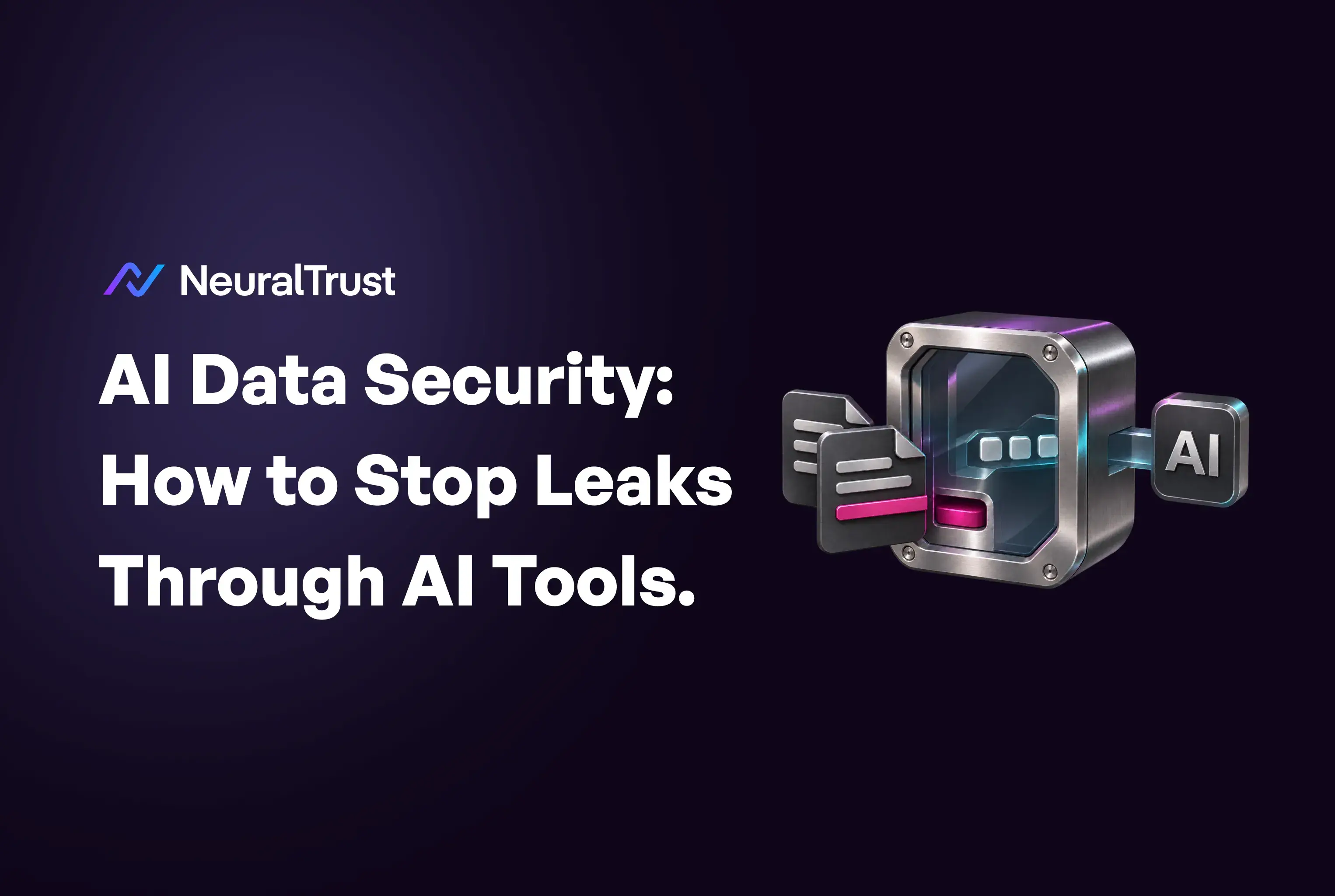
What is AI data security? AI data security is the set of controls that stop sensitive data from leaking through AI tools, models and agents. It covers what employees paste into chatbots, what applications send to model providers and what agents retrieve and return. In a 2026 survey, 47% of security leaders reported sensitive data exposure through an AI tool, and most of those incidents involved an approved one.
TL;DR: Key Takeaways
- Exposure: 47% of security leaders have had sensitive data exposed through an AI tool, and 77% of those incidents involved a company-approved tool, according to Infosecurity Magazine (2026) reporting BlackFog research.
- Policy gap: 98% have an AI usage policy, but only 56% back it with comprehensive technical controls, and 35% have a written policy with no technical enforcement (Infosecurity Magazine).
- Shadow AI: it figured in 43% of security incidents in IBM's 2026 breach study, more than double the previous share, according to Help Net Security (2026).
- Access controls: 92% of the organizations hit through an AI system lacked role-based access, multi-factor authentication and similar controls (Help Net Security).
- Personal accounts: 45% of employees are regular AI users on corporate devices, up from 15% in 2024, and 67% of them use non-corporate accounts, according to the Verizon 2026 DBIR as summarized by TechTarget (2026).
- Standard: Sensitive Information Disclosure holds second place in the 2026 OWASP Top 10 for LLM Applications, and its scope now includes logs, embeddings and retrieval permissions (CSA (2026)).
AI data security at a glance
Data leaves through five main paths: employee prompts, approved assistants with too much access, application traffic to model providers, agent tool calls, and the logs and stores that keep copies. Each path needs a different control, which is why one policy document is not enough.
| Leak path | Example | Main control |
|---|---|---|
| Employee prompts | Pasting source code or customer records into a chatbot | Inspect and redact at the point of use |
| Approved assistants with broad access | An assistant that surfaces files the asking user should not see | Least-privilege access and permission-aware retrieval |
| Application traffic to model providers | An app that sends personal data inside prompts | Masking and policy at a gateway |
| Agent tool calls | An agent that copies records into an external system | Scoped credentials, tool allowlists and approval for sensitive actions |
| Logs, embeddings and memory | Prompts and tool results kept in logs or a vector store | Retention limits and access control on every store |
Source: CSA (2026) on the 2026 OWASP scope for sensitive information disclosure. The examples are ours.
How data leaks through AI tools
Leaks rarely look like attacks. Most start as ordinary work: someone pastes a contract into a chatbot, an assistant answers from a folder it should not have reached, or an agent logs a customer record while doing its job. The data leaves through normal paths that existing controls were not built to watch.
Start with the user. A person who wants a quick summary has no reason to think about where the text goes. The risk grows when the tool is personal. According to TechTarget (2026), 67% of regular AI users still rely on non-corporate accounts on corporate devices, so the company has no contract, no retention terms and no logs.
Then look at the application. A support bot, a coding assistant or an internal search tool sends text to a model provider on every request. If that text contains personal data or secrets, the provider receives them unless something strips them first.
Agents add a third layer. An agent holds credentials, calls tools and writes results somewhere. The OWASP 2026 list moved Excessive Agency up to third place, according to Help Net Security (2026), and the overlap with data leakage is direct: an agent with broad access can move data far faster than a person can.
AI data security statistics for 2026
The 2026 figures point the same way. Exposure is common, policies are nearly universal, and technical enforcement lags. Four sources give the clearest picture, and they come from vendors or vendor-commissioned research, so read them as indicators rather than audited counts.
| Finding | Figure | Published by |
|---|---|---|
| Security leaders with a sensitive data exposure through an AI tool | 47% | BlackFog research, via Infosecurity Magazine |
| Exposures that involved a company-approved tool | 77% | Same source |
| Organizations with an AI usage policy | 98% | Same source |
| Organizations with a formal AI policy | 37% | Darktrace, via CSA |
| Organizations with comprehensive technical controls | 56% | BlackFog research, via Infosecurity Magazine |
| Organizations that can provide any record of the data types sent to AI tools | 48% | Same source |
| Security incidents that involved shadow AI | 43% | IBM, via Help Net Security |
| Organizations hit through an AI system that lacked access controls | 92% | IBM, via Help Net Security |
| Regular AI users on corporate devices, up from 15% in 2024 | 45% | Verizon DBIR, via TechTarget |
| Regular AI users on non-corporate accounts | 67% | Same source |
How we compared
We did not run these surveys. We collected figures from published coverage and listed who published each. The BlackFog research surveyed 400 security decision makers at companies with more than 500 employees in the UK and the US. IBM's study covers 602 organizations that had a breach between March 2025 and February 2026, according to Cybersecurity Dive (2026).
The sources do not agree on policy coverage. BlackFog reports 98% with an AI usage policy, while Darktrace reports 37% with a formal one. The questions and samples differ, so do not average them. The conclusion that holds in both is that a policy on paper is not the same as control in practice.
Why approved tools leak too
Approved tools leak because they inherit the access of the people and agents that use them. In the BlackFog research, 77% of the exposures involved an approved tool, according to Infosecurity Magazine (2026). Blocking shadow AI does not close that gap.
Three mechanisms explain most of it. First, an assistant answers from whatever its connectors can reach. If retrieval runs under a shared, overprivileged identity, the assistant can return data the asking user should not see. The 2026 OWASP text treats this retrieval authorization failure as part of Sensitive Information Disclosure, according to CSA (2026).
Second, copies accumulate. The same source notes that sensitive data can leave through tool-call records, logs and embeddings, not only through the model's answer. A tool that is safe in its answers can still keep a readable copy of everything it saw.
Third, agents sit outside most controls. In the BlackFog research, 56% of respondents said autonomous agents acting for employees fall outside their existing controls. Only 48% could provide any record of the data types that left through AI tools.
AI data security controls that work
Effective AI data security combines six controls: discovery, classification, enforcement at the point of use, limited retrieval, logging and testing. None of them works alone, and each answers a specific gap visible in the 2026 data.
| Control | What it stops | Gap in the 2026 data |
|---|---|---|
| Discover | Unknown tools, accounts and agents | Only 62% can identify the users or departments sending data to AI tools |
| Classify and set policy | Staff guessing what is allowed | 35% have a written policy with no technical enforcement |
| Enforce at the point of use | Sensitive data in prompts and responses | Only 54% can block or restrict unsanctioned tools |
| Limit retrieval | Assistants and agents reading too much | 92% of organizations hit through AI lacked access controls |
| Log and set retention | Blind spots and unmanaged copies | Only 48% can provide any record of data types sent |
| Test | Leaks you have not found yet | No figure; red teaming is the only way to find them before an attacker |
Sources: Infosecurity Magazine (2026) for the BlackFog figures and Help Net Security (2026) for IBM.
Discover what is in use
You cannot protect traffic you cannot see. Start with an inventory of AI tools, browser extensions, connectors, MCP servers and agents, along with who uses them and what data they reach. According to Help Net Security (2026), roughly seven in ten breached organizations lacked governance for spotting unapproved AI use.
Classify data and write a policy people can follow
Name the data that must never leave: customer records, credentials, source code, unreleased financials. Then say which tools may handle which class. A rule that staff can apply in five seconds beats a 20-page policy. Our guide to shadow AI covers the governance side in more detail.
Enforce at the point of use
Policy needs a technical anchor. Inspect prompts and responses where they pass between your users or applications and the model, and redact or block what the policy forbids. A gateway gives you one place to do it for every provider, instead of one setting per tool.
Limit what assistants and agents can retrieve
Give each assistant and agent its own identity and the least access it needs. Evaluate access by the agent's identity and, where it acts for a person, by that person's rights. Only about two in five organizations apply access controls to AI models and data, according to Help Net Security (2026).
Log, monitor and set retention
Record which tool saw which class of data, and for how long you keep prompts, tool results and embeddings. Logs are evidence for audits and for incident response, and they are also a store of sensitive data, so control access to them.
Test before attackers do
Try to extract data from your own assistants and agents with hostile prompts, poisoned documents and over-broad queries. Run the tests before launch and again after every change to a model, a connector or a permission.
AI data security: security and governance
AI data security maps directly to the 2026 OWASP Top 10 for LLM Applications. Sensitive Information Disclosure sits at second place and Excessive Agency at third, according to Help Net Security (2026). The first is about what leaves, and the second is about how much an agent can reach.
The OWASP list drew 75% of its weight from expert votes and 25% from incident data, according to CSA (2026). Its framing is a shift from protecting the conversation to containing the consequences. For data security, that means limiting access and watching behavior, not only filtering prompts. Our OWASP Top 10 for LLM Applications 2026 guide covers the full list.
NeuralTrust is a Barcelona-based AI agent security company, and the table maps each leak path to a control.
| Leak path | Control | NeuralTrust capability |
|---|---|---|
| Unknown AI tools, models and agents | Inventory what runs and what it can reach | Agent Posture Management (TrustLens) |
| Sensitive data in prompts and responses | Apply policy and redaction to every request | Agent Gateway (TrustGate) and NeuralTrust's Data Loss Prevention |
| Agents moving data beyond their task | Monitor behavior as the agent runs | Agent Runtime Security (TrustGuard) |
| Leaks in RAG and agent workflows | Test with your own attack cases before launch | AI Red Teaming (TrustTest) |
These capabilities form NeuralTrust's Runtime Security Mesh.
Which should you choose?
Choose the first control by your biggest blind spot, not by the product category you already own. The 2026 data suggests most teams have the policy and lack the enforcement, so start where evidence is thinnest.
| If you are... | Start with | Why |
|---|---|---|
| Unsure which AI tools your staff use | Discovery and inventory | Only 62% can identify who sends data to AI tools |
| Holding a policy that nobody enforces | Enforcement at a gateway | 35% have a policy without technical controls |
| Running an internal assistant or RAG | Retrieval permissions | The 2026 OWASP scope covers retrieval authorization failures |
| Deploying agents with tool access | Scoped credentials and runtime monitoring | Excessive Agency is third on the 2026 OWASP list |
| Preparing for an audit | Logging and retention | Only 48% can provide a record of the data types sent |
Conclusion
AI data security comes down to closing the gap between policy and control. The 2026 evidence shows that exposure is common, approved tools are involved in most incidents and agents sit outside many existing controls. Discover what runs, enforce policy where data passes, limit what assistants and agents can retrieve, and test the result. Treat survey numbers as direction, and measure your own exposure.
Secure Your AI Tools and Agents in Production with NeuralTrust
Put policy, monitoring and testing around every AI tool and agent that touches your data, from day one.
Related Reading
- OWASP Top 10 for LLM Applications 2026
- Shadow AI: What It Is, Why It's Dangerous, and How to Stop It
- Microsoft 365 Copilot Security: NeuralTrust Integration
FAQs about AI Data Security
1. What is AI data security?
AI data security is the set of controls that keep sensitive data from leaking through AI tools, models and agents. It covers prompts, model provider traffic, retrieval, agent tool calls, and the logs and embeddings that store copies. It combines discovery, policy, enforcement, access control, monitoring and testing.
2. How does data leak through AI tools?
Data leaks through employee prompts, assistants with excessive access, application traffic to model providers, agent tool calls and stored logs or embeddings. Most leaks start as normal work, not attacks. In one 2026 survey, 47% of security leaders reported a sensitive data exposure through an AI tool.
3. Are approved AI tools safe?
Not automatically. In the BlackFog research reported by Infosecurity Magazine, 77% of exposures involved a company-approved tool. Approved tools inherit the access of their users and connectors, so a tool can be approved and still return data the user should not see.
4. What is shadow AI?
Shadow AI is the use of AI tools that the organization has not approved, often through personal accounts. According to Verizon's 2026 DBIR as summarized by TechTarget, 67% of regular AI users rely on non-corporate accounts on corporate devices. IBM found shadow AI in 43% of incidents.
5. Does DLP stop data leaks through AI tools?
Only if it sees AI traffic. Many DLP tools were designed for files, email and endpoints, so check whether yours inspects prompts, browser sessions and agent tool calls. Add inspection where prompts leave your environment and where agents retrieve data.
6. How do you protect data in RAG and agents?
Give each agent its own identity, limit its access to what the task needs and evaluate retrieval by the rights of the person it acts for. Keep logs and embeddings under access control, and test with hostile prompts. The 2026 OWASP guidance treats retrieval authorization as part of data disclosure risk.
7. What does OWASP say about AI data leakage?
The 2026 OWASP Top 10 for LLM Applications ranks Sensitive Information Disclosure second. According to CSA, its scope covers tool-call records, logs and embeddings, plus retrieval authorization failures. Excessive Agency, which covers agents with too much reach, sits third.
About the Author
Roger Howroyd is Head of Global SEO and AI at NeuralTrust, where he leads the company's search strategy across SEO, AEO, GEO, and LLM optimization. He specializes in AI-powered search, content strategy, and SEM. Connect on LinkedIn.
NeuralTrust is the leading platform for securing and scaling AI agents. Named a Pioneer in the Gartner Emerging Market Quadrant for AI Application Security 2026, recognized across four Gartner Hype Cycle reports in 2026, and featured in the Gartner Market Guide for Guardian Agents 2026, the Gartner Market Guide for AI Gateways 2025 and the KuppingerCole Leadership Compass for Generative AI Defense 2025. Headquartered in Barcelona with offices in London and New York. ISO 27001 certified.
Sources
- Infosecurity Magazine, "Half of Security Leaders Report Sensitive Data Exposure Through AI Tools," 2026 (reporting BlackFog research): https://infosecurity-magazine.com/news/security-data-exposure-ai
- Help Net Security, "Data breach cost 2026 averaged $4.99 million, AI attacks ran higher," July 30, 2026 (IBM Cost of a Data Breach 2026): https://www.helpnetsecurity.com/2026/07/30/ibm-cost-of-a-data-breach-2026/
- Cybersecurity Dive, "Data breach costs and AI governance," July 29, 2026 (IBM Cost of a Data Breach 2026): https://www.cybersecuritydive.com/news/data-breach-costs-ai-governance-ibm/826463/
- TechTarget, "Verizon 2026 DBIR: 6 key takeaways for CISOs," May 22, 2026: https://www.techtarget.com/cybersecurity/news/366643420/Verizon-2026-DBIR-6-key-takeaways-for-CISOs
- Help Net Security, "OWASP 2026 LLM Top 10," August 6, 2026: https://www.helpnetsecurity.com/2026/08/06/owasp-2026-llm-top-10-released/
- Cloud Security Alliance, "The OWASP Top 10 for LLM Applications 2026: What Changed and Why It Matters," October 21, 2026: https://cloudsecurityalliance.org/articles/the-owasp-top-10-for-llm-applications-2026-what-changed-and-why-it-matters
- Cloud Security Alliance, "State of AI Cybersecurity 2026: 92% of security professionals concerned about the impact of AI agents," May 27, 2026 (Darktrace): https://cloudsecurityalliance.org/articles/state-of-ai-cybersecurity-2026-92-of-security-professionals-concerned-about-the-impact-of-ai-agents