Last updated: November 20, 2026
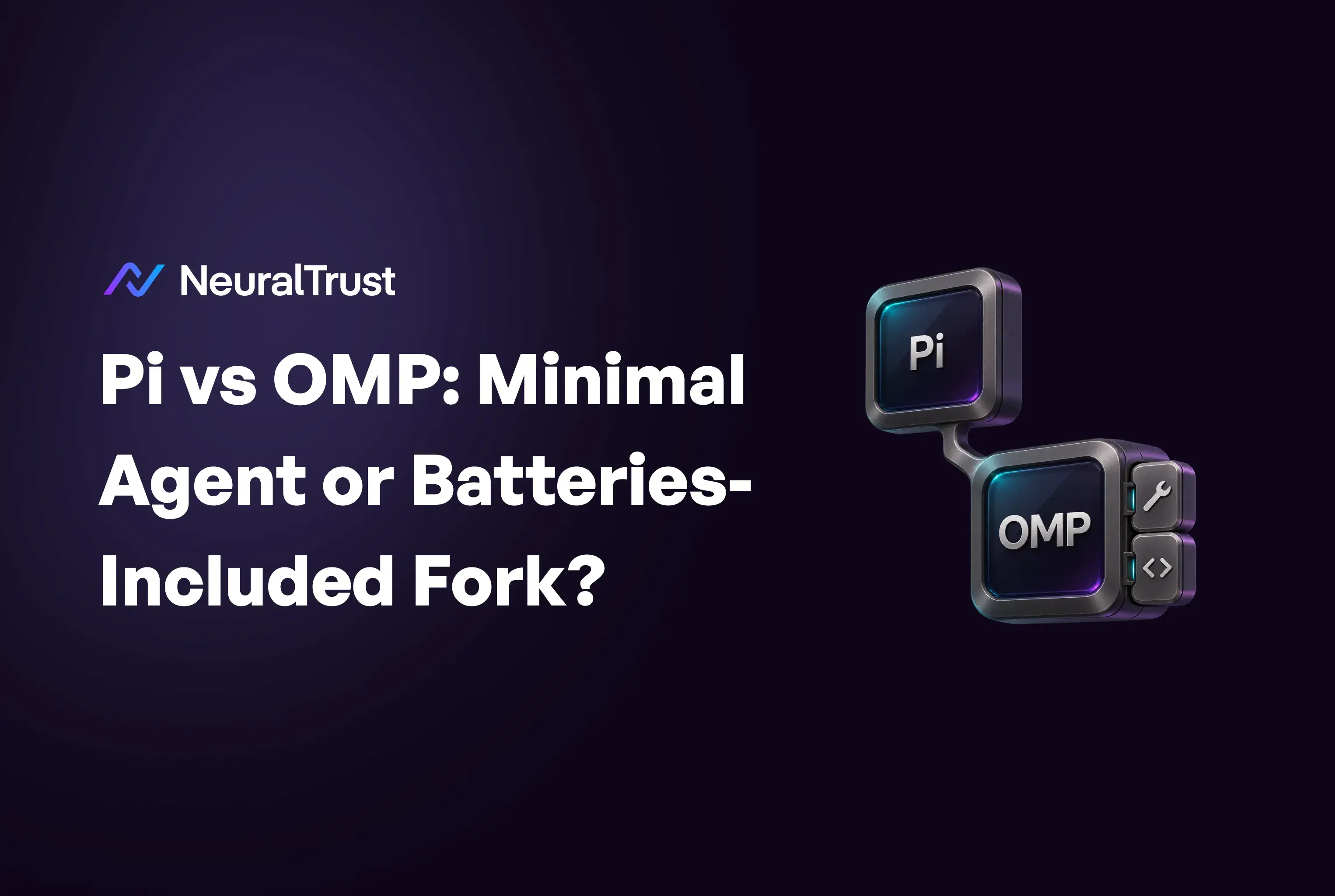
Pi vs OMP: what is the difference? Pi is a minimal terminal coding agent with four built-in tools and a system prompt under 1,000 tokens. OMP, short for Oh My Pi, is a fork of Pi that adds more than 30 built-in tools, including language server support, a debugger and hash-anchored edits. Both are free under the MIT license, and Pi runs with no permission prompts by default.
TL;DR: Key Takeaways
- Scope: Pi ships with four tools (read, write, edit and bash), according to the Pi README, while OMP ships with 32, according to i-SCOOP (2026).
- Benchmark: in Composio's DeepSeek V4 Flash test, Pi passed 20 of 30 workflows and OMP passed 17, according to Composio (2026).
- Cost: the same test recorded $0.028 per successful task for Pi and $0.103 for OMP, according to Composio (2026).
- Permissions: the Pi README says Pi has no permission popups and tells you to run it in a container or add your own confirmation flow.
- Supply chain: the same README warns that Pi packages run with full system access, so review any extension or skill before you install it.
- Caveat: the benchmark measures tool use through hosted integrations, not code editing, and each workflow ran once, so treat it as one data point.
Pi vs OMP at a glance
| Detail | Pi | OMP |
|---|---|---|
| What it is | Minimal terminal coding agent | Fork of Pi with a larger built-in toolset |
| License and price | MIT, free (you pay your model provider) | MIT, free (you pay your model provider) |
| Built-in tools | 4 by default: read, write, edit, bash | 32, including LSP, debugger, code evaluation and sub-agent tasks |
| Edit method | Standard edit tool | Hash-anchored line edits that reject stale patches |
| Language servers and debugger | Not among its built-in tools | 14 LSP operations and 28 DAP operations |
| Sub-agents | Not among its built-in tools | Yes, in isolated git worktrees |
| Model providers | 18 API-key providers and 5 subscription logins in the 0.68.0 README, plus local models | 40+ providers and custom OpenAI-compatible endpoints |
| Permission prompts | None by default | Not described in the sources we reviewed |
| Config import | Not applicable | Reads eight formats, including .claude, .cursor and .codex |
Sources: Pi README, Flavio Copes (2026) and i-SCOOP (2026). Pi's repository moved to the Earendil organization in 2026, and its README snapshot is older than the current release, so check the current docs for tool counts and install commands.
What each tool is built to do
Pi is built around restraint. It gives the model four tools and a short prompt, then lets you add the rest through TypeScript extensions. OMP starts from Pi and adds most of what an IDE offers, which makes it heavier but more capable on large codebases.
Pi: four tools and your own extensions
According to the Pi README, the default tools are read, write, edit and bash. Grep, find and ls are available through a flag. Extensions are TypeScript modules that reload with a /reload command, and skills follow the Agent Skills format.
Sessions are stored as a JSONL tree, so you can branch a conversation and return to an earlier point. Flavio Copes (2026) reports that Mario Zechner joined Earendil in April 2026 and that Pi reached 1.0 in October 2026. The same guide gives the newer package name and repository, so do not copy the install line from older posts.
OMP: a fork with an IDE's worth of tools
i-SCOOP (2026) describes OMP as a fork of Pi with a Rust core and a TypeScript extension layer. Its main additions are:
- Hash-anchored edits: each line carries a short content hash, and a patch is rejected before it corrupts a file if the anchor no longer matches.
- Language servers: renames go through the language server, so imports and re-exports update with the file.
- Debugger: debug adapter sessions attach through tools such as lldb, dlv and debugpy.
- Sub-agents: a
tasktool runs workers in isolated git worktrees and returns schema-validated JSON. - Git helpers:
omp commitsplits changes into atomic commits, and/reviewruns parallel reviewers. - Model roles: separate models for default, small, slow, plan and commit work, with fallback chains.
i-SCOOP also relays a project-reported figure of 61% fewer output tokens on the same work with Grok 4 Fast. That number comes from the project, not from an independent test.
Pi vs OMP benchmarks
We found one head-to-head test. Composio ran both tools on 30 workflows against real apps with the same model, DeepSeek V4 Flash, and a 900-second limit per task. Pi passed more workflows, finished faster and cost less per success.
| Measure | Pi | OMP |
|---|---|---|
| Workflows passed | 20 of 30 | 17 of 30 |
| Pass rate | 66.7% | 56.7% |
| Median time per task | 132.2 s | 272.4 s |
| Average tokens per task | 558,885 | 742,283 |
| Total cost | $0.56 | $1.75 |
| Cost per successful task | $0.028 | $0.103 |
Source: Composio (2026), "Pi vs OMP (Oh My Pi Agent): Everything You Need to Know" and its DeepSeek V4 Flash agent comparison. Five other agent tools passed between 14 and 16 workflows in the same test.
How we compared
We did not run these tests. The figures come from Composio, a company that sells tool integrations for agents, and every tool in the test used Composio's hosted MCP server. A programmatic verifier checked the state of the real apps, and a workflow passed only if every check passed.
Reading the numbers
Four details limit what the table can tell you.
First, the gap is three workflows out of 30, with one run each and no confidence intervals. Second, Composio says Pi ran at a high reasoning setting rather than the maximum, and that 24 of its 30 Pi trials used the official DeepSeek API instead of OpenRouter. The write-up does not say how OMP was routed.
Third, i-SCOOP reports that DeepSeek V4 needs a custom model file in OMP to avoid HTTP 400 errors in long tool-call sessions. Composio does not say whether that fix was applied. Fourth, the workflows cover apps such as Airtable, Gmail, GitHub and Slack, not code editing. OMP's language server, debugger and hash-anchored edits are not exercised.
The fair reading is narrow. On tool-heavy workflows with this model, Pi was cheaper and faster. The test says nothing about which tool edits a large repository better.
Extensions, skills and config import
Both tools extend through TypeScript. Pi has more than 50 example extensions, according to Flavio Copes (2026), and installs packages with pi install from npm or git sources. According to Composio (2026), OMP keeps Pi's extensions and hooks and can write and reload its own extensions during a session.
The biggest practical difference is config import. According to i-SCOOP (2026), OMP reads rules, skills and MCP server definitions from eight formats: .claude, .cursor, .windsurf, .gemini, .codex, .cline, .github/copilot and .vscode. If you already use another coding agent, OMP can pick up your setup on the first run.
MCP support is the area where the sources disagree. Pi's original design left MCP out, and a guide updated in October 2026 describes MCP support in current Pi. For OMP, we could confirm that it imports MCP server definitions but not whether it is a native MCP client. Check the docs for the version you install.
Models, setup and cost
Both tools are free, so your cost is model usage. Pi lists 18 API-key providers and five subscription logins in the older README, plus local models through Ollama, vLLM and llama.cpp. OMP lists more than 40 providers and custom OpenAI-compatible endpoints.
Be careful with subscription logins. According to Composio (2026), using a consumer subscription through a third-party tool is risky with some providers, and a provider can restrict the account. For team use, bring your own API key and set a spend limit at the provider.
In the benchmark, 30 workflows cost $0.56 with Pi and $1.75 with OMP on the same model. Token use drove that gap: OMP averaged about 742,000 tokens per task against about 559,000 for Pi. Your own numbers will depend on the model, the reasoning level and how often a task retries.
Pi vs OMP: security and governance
Both are terminal agents that can run shell commands, so the main risks are excessive agency, supply chain exposure and prompt injection. The Pi README says Pi has no permission prompts and recommends a container. We found no documented approval model for OMP, so treat it the same way until its docs say otherwise.
According to Help Net Security (2026), the 2026 OWASP Top 10 for LLM Applications keeps Prompt Injection first, and Excessive Agency rose to third place. A coding agent that reads repositories, issues and web pages and then runs commands sits where those two risks meet.
The access picture is not reassuring. In IBM's 2026 breach study, 92% of the organizations hit through an AI system lacked role-based access, multi-factor authentication and similar controls, according to Help Net Security (2026). Assume that an agent with shell access will eventually read something hostile.
| Risk | How it shows up in Pi and OMP | Control |
|---|---|---|
| Unrestricted shell and file access | Pi runs with the rights of the user who launched it, with no prompts | Run in a container or micro VM, and add a permission-gate extension |
| Untrusted extensions and skills | Pi packages run with full system access, and install from npm or git | Review source, pin versions and install with scripts disabled |
| Inherited tool grants | OMP imports MCP server definitions and rules from eight other config formats | Audit imported servers and tokens before the first run |
| Provider keys in the sandbox | A plain Docker container holds your provider API key, as Botmonster (2026) points out | Use scoped, short-lived keys issued through a gateway |
| Prompt injection through repos and pages | The agent reads untrusted text and can act on it | Restrict network egress and require review for destructive commands |
| Wider capability surface in OMP | A persistent Python or Bun kernel and a debugger that attaches to live processes | Enable only the tools the task needs |
Sources: Pi README, Flavio Copes (2026), Botmonster (2026) and i-SCOOP (2026). The OMP rows reflect what its reviewers describe, not a security audit.
NeuralTrust is a Barcelona-based AI agent security company, and the table maps each exposure to a control.
| Exposure with Pi or OMP | What you need | NeuralTrust capability |
|---|---|---|
| Unknown agents, models and MCP servers on developer machines | See what runs and what it can reach | Agent Posture Management (TrustLens) |
| Provider keys and tool calls leaving the sandbox | Central policy and scoped credentials | Agent Gateway (TrustGate) |
| Unexpected commands at runtime | Monitor what the agent does | Agent Runtime Security (TrustGuard) |
| Untested behavior against hostile input | Attack the agent before an attacker does | AI Red Teaming (TrustTest) |
These capabilities form NeuralTrust's Runtime Security Mesh. For deeper guidance on a related tool, see our guide to Claude Code security.
Which should you choose?
Choose by the work and by your risk tolerance, not by star count. Pi suits people who want a small tool they can read end to end. OMP suits people who want language servers, a debugger and sub-agents out of the box. Neither replaces a sandbox.
| If you are... | Consider | Why |
|---|---|---|
| A developer who wants a small, auditable tool and writes your own extensions | Pi | Four tools, a short prompt and MIT license |
| Working in a large typed codebase and want renames and debugging | OMP | Built-in language server and debugger operations |
| Running tool-heavy workflows across SaaS apps on a budget | Test Pi first | Composio's test shows a lower cost per success, so confirm on your own tasks |
| Moving from Claude Code, Cursor or Codex and want your config carried over | OMP | It reads eight config formats, including MCP definitions |
| In a security-sensitive team | Either, inside a container with scoped keys | Neither documents an approval flow you can rely on without extra controls |
Conclusion
Pi vs OMP comes down to scope. Pi is the smaller tool, and in the one head-to-head test we found it passed more workflows at a lower cost. OMP adds language servers, a debugger, sub-agents and hash-anchored edits that the benchmark never exercised. Run both on your own repositories, keep them in a sandbox, and give each only the keys and tools it needs.
Secure Coding Agents in Production with NeuralTrust
Put policy, monitoring and testing around every coding agent your developers run, from day one.
Related Comparisons
- Claude Code vs. Cursor: Benchmark Comparison 2026
- Codex vs. Claude Code: Benchmark Comparison 2026
- OpenClaw Alternatives
- Hermes Agent Security: Risks, CVEs and Safe Setup
FAQs about Pi vs OMP
1. Pi vs OMP: which is better?
It depends on the work. Pi is smaller and cheaper in the one benchmark we found, with 20 of 30 workflows passed against 17 for OMP. OMP adds language servers, a debugger and sub-agents that the test did not measure. Try both on your own repositories before you standardize.
2. Is OMP the same as Pi?
No. OMP, or Oh My Pi, is a fork of Pi. It keeps Pi's extension model and session format, but it adds a Rust core, more than 30 built-in tools and hash-anchored edits. Pi stays deliberately small, with four default tools, so the two have different goals.
3. Are Pi and OMP free?
Yes. Both are released under the MIT license and cost nothing to install. You pay your model provider for tokens. In Composio's test, 30 workflows cost $0.56 with Pi and $1.75 with OMP on the same model.
4. Which models do Pi and OMP support?
Both are model-agnostic. The older Pi README lists 18 API-key providers and five subscription logins, and Pi also works with local models through Ollama, vLLM and llama.cpp. OMP lists more than 40 providers and custom OpenAI-compatible endpoints. Some models need extra configuration.
5. Is it safe to run Pi on my own machine?
Not without precautions. The Pi README says there are no permission popups and suggests a container or a confirmation extension. Pi packages also run with full system access. Use a container or micro VM, scope your API keys and review third-party extensions before installing them.
6. Does OMP support MCP?
Partly confirmed. i-SCOOP reports that OMP imports MCP server definitions from other tools' config files, but the sources we reviewed do not say whether OMP is a native MCP client. Check the documentation for your version, and audit any imported server before first use.
7. Which one costs less to run?
In Composio's DeepSeek V4 Flash test, Pi cost $0.028 per successful task and OMP cost $0.103. OMP also used more tokens per task. The test covered tool workflows, not code editing, so your costs may differ with a different model or task mix.
About the Author
Roger Howroyd is Head of Global SEO and AI at NeuralTrust, where he leads the company's search strategy across SEO, AEO, GEO, and LLM optimization. He specializes in AI-powered search, content strategy, and SEM. Connect on LinkedIn.
NeuralTrust is the leading platform for securing and scaling AI agents. Named a Pioneer in the Gartner Emerging Market Quadrant for AI Application Security 2026, recognized across four Gartner Hype Cycle reports in 2026, and featured in the Gartner Market Guide for Guardian Agents 2026, the Gartner Market Guide for AI Gateways 2025 and the KuppingerCole Leadership Compass for Generative AI Defense 2025. Headquartered in Barcelona with offices in London and New York. ISO 27001 certified.
Sources
- Pi, "pi-coding-agent README," package version 0.68.0: https://unpkg.com/@mariozechner/pi-coding-agent@0.68.0/README.md
- Flavio Copes, "A deep dive into Pi," published September 23, 2026, updated October 2, 2026: https://flaviocopes.com/pi/
- Botmonster, "Pi never asks permission before it touches your files," August 7, 2026: https://botmonster.com/ai/pi-never-asks-permission-before-touching-your-files/
- i-SCOOP, "Omp, the Pi-based coding agent that turns your CLI into an IDE," July 7, 2026, updated November 1, 2026: https://www.i-scoop.eu/omp-the-terminal-coding-agent-that-turns-your-cli-into-an-ide/
- Composio, "Pi vs OMP (Oh My Pi Agent): Everything You Need to Know," September 1, 2026
- Composio, DeepSeek V4 Flash agent tool comparison, August 11, 2026
- Help Net Security, "OWASP 2026 LLM Top 10," August 6, 2026: https://www.helpnetsecurity.com/2026/08/06/owasp-2026-llm-top-10-released/
- Help Net Security, "Data breach cost 2026 averaged $4.99 million, AI attacks ran higher," July 30, 2026: https://www.helpnetsecurity.com/2026/07/30/ibm-cost-of-a-data-breach-2026/