Last updated: November 20, 2026
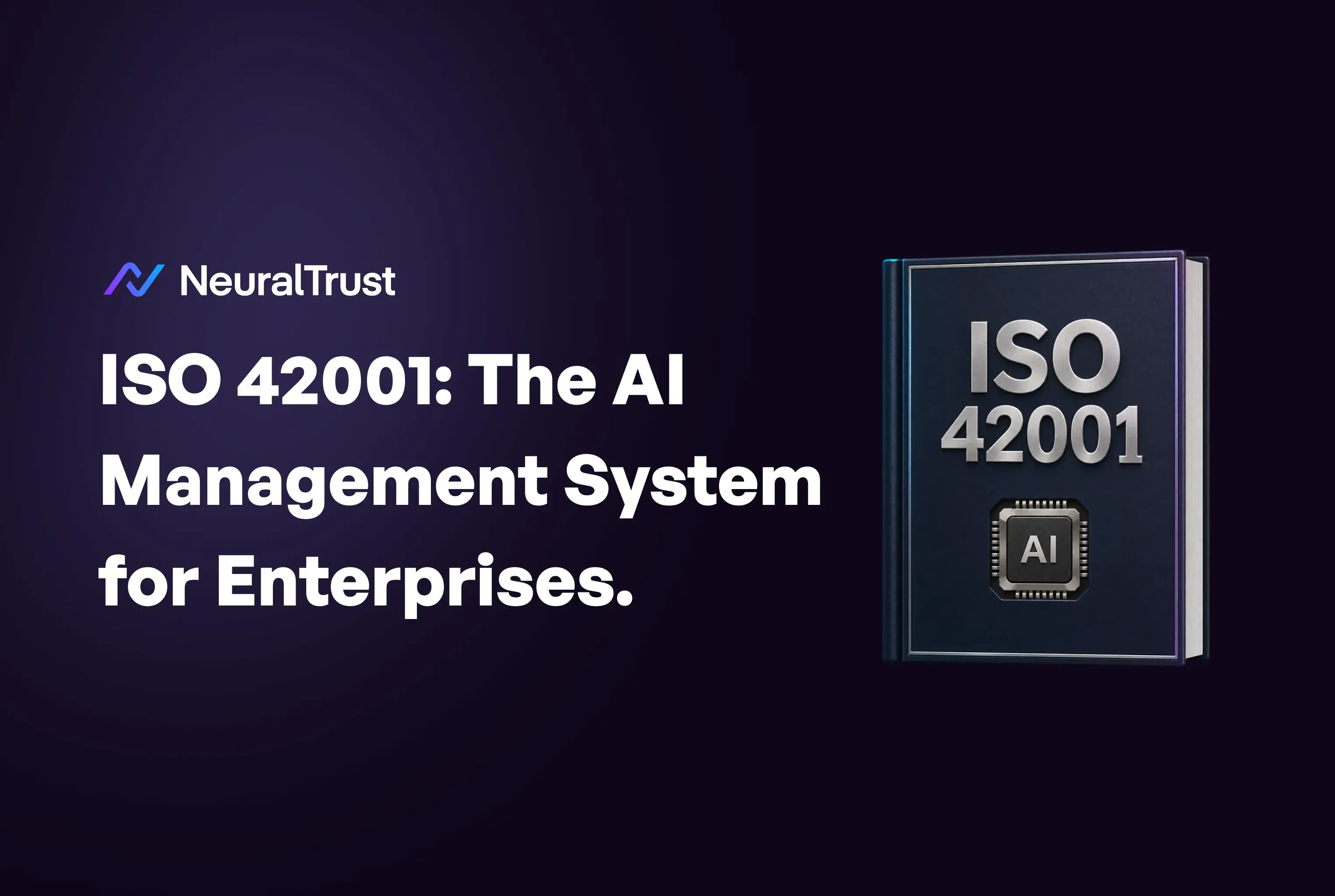
What is ISO 42001? ISO 42001, formally ISO/IEC 42001:2023, is the international standard for an AI management system. It sets requirements for how an organization governs the AI it builds, buys and runs, and an accredited body can certify against it. BSI issued 11 certificates in 2025, and in 2026 that figure more than tripled.
TL;DR: Key Takeaways
- Momentum: BSI issued 11 ISO 42001 certificates in 2025, and that figure more than tripled in 2026, according to BSI (2026). Its 50th certificate was awarded on October 21, 2026.
- Structure: the standard has requirements in clauses 4 to 10 and an Annex A of 38 controls across nine areas, according to the Cloud Security Alliance (2026).
- Process: certification is a two-stage audit. Stage 1 typically lasts 1 to 2 days and Stage 2 lasts 3 to 9 days or more, and the certificate runs for three years with annual surveillance audits (Schellman, via CSA).
- EU AI Act: EN 18286:2026, a quality management system standard, is the first harmonised standard under the Act, according to Orrick (2026). ISO 42001 on its own does not give a presumption of conformity.
- ISO 27001: an ISO 27001 scope does not automatically extend to AI governance, according to BSI.
- Agents: none of the sources we reviewed says the standard addresses agentic systems, so runtime evidence has to come from your own controls.
ISO 42001 at a glance
| Detail | ISO/IEC 42001:2023 |
|---|---|
| What it is | A management system standard for AI |
| Issued by | ISO and IEC |
| Requirements | Clauses 4 to 10 |
| Controls | Annex A, 38 controls in nine areas |
| Certifiable | Yes, by an accredited certification body |
| Certificate cycle | Three years, with annual surveillance audits |
| Mandatory | No, it is voluntary |
| EU AI Act status | Not a harmonised standard, no presumption of conformity on its own |
Sources: CSA (2026), Schellman, via CSA and Orrick (2026).
What ISO 42001 requires
ISO 42001 asks an organization to build a management system around AI: define scope, assign leadership, assess risk and impact, control the AI lifecycle, measure performance and improve. It is a standard about process and accountability. It does not prescribe specific technical tools.
| Clause | What it asks for |
|---|---|
| 4. Context | Internal and external issues, interested parties and the scope of the AI management system |
| 5. Leadership | Top management commitment, an AI policy, roles and responsibilities |
| 6. Planning | AI risk and opportunity assessment, impact assessment, risk treatment and objectives |
| 7. Support | Resources, competence, awareness, communication and documented information |
| 8. Operation | Operational control across the AI lifecycle, including third-party AI services |
| 9. Performance evaluation | Monitoring, measurement, internal audit and management review |
| 10. Improvement | Nonconformity, corrective action and continual improvement |
Sources: CSA (2026), Advisera (2026) and BARR Advisory, via CSA (2025).
Annex A, the impact assessment and the Statement of Applicability
Annex A lists 38 controls in nine areas: AI policies, internal organization, resources, impact assessment, the AI system lifecycle, data, information for interested parties, use of AI systems, and third-party and customer relationships. The controls are objectives, not prescriptive requirements, according to the CSA (2026).
Two parts deserve attention. The impact assessment (Annex A.5) asks you to evaluate how an AI system affects people and society, and the lifecycle controls (Annex A.6) cover design, testing, deployment and monitoring. You then record which controls you apply and why in a Statement of Applicability, which auditors review at Stage 1.
How we compared
We did not read the standard itself, which ISO sells. We compiled this summary from the certification body BSI, the law firm Orrick, the Cloud Security Alliance, an audit firm and a training provider. The sources disagree in one place: a CSA table lists Annex A groups whose control counts add up to 42, while the text and Advisera both say 38. We use 38. Two of the process sources date from 2025, so check durations with your auditor.
ISO 42001 certification: process, timeline and who certifies
Certification is a two-stage audit by an accredited certification body. You prepare first by defining scope, assessing risk and impact, and writing the policy and procedures. The auditor then reviews your documents at Stage 1 and tests whether the system operates at Stage 2.
| Step | What happens | Typical duration |
|---|---|---|
| Preparation | Scope, risk assessment, impact assessment, policy, controls | Not published by the sources we reviewed |
| Readiness assessment | Optional gap check before the audit | Varies |
| Stage 1 | Documentation review and meetings | 1 to 2 days |
| Gap between stages | Fix findings from Stage 1 | 4 to 12 weeks, and no more than six months |
| Stage 2 | Tests operating effectiveness, including clause 8 and in-scope Annex A controls | 3 to 9 days or more |
| Certificate | Valid for three years | Three years |
| Surveillance audits | Annual sampling, about a third of the initial audit time | 2 to 5 days or more |
Source: Schellman, via CSA (2025).
Who certifies matters. BSI says it secured accreditation from ANAB in March 2026 and describes itself as the first certification body to hold accreditation from UKAS, RvA and ANAB for ISO/IEC 42001, according to BSI (2026). Check that your chosen body is accredited for this standard.
Cost is the question buyers ask most, and we found no authoritative published price. It depends on scope, the number of AI systems, your size and the auditor. Ask two or three accredited bodies for quotes against the same scope.
ISO 42001 vs ISO 27001, NIST AI RMF and the EU AI Act
ISO 42001 sits beside other frameworks rather than replacing them. It shares a high-level structure with ISO 27001, it is certifiable where the NIST AI RMF is not, and it supports the EU AI Act without satisfying it. The right combination depends on where you sell and what you build.
| Framework | What it is | Relationship to ISO 42001 |
|---|---|---|
| ISO/IEC 27001 | Information security management system | Same family of management system standards, but its scope does not automatically cover AI governance |
| NIST AI RMF | Voluntary US risk management framework | Provides risk guidance, with no certificate to earn |
| EU AI Act | Binding EU regulation | 42001 supports it, but gives no presumption of conformity on its own |
| EN 18286:2026 | Harmonised quality management standard for the AI Act | Layers on top of 42001 rather than replacing it |
Sources: BSI, Orrick (2026) and the European Commission (2026). For the US side, see our NIST AI RMF implementation guide.
Where ISO 27001 helps and where it stops
BSI describes ISO 27001 as a starting point that should be built on. ISO 27001 protects information, while ISO 42001 governs how AI processes and uses it, according to BSI. If you already run a certified management system, you can reuse its structure, audit cycle and document control.
What EN 18286 changes for the EU AI Act
According to Orrick (2026), the European Commission published EN 18286:2026, "Artificial intelligence, Quality management system," on October 14, 2026 as the first harmonised standard under the Act. It covers how providers identify applicable requirements, define scope and document a compliance strategy across Articles 9 to 15.
The practical point is the presumption of conformity. Following ISO 42001 or ISO 9001 on their own does not give a provider that presumption, and existing processes should not be assumed to satisfy Article 17. The Commission says the same in its 2026 FAQ: ISO/IEC 42001 helps set up an AI management system, but its goals are not aligned with the quality management system the Act requires. EN 18286 is designed to sit on top of 42001.
We did not confirm the publication details on EUR-Lex, so check the Official Journal reference before you rely on the date. We also do not cover the Act's high-risk deadlines here, because they were under revision during 2026.
ISO 42001 for AI agents: where the standard stops
ISO 42001 gives you a management system for AI, and agents stress it in ways its text does not spell out. None of the sources we reviewed says the standard addresses agentic systems. What follows is our reading of how its requirements apply when AI can act.
An agent holds credentials, calls tools and changes data. That changes what auditors will want to see. The risk assessment in clause 6 has to cover what the agent can do, not only what it can say. The lifecycle controls have to cover changes to prompts, tools and permissions, since any of them changes behavior. Clause 8 and the third-party controls have to cover the model providers and MCP servers the agent depends on.
The standard also leaves a gap between policy and evidence. It asks you to monitor and measure, but it does not say how to observe an agent at runtime or how to stop it from acting outside its task. According to Help Net Security (2026), the 2026 OWASP Top 10 for LLM Applications ranks Excessive Agency third, which is the risk an auditor is most likely to probe. Evidence of limits, logs and test results has to come from your own tooling.
ISO 42001: security and governance
For an agent-heavy organization, ISO 42001 sets the governance frame and your runtime controls supply the evidence. Auditors look for an inventory, enforced policy, monitoring and testing records. NeuralTrust is a Barcelona-based AI agent security company, and the table maps each area to a capability.
| ISO 42001 area | Evidence an auditor may ask for | NeuralTrust capability |
|---|---|---|
| Scope and AI system inventory (clauses 4 and 6) | A current list of AI systems, agents, models and MCP servers | Agent Posture Management (TrustLens) |
| Operational control and third-party services (clause 8) | Policy enforced on traffic to model providers and tools | Agent Gateway (TrustGate) |
| Monitoring and performance evaluation (clause 9) | Records of agent behavior at runtime | Agent Runtime Security (TrustGuard) |
| Verification across the lifecycle (Annex A.6) | Red team results before release and after each change | AI Red Teaming (TrustTest) |
These capabilities form NeuralTrust's Runtime Security Mesh. They produce evidence for controls. They do not certify an organization, and only an accredited certification body can issue an ISO/IEC 42001 certificate. For governance policy on agents, see our guide to agentic AI governance.
Which should you choose?
Choose by your customers, your market and your risk, not by which framework is newest. A management system certificate answers customer assurance questions, and EN 18286 answers a legal question for EU providers. Neither replaces technical controls on the agents you run.
| If you are... | Consider | Why |
|---|---|---|
| Selling AI products to enterprises that ask for assurance | ISO 42001 certification | It is certifiable, and BSI's certificate volume more than tripled in 2026 |
| A provider of a high-risk AI system in the EU | EN 18286 plus a management system | 42001 alone gives no presumption of conformity |
| Already certified to ISO 27001 | Extend your management system to AI | Its scope does not automatically cover AI governance |
| Early on, with no budget for an audit | Start with an AI inventory and risk work | The same work feeds clauses 4 and 6 later |
| Running AI agents with tool access | Add runtime controls and evidence | The standard does not specify how to monitor or limit agents |
Conclusion
ISO 42001 gives enterprises a certifiable way to show that AI is governed, and demand is rising fast. It will not by itself satisfy the EU AI Act, and it does not tell you how to control an agent at runtime. Treat it as the management frame, add EN 18286 where the Act applies to you, and build the technical evidence that auditors will ask for.
Secure AI Agents for ISO 42001 Audits with NeuralTrust
Give auditors a live inventory, enforced policy, runtime records and test results for every agent you run.
Related Reading
- AI Governance Frameworks Compared: NIST, ISO 42001, EU AI Act & OECD Principles
- EU AI Act Compliance for Enterprises: What You Must Do Before Full Enforcement
- NIST AI RMF 1.0: A Step-by-Step Implementation Guide for Enterprises
FAQs about ISO 42001
1. What is ISO 42001?
ISO 42001, or ISO/IEC 42001:2023, is the international standard for an AI management system. It sets requirements in clauses 4 to 10 and an Annex A with 38 controls. It helps organizations govern the AI they build, buy and run, and accredited bodies can certify against it.
2. Is ISO 42001 mandatory?
No. It is a voluntary standard. Some regulations may push organizations toward it, but certification is not a legal requirement on its own. Customers and partners increasingly ask for it as assurance, and BSI reports its certificate volume more than tripled in 2026.
3. How long does ISO 42001 certification take?
The audit itself is short: Stage 1 typically takes 1 to 2 days, there is a gap of 4 to 12 weeks, and Stage 2 takes 3 to 9 days or more. Preparation takes longer, and the sources we reviewed publish no total. Scope and existing management systems drive the timeline.
4. How much does ISO 42001 certification cost?
We found no authoritative published price. Cost depends on scope, the number of AI systems, organization size and the certification body. Request quotes from two or three accredited bodies against an identical scope, and budget for annual surveillance audits across the three-year certificate.
5. Does ISO 42001 make you compliant with the EU AI Act?
No. ISO 42001 supports AI Act work, but it gives no presumption of conformity on its own, according to Orrick. The first harmonised standard is EN 18286:2026, a quality management system standard designed to layer on top of ISO 42001. Check obligations for your risk category.
6. How is ISO 42001 different from ISO 27001?
ISO 27001 protects information, while ISO 42001 governs how AI processes and uses it. Both are management system standards with a similar structure. According to BSI, an ISO 27001 scope does not automatically extend to AI governance, so you must define AI in scope.
7. Does ISO 42001 cover AI agents?
It applies to any AI system in scope, but none of the sources we reviewed says it addresses agentic systems specifically. The standard asks for risk assessment, lifecycle control and monitoring without prescribing runtime tools. For agents, add your own controls for access, logging and testing.
About the Author
Roger Howroyd is Head of Global SEO and AI at NeuralTrust, where he leads the company's search strategy across SEO, AEO, GEO, and LLM optimization. He specializes in AI-powered search, content strategy, and SEM. Connect on LinkedIn.
NeuralTrust is the leading platform for securing and scaling AI agents. Named a Pioneer in the Gartner Emerging Market Quadrant for AI Application Security 2026, recognized across four Gartner Hype Cycle reports in 2026, and featured in the Gartner Market Guide for Guardian Agents 2026, the Gartner Market Guide for AI Gateways 2025 and the KuppingerCole Leadership Compass for Generative AI Defense 2025. Headquartered in Barcelona with offices in London and New York. ISO 27001 certified.
Sources
- BSI, "BSI awards its 50th ISO/IEC 42001 certificate," November 2026: https://www.bsigroup.com/en-US/insights-and-media/media-center/press-releases/2026/november/bsi-awards-its-50th-iso-iec-42001-certificate/
- BSI, "BSI secures ANAB accreditation to certify ISO/IEC 42001," March 2026: https://www.bsigroup.com/en-US/insights-and-media/media-center/press-releases/2026/march/bsi-secures-anab-accreditation-to-certify-isoiec-42001/
- BSI, "ISO/IEC 27001 certified organizations pursue ISO/IEC 42001" (infographic), 2026: https://groupsite.bsigroup.com/siteassets/pdf/en/insights-and-media/insights/brochures/bsi-ai-isoiec-27001-certified-organizations-pursue-isoiec-42001-infographic-en-gb.pdf
- Orrick, "First Harmonised Technical Standard Published Under the EU AI Act," October 27, 2026: https://www.orrick.com/en/Insights/2026/10/First-Harmonised-Technical-Standard-Published-Under-the-EU-AI-Act
- European Commission, "Understanding standardisation under the AI Act" (FAQ), March 10, 2026: https://digital-strategy.ec.europa.eu/en/faqs/understanding-standardisation-ai-act
- Cloud Security Alliance, EU AI Act, ISO 42001 and prEN 18286 compliance whitepaper, May 6, 2026: https://labs.cloudsecurityalliance.org/research-rb/csa-whitepaper-eu-ai-act-iso42001-pren18286-compliance-20260/
- Cloud Security Alliance (Schellman), "What to Expect in the ISO 42001 Certification Process," July 23, 2025: https://cloudsecurityalliance.org/articles/what-to-expect-in-the-iso-42001-certification-process
- Cloud Security Alliance (BARR Advisory), "ISO 42001 requirements explained," May 14, 2025: https://cloudsecurityalliance.org/articles/iso-42001-requirements-explained-what-you-need-for-compliance
- Advisera, "What is ISO 42001?", updated January 15, 2026: https://advisera.com/articles/what-is-iso-42001/
- Help Net Security, "OWASP 2026 LLM Top 10," August 6, 2026: https://www.helpnetsecurity.com/2026/08/06/owasp-2026-llm-top-10-released/