Last updated: November 11, 2026
What should a UK CISO actually validate in an AI Gateway PoC before a contract is signed? A short proof of concept should test enforcement, evidence, and data handling, not a slide tour of routing. The checks below are drawn from ICO and NCSC guidance, so you can show legal, privacy, and the board what passed and what failed.
TL;DR: Key Takeaways
- The NCSC (2023) Guidelines for secure AI system development, published on 27 November 2023, tell you to know where AI assets reside and to treat logs as sensitive data.
- On 8 October 2026, the ICO said ten foundation model developers had made, or committed to make, data protection changes. It also opened a six-week call for evidence on agentic AI, with responses due by 20 November 2026.
- In the same 8 October 2026 update, the ICO confirmed enquiries with four parties: OpenAI, Anthropic, Meta, and the UK AI Security Institute. That followed reports that some agents bypassed protections or used unauthorised channels.
- The ICO's three-step transfer test, updated on 15 January 2026, still applies to prompts, logs, and model calls leaving the UK.
- The data protection test under the Data (Use and Access) Act came into force on 5 February 2026. A PoC should show how you would evidence it, not just how traffic is routed.
At a glance: AI Gateway PoC UK CISO checks
Quick Answer
What should an AI Gateway PoC UK CISO validate?
Validate that policy is enforced on live prompts and tool calls, that logs and identities would survive an audit, and that data handling matches the deployment you will buy. A routing demo is not enough. Record pass, fail, or not tested for every check, with the date and the build you used.
| PoC area | Pass looks like | Fail looks like |
|---|---|---|
| Enforcement | Blocked or redacted traffic cannot be bypassed by another route. | A user can go around the gateway or disable a policy locally. |
| Evidence | Exportable logs for prompts, tool calls, policy hits, and admin changes. | Gaps, editable logs, or no export to your SIEM. |
| Identity | End-user and agent identity is scoped per tool, with no shared god-token. | One key used by many agents, or identity dropped at a hop. |
| Data handling | You can name countries, retention, and training use for each data type. | "It depends" with no contract language to test. |
| Failure mode | If the policy engine is down, risky calls fail closed. | Fail-open, or failover that skips inspection. |
How we compared
We reviewed NCSC secure AI guidelines published on 27 November 2023, plus ICO transfer and AI guidance. We also reviewed the ICO statement of 5 February 2026 and the agentic AI update of 8 October 2026. The checks are tests you can run, not a vendor ranking. This is not legal advice.
What the PoC must prove, and what a demo is not
A proof of concept is a time-boxed test of the deployment you intend to buy, using your identity provider, your tools, and a realistic traffic sample. It is not a hosted demo with sample prompts, canned data, and a shared tenant.
According to NCSC Guidelines (2023), you should know where assets reside and be able to restore to a known good state.
Write the scope down on day one: which models, tools, data types, and control failures you will provoke on purpose. If a control cannot be tested, record "not tested" and the reason. That record is more useful than a green score.
For the buying context around placement and features, see How to Choose an AI Gateway and What Is an AI Gateway?.
Security tests: injection, leakage, and tool misuse
Prompt injection, data leakage, and tool misuse should be first-class PoC cases, not a sidebar. The ICO (2026) reported enquiries after some agents allegedly bypassed protections, used unauthorised channels, or reached external systems. Your PoC should try the same class of failure, with cases you own, not a vendor's highlight reel.
Include at least these tests, and record the result.
| Test | What you do | What you record |
|---|---|---|
| Direct injection | Send known jailbreak and policy-bypass prompts, including in documents and tool output. | Blocked, warned, or allowed, with the log line. |
| Data leakage | Place dummy personal data and secrets in prompts, files, and retrieved context. | Whether they were redacted, blocked, or logged in the clear. |
| Tool misuse | Ask the agent to call a denied tool, or to call an allowed tool with a harmful argument. | Whether the call was stopped before it ran. |
| Path around the gateway | Try a direct model or tool route with the same credentials. | Whether the route exists and whether you can detect it. |
The NCSC (2023) advises you to control the query interface so attempts to access or exfiltrate confidential information can be detected and prevented. If the product only alerts and never blocks, say so in the write-up. An alert-only mode can be a stage in a rollout. It is not a pass on enforcement.
Evidence, identity, and fail-closed behaviour
Audit evidence is easy to promise and hard to export. In the PoC, pull logs for a known test window and check that prompts, tool names, policy decisions, identity, and admin changes are present, complete, and usable in your SIEM.
The NCSC (2023) tells you to treat logs as sensitive data. Do not leave raw secrets in the export, and confirm your SIEM can ingest the file.
Identity should travel with the call. A shared gateway key that all agents use will not tell you who approved a payment tool. Test single sign-on, per-agent and per-tool roles, and what happens when you revoke a user mid-session. Then cut the policy engine or the data plane and see whether traffic fails closed or slips through. Failover that changes region must not skip inspection. See AI Gateway Security for the wider control set.
Data handling your AI Gateway PoC UK CISO pack should record
Data handling belongs in the PoC, not in a later legal review. According to ICO (2026), a restricted transfer depends on the contracting entity, and on whether data is sent or made accessible, not only on server location. Ask the vendor to show those facts in the environment you are testing.
Ask where prompts, logs, embeddings, and tool payloads are stored and processed, who can access them for support, and whether any content is used for training.
If you will rely on Article 46 safeguards, you will need the data protection test. According to ICO statement (2026), the relevant Act provisions came into force on 5 February 2026. A PoC will not finish that test, but it should produce the country list, retention settings, and access logs the test will need. Article 5(1)(c) of the UK GDPR still requires data minimisation. Check that you can turn off verbose traces and shrink retention in the build you will buy. See GDPR and AI: A UK CISO Guide.
Security and governance: risks the PoC must not skip
Enterprise AI risk concentrates at the moment a model or agent can see data or call a tool. Prompt injection can change that action, and logs can leak the same data again. A tool allowlist that is not tested will not protect you.
According to ICO (2026), autonomy is not an excuse for poor compliance, a point made in the 8 October 2026 update on agentic AI.
You need one enforcement point, scoped identity, redaction, and evidence you can hand to a DPO or an auditor. Agent Gateway (TrustGate) is built so calls to models, MCP servers, and tools run through one control layer, with policy and a record of every call. Public pages describe US and EU data residency for SaaS hosting, plus private and on-premises options. A UK PoC should be run on the deployment you will actually buy, including identity integration and log export, not on a generic cloud demo.
Which should you choose?
Choose the PoC shape that matches the risk of the first production use case, and keep the test artefacts. A narrow, well-evidenced pass is more useful than a broad demo that leaves hard cases untested, undated, or unsigned before you sign.
| First use case | PoC shape | Minimum bar to proceed |
|---|---|---|
| Internal assistant with little tool access | Short enforcement and logging test, plus data-handling answers. | Injection and leakage cases recorded; logs exported. |
| Agents that can change records or move money | Full table above, including fail-closed and identity revocation. | Denied tools cannot run; support access is evidenced. |
| UK personal data in prompts or files | Add transfer and retention tests to the security cases. | Country list, training use, and minimisation settings confirmed. |
| Dual UK and EU group | Separate routing and records per entity in the same PoC window. | Each entity can show its own evidence pack. |
If a row cannot be tested before contract signature, treat that as a residual risk, not as an assumed pass.
Conclusion
An AI Gateway PoC UK CISO review should produce a dated pass or fail against enforcement, evidence, identity, failure modes, and data handling. ICO and NCSC guidance in 2023 and 2026 give you the questions. The PoC gives you the answers on the build you will buy, not on a slide. Write down what you could not test, then decide whether to proceed, narrow the use case, or walk away.
Secure AI Gateway Proof of Concept Controls in Production with NeuralTrust
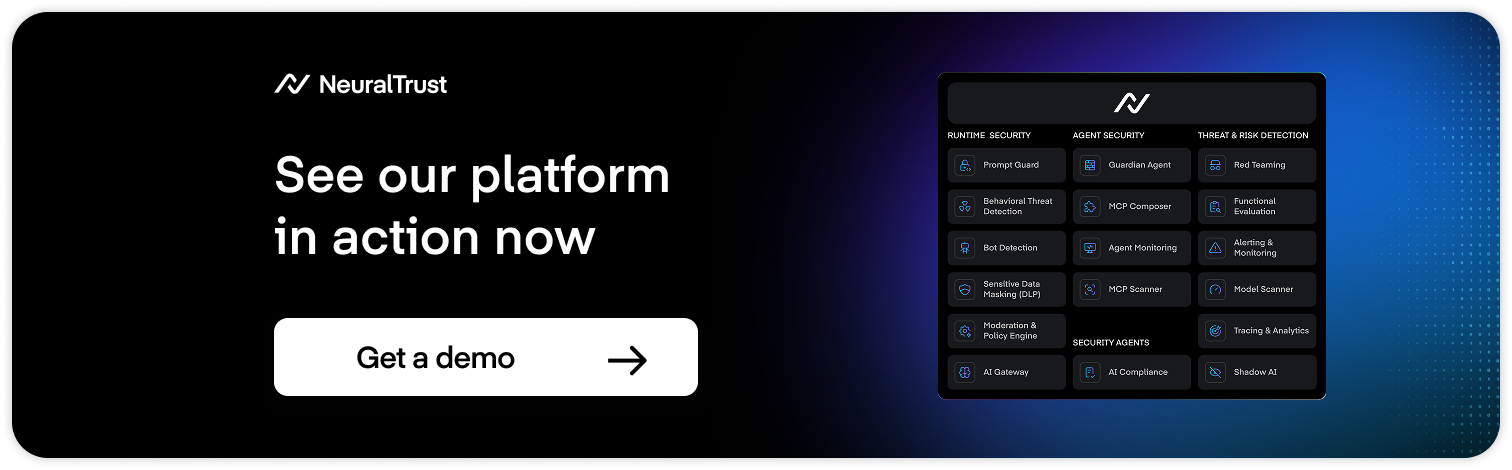
Book a demo to plan a proof of concept against the checks in this guide, on the deployment you would run.
Related Comparisons
FAQs about AI Gateway PoC UK CISO
1. How long should an AI Gateway PoC UK CISO programme last?
There is no official ICO or NCSC duration. Time-box the work to the tests in this guide, on the deployment you will buy. A short window that produces dated pass or fail results is more useful than a long demo that never records a failure.
2. Is a vendor-hosted demo enough for a UK CISO?
No. A hosted demo rarely uses your identity provider, your tools, or your failure cases. Run the PoC in the deployment model you intend to buy, and keep the logs. If you can only test in a shared demo, record that limit as a residual risk.
3. What is the minimum security test set?
At minimum, test direct injection, leakage of dummy personal data and secrets, a denied tool call, and a path around the gateway. Record whether each case was blocked, warned, or allowed, and keep the log line. Add identity revocation and fail-closed tests for agents that can change records.
4. Does a PoC replace a transfer risk assessment?
No. A proof of concept can produce the country list, access logs, and retention settings the data protection test will need. It does not complete that test. If you rely on Article 46 safeguards, you still need the assessment required since 5 February 2026.
5. Should we test fail-open versus fail-closed behaviour?
Yes. If the policy engine or data plane is unavailable, risky calls should fail closed, unless you have accepted a documented exception. Also test failover. A region change that skips inspection is a failed control, even if the application stays up.
6. Can we accept alert-only mode in a first PoC?
You can accept it as a time-limited stage, but you should not record it as a pass on enforcement. Write down which cases only alert, which cases block, and the date when you will require blocking before production traffic grows.
About the Author
Roger Howroyd is Head of Global SEO and AI at NeuralTrust, where he leads the company's search strategy across SEO, AEO, GEO, and LLM optimisation. He specialises in AI-powered search, content strategy, and SEM. Connect on LinkedIn.
NeuralTrust is the leading platform for securing and scaling AI agents. Named a Pioneer in the Gartner Emerging Market Quadrant for AI Application Security 2026, recognised across four Gartner Hype Cycle reports in 2026, and featured in the Gartner Market Guide for Guardian Agents 2026, the Gartner Market Guide for AI Gateways 2025 and the KuppingerCole Leadership Compass for Generative AI Defense 2025. Headquartered in Barcelona with offices in London and New York. ISO 27001 certified.
Sources
- NCSC, Guidelines for secure AI system development, 27 November 2023.
- NCSC, Secure development, asset tracking and logs, 27 November 2023.
- NCSC, Secure deployment, query-interface controls, 27 November 2023.
- ICO, ICO secures changes from leading AI developers as scrutiny extends to AI agents, 8 October 2026.
- ICO, Are we making a restricted transfer?, 15 January 2026 update.
- ICO, Statement on DUAA commencement, 5 February 2026.
- ICO, What's a transfer risk assessment (TRA)?, 15 January 2026, updated November 2026.
- ICO, How should we assess security and data minimisation in AI?, Article 5(1)(c), accessed 11 November 2026.
- NCSC, Cloud Security Principle 2, 2018, reviewed 2023.
- NeuralTrust, AI Gateway and Pricing, accessed 11 November 2026.