)
AI agents are now in production inside the enterprise, and the question every security team faces is no longer whether they exist but what they are actually doing. AI security posture management is how you answer that, and the answer is only as good as what your posture is built from: how agents are configured, or what they did.
Most platforms in this category describe an agent by scanning its configuration, its permissions, and the cloud around it, then inferring risk from that declared state. That tells you what an agent could do. It does not tell you which tool it called, which record it pulled, or which action it took while it ran. For agents that read data, send messages, and act on a user's behalf, the posture that matters is the one grounded in observed behavior, not the one assembled from settings.
This guide compares eight of the most relevant AI-SPM platforms for enterprise AI security in 2026, starting with NeuralTrust TrustLens and then covering seven others, so security and platform leaders can understand where each one fits and which question it actually answers.
TL;DR
- AI-SPM is the continuous discovery, assessment, and governance of every AI agent in the enterprise and the risks around it. The dividing line between platforms is whether posture reflects observed behavior or declared configuration.
- NeuralTrust TrustLens is the only platform in this list that builds posture from observed behavior. It is integrated directly in the interaction path on a native AI gateway, captures every agent's real tool-call execution, runs in your private environment with data staying in your perimeter, and turns observed risk into enforcement on the same platform.
- Cloud and agentless platforms (Wiz, Reco, Pillar, Noma) build posture from configuration, scans, OAuth scopes, or platform telemetry. They map what an agent could do and where the infrastructure is exposed.
- Agent-native and endpoint platforms (Zenity, Geordie) and network platforms (WitnessAI) observe agents from around the call rather than on it, and their reach is bounded by connectors, endpoints, or the platforms they integrate with.
- The dimension most buyers underweight: whether posture is observed or declared, and where your agent data lives.
What Is AI-SPM?
AI Security Posture Management (AI-SPM) is the practice of continuously discovering every AI asset an organization runs, models, agents, pipelines, and MCP servers, assessing the risk each one carries, and governing them against policy. It is the AI-native counterpart to cloud and SaaS posture management: where those disciplines keep infrastructure and applications in a known-good state, AI-SPM does the same for the AI systems and the agents now acting inside the business.
A capable AI-SPM platform does several things. It discovers and inventories AI agents and the tools they reach, including shadow AI nobody registered. It assesses risk across misconfigurations, permissions, data exposure, and behavior. It governs against frameworks like the OWASP Top 10 for LLMs, MITRE ATLAS, and the EU AI Act. And it gives security teams a single place to see, prioritize, and remediate agent risk.
The platforms in this comparison differ most on one axis: what their posture is built from. Some assess the declared state, scanning configuration, permissions, OAuth scopes, and cloud attack paths to describe what an agent is set up to do. Others observe the agent from the endpoint, the network, or a platform's API. Only one builds posture from the interaction itself, the actual call the agent made, captured firsthand. That difference decides whether your posture is a map of the possible or a record of the actual, and it is the lens this guide uses throughout.
Comparison at a Glance
| Platform | Category | Posture basis | Integration model | Deployment | Best for |
|---|---|---|---|---|---|
| NeuralTrust TrustLens | In-path agent posture and observability | Observed behavior | Directly in the interaction path, native AI gateway | Private and cloud | Teams that want posture built on what agents actually did |
| Zenity | Agent security and governance | Configuration and platform telemetry | Agentless SaaS connectors | Cloud service | Governing SaaS-managed agents like Copilot and Agentforce |
| Noma Security | Full-lifecycle AI security | Static discovery and posture | Agentless discovery plus a centralized runtime gateway | On-prem and cloud | Broad lifecycle coverage across build and runtime |
| Wiz AI-SPM | Cloud posture (CNAPP) | Declared configuration and attack paths | Agentless cloud scanning via APIs | Cloud-delivered SaaS | Cloud infrastructure posture around AI services |
| Pillar Security | Full-lifecycle AI security | Static code and repository analysis | Agentless (repos, platforms, endpoints) | Cloud service | Shift-left discovery, red teaming, and guardrails |
| WitnessAI | Network-level AI governance | Network traffic observation | Network interception, single-tenant cloud | Single-tenant cloud | Employee AI usage governance |
| Reco | SaaS security posture (SSPM) | Configuration, OAuth, and platform signals | Agentless (API, IDP, CASB, browser, network) | Cloud service | SaaS and identity posture across the estate |
| Geordie AI | Agent-native, endpoint-based | Endpoint and API correlated signals | Endpoint-based, no gateway | Cloud service plus endpoint | Endpoint-based agent discovery and governance |
The 8 Best AI-SPM Platforms in 2026
1. NeuralTrust TrustLens
)
Most platforms in this list describe an agent from the outside: they scan its configuration, read a platform's telemetry, or map the cloud around it, then infer what it might do. TrustLens is built on the opposite premise, that posture should reflect what an agent actually did, seen firsthand.
TrustLens gets that vantage point because it is integrated directly in the interaction path. Agent traffic flows through TrustGate, NeuralTrust's own AI gateway and the single point every LLM, MCP, and tool call passes through, and that call feeds TrustLens with trace-level detail on every execution. When an agent invokes a tool, reads data, or reaches an external service, TrustLens records the actual inputs, outputs, and system calls, maps them to frameworks like OWASP, MITRE, and ISO, and makes the whole history searchable. Posture here is the record of behavior, not a projection from settings.
Coverage is a property of the path rather than of how thoroughly endpoints or platforms were instrumented. Every agent whose traffic flows through the gateway is captured the same way, whether it is a packaged SaaS assistant or a custom internal build, so there are no coverage gaps waiting where an agentless connector never reached. And because TrustLens runs in your private environment or the cloud, the traffic, the observed behavior, and the audit trail all stay inside your perimeter.
The final difference is what happens after posture. Because TrustLens shares a platform with NeuralTrust's runtime security enforcement, an observed risk does not just become a finding in a dashboard. It can be acted on in the same path, so posture leads to prevention rather than to a report someone has to chase down.
- Posture basis: Observed behavior, the actual calls agents made
- Integration: Directly in the interaction path on a native AI gateway
- Coverage: Every agent's real tool-call execution, firsthand
- Deployment: Private and cloud, with agent data staying in your perimeter
- From posture to prevention: Observed risk enforced on the same in-path platform
- Enterprise readiness: SSO, domain verification, audit trails, and SIEM
- Analyst recognition: Gartner AI Gateways and Guardian Agents, KuppingerCole Leadership Compass
Best for: Teams that want AI-SPM built on what agents actually did, captured in the path and running in their own environment.
)
2. Zenity
)
Zenity is an agentless AI agent security and governance platform organized into three modules: Observe for discovery and telemetry, Govern for posture management, and Defend for detection and response. It connects to SaaS platforms through their APIs, covering agents such as Microsoft 365 Copilot, Copilot Studio, and Salesforce Agentforce.
Its posture management evaluates how agents are configured, reviewing permissions, integrations, memory, and tool access, and enforces policy against that declared state before deployment. Because it is agentless, its picture of any given agent is assembled from what those SaaS platforms expose through their connectors, so it describes how an agent is arranged rather than capturing the calls it made in the path.
- Posture basis: Configuration plus platform telemetry
- Integration: Agentless SaaS connectors
- Coverage: SaaS-managed platform agents
- Deployment: Cloud service
- Best for: Governing configuration of SaaS-managed agents
Related article: NeuralTrust vs Zenity: AI-SPM Comparison 2026
3. Noma Security
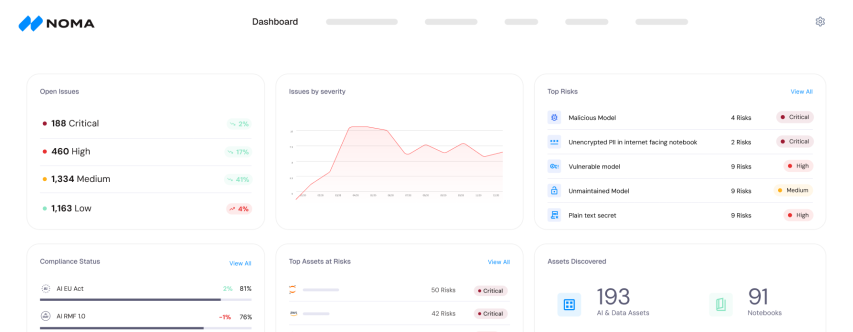
Noma Security is a full-lifecycle AI security platform covering discovery, posture management, red teaming, and runtime protection across models, agents, pipelines, and MCP servers. It supports on-prem and cloud deployment, integrates with 80-plus platforms, and holds SOC 2 Type II, HIPAA, and ISO 27001.
Its posture core is built on static discovery and assessment, inventorying assets and flagging misconfigurations, over-permissioned identities, and supply-chain risks. Runtime protection is a separate layer, enforced through a centralized gateway and SDK hooks that apply guardrails to tool calls and MCP connections. So posture and enforcement are two layers of one platform, a static AISPM layer that describes the assets and their risks and a runtime layer that guards the calls, rather than a single in-path layer where the posture is the observed call itself.
- Posture basis: Static discovery and posture, with runtime guardrails as a separate layer
- Integration: Agentless discovery plus a centralized gateway for runtime
- Coverage: Broad asset inventory across build and runtime
- Deployment: On-prem and cloud
- Best for: Broad lifecycle coverage across build and runtime
Related article: NeuralTrust vs Noma Security: AI-SPM Comparison 2026
4. Wiz AI-SPM
)
Wiz AI-SPM is part of the Wiz cloud-native application protection platform. It connects to your cloud accounts agentlessly through API connectors and discovers the AI services, models, pipelines, and SDKs running there, building an AI Bill of Materials and surfacing MCP usage.
Its work is cloud posture. It enforces configuration baselines, detects misconfigurations in AI services like OpenAI and Bedrock, extends data posture management to sensitive training data, and uses its Security Graph to trace attack paths that show how a breach could move from an exposed endpoint to a dataset. That is a map of the possible, the misconfigurations and reachable paths in the cloud around an agent, surfaced before anything happens. It answers whether your AI cloud infrastructure is exposed, which is a different question from what an agent did when it ran, and it does not sit on the agent's calls.
- Posture basis: Declared configuration and attack paths
- Integration: Agentless cloud scanning via APIs
- Coverage: Cloud AI services, AI-BOM, MCP discovery
- Deployment: Cloud-delivered SaaS
- Best for: Posture of the cloud infrastructure around AI services
Related article: NeuralTrust vs Wiz: AI-SPM Comparison 2026
5. Pillar Security
)
Pillar Security is an agentless, full-lifecycle AI security platform covering discovery, posture management, red teaming, and runtime guardrails. It connects agentlessly to source code repositories, data platforms, and endpoints rather than sitting in the traffic.
Its foundation is static. Discovery scans repositories, platforms, and endpoints to catalog agents, models, prompts, tools, and MCP servers, and its posture management maps the attack surface and flags misconfigurations and supply-chain risks. It adds runtime guardrails that monitor inputs and outputs, but the posture core is a shift-left model assembled from analysis of code and configuration, describing the attack surface an agent's code exposes rather than the behavior it exhibited.
- Posture basis: Static code and repository analysis
- Integration: Agentless (repositories, platforms, endpoints)
- Coverage: Discovered assets and attack surface, guardrails at runtime
- Deployment: Cloud service
- Best for: Shift-left discovery, pre-deployment red teaming, and guardrails
Related article: NeuralTrust vs Pillar Security: AI-SPM Comparison 2026
6. WitnessAI
)
WitnessAI is a network-level AI security and governance platform, delivered as an isolated single-tenant cloud service that intercepts AI traffic without a device agent. It is organized into Observe for visibility, Control for policy and prompt routing, and Protect for runtime defense.
Its center of gravity is governing how employees use AI. It surfaces shadow AI, applies intent-based policy, and adds runtime defense against prompt injection and jailbreaks. For agents, it provides network-level visibility into which agents exist and which MCP servers they connect to, and it controls access to approved servers. It observes real activity, but from the network, so its view of an agent is the traffic it intercepts rather than the structured call captured at the point of execution, and it has no gateway of its own.
- Posture basis: Network traffic observation
- Integration: Network interception, single-tenant cloud
- Coverage: Employee AI usage, network-level MCP connection visibility
- Deployment: Single-tenant cloud service
- Best for: Governing employee AI usage across the network
Related article: NeuralTrust vs WitnessAI: AI-SPM Comparison 2026
7. Reco
)
Reco is a SaaS security posture management platform extended to AI. It connects agentlessly to your SaaS stack through APIs and discovers agents and apps across API, IDP, CASB, browser, and network signals, mapping each agent to its users, roles, permissions, and OAuth scopes.
Its foundation is SSPM. It scores misconfigurations, governs identity and access, and maps what each agent is permitted to reach, then extends that model to AI agents. It adds behavioral signals drawn from the SaaS platforms it connects to, noticing when an agent's access pattern through a platform's API looks unusual, but its posture is anchored in configuration and OAuth scopes. Reco itself describes its approach as covering what gateways miss, which is a candid description of a platform that discovers from around the agent rather than from the calls it runs.
- Posture basis: Configuration, OAuth, and platform signals
- Integration: Agentless (API, IDP, CASB, browser, network)
- Coverage: SaaS estate, permissions, and OAuth scopes
- Deployment: Cloud service
- Best for: SaaS and identity posture across a large estate
Related article: NeuralTrust vs Reco: AI-SPM Comparison 2026
8. Geordie AI
)
Geordie AI is an endpoint-based AI agent security and governance platform. It discovers agents by correlating signals from code, endpoints, and APIs, builds an inventory with configuration understanding and behavioral observability, scores risk against frameworks, and offers a remediation engine that intervenes at the agent level.
Its defining choice is to avoid the gateway. Geordie positions its endpoint-based model as simpler than a gateway approach, watching agents from where they run rather than sitting on the traffic they generate. That gives it a light footprint across agent types, but it also sets the terms of what it can see: its picture of an agent is assembled from the code, endpoint, and API signals it can correlate, and its coverage extends to the agents its instrumentation reaches, rather than to every call on a path.
- Posture basis: Endpoint and API correlated signals
- Integration: Endpoint-based, no gateway
- Coverage: Agents its endpoint and API instrumentation reaches
- Deployment: Cloud service plus endpoint
- Best for: Endpoint-based agent discovery and governance
Related article: NeuralTrust vs Geordie AI: AI-SPM Comparison 2026
Best AI-SPM Platforms of 2026: The Final Overview
| Feature | NeuralTrust | Other AI-SPM Platforms |
|---|---|---|
| Posture basis | ✅ Built from observed behavior, the actual calls agents made | ❌ Built from configuration, scans, OAuth, or static discovery |
| Integration | ✅ Directly in the interaction path, on the call | ❌ Agentless connectors, endpoint, or network, around the agent |
| First-party AI gateway | ✅ A native gateway on the call is the source of posture | ❌ Posture comes from connectors or scans, not a gateway on the call |
| Tool-call coverage | ✅ Captures every agent's real tool-call execution firsthand | ❌ Inventory, attack paths, or connection visibility, not the call |
| Coverage model | ✅ Follows the traffic through the gateway | ❌ Bounded by connector, endpoint, or scan reach |
| From posture to prevention | ✅ Posture and enforcement are one in-path layer | ❌ Posture and enforcement are separate layers |
How to Choose the Right AI-SPM Platform
Most buyers approach this decision by driver: "I need cloud posture", "I need SaaS governance", "I need agent discovery". That framing makes sense when the products are single-purpose tools. It breaks down on the one question that decides whether your posture is trustworthy for agents: is it built on what agents did, or on how they were configured?
The honest question to ask about every platform in this list is: does its posture reflect the actual call, and where does my agent data end up?
-
TrustLens builds posture from observed behavior, on the call, through a native AI gateway, runs in your private environment with data in your perimeter, and turns observed risk into enforcement on the same platform. It is the only option here that reports what agents did rather than what they could do.
-
Zenity governs the configuration of SaaS-managed agents through agentless connectors. Its posture is the declared state, mediated by the platforms it integrates with.
-
Noma Security offers broad lifecycle coverage with on-prem and cloud deployment, but its posture core is static discovery and its runtime is a separate guardrail layer, rather than posture built from the observed call in the path.
-
Wiz AI-SPM is a cloud posture platform for the infrastructure around AI. It maps misconfigurations and attack paths agentlessly, which is the possible rather than the actual, and it does not sit on the agent's calls.
-
Pillar Security is a shift-left, agentless platform whose posture is built from static scans of code, repositories, and platforms, with guardrails added at runtime.
-
WitnessAI governs employee AI usage at the network from a single-tenant cloud, observing intercepted traffic rather than the structured call.
-
Reco brings SSPM to AI, anchoring posture in configuration and OAuth scopes across the SaaS estate, and by its own description covers what gateways miss.
-
Geordie AI is endpoint-based and deliberately avoids the gateway, observing agents from correlated signals with coverage bounded by its instrumentation reach.
The one dimension every team underweights: whether posture is observed or declared, and where the record of your agent activity lives. Configuration tells you what an agent was allowed to do. Observed behavior tells you what it did, and for agents in production that is the difference between a report and a record.
See how TrustLens compares to your current AI-SPM tool
Key Takeaways
- AI-SPM is the continuous discovery, assessment, and governance of every AI agent in the enterprise and the risks around it, from misconfigurations and permissions to behavior.
- The platforms here fall into distinct categories: in-path agent posture, cloud posture, SaaS security posture, agentless full-lifecycle, agent-native and endpoint, and network governance.
- NeuralTrust TrustLens is the in-path option, building posture from observed behavior on a native AI gateway, covering every agent's real tool-call execution, running in your private environment, and turning observed risk into enforcement.
- Cloud and agentless platforms (Wiz, Reco, Pillar, Noma) build posture from configuration, scans, OAuth scopes, or platform telemetry, describing the declared state and the attack surface.
- Agent-native and endpoint platforms (Zenity, Geordie) and network platforms (WitnessAI) observe agents from around the call, with reach bounded by connectors, endpoints, or integrated platforms.
- The right choice follows from one question: whether your posture reflects what agents actually did, and whether your agent data stays inside your perimeter.
Frequently Asked Questions
1. What is AI-SPM?
AI Security Posture Management is the practice of continuously discovering every AI asset an organization runs, including models, agents, pipelines, and MCP servers, assessing the risk each one carries, and governing them against policy. It gives security teams a single place to inventory AI, prioritize risk, and remediate, in the same way cloud and SaaS posture management do for infrastructure and applications.
2. What is the difference between observed and declared posture?
Declared posture is built from an agent's configuration, permissions, OAuth scopes, and the cloud around it, and it describes what the agent is set up to do. Observed posture is built from the calls the agent actually made, and it describes what it did. The two diverge exactly where risk lives, in the tool an agent invoked or the data it moved that no configuration predicted. NeuralTrust TrustLens builds observed posture because it sits on the call.
3. Which AI-SPM platform is best for enterprise AI agent security?
For posture grounded in what agents actually do, NeuralTrust TrustLens is built for it: integrated directly in the interaction path on a native AI gateway, capturing every agent's real tool-call execution, running in your private environment, and turning observed risk into enforcement on the same platform. Cloud and agentless platforms are a fit when the goal is infrastructure posture, SaaS governance, or discovery rather than the agent's live behavior.
4. Do I need an AI gateway for AI-SPM?
A gateway is the one place that sits on every LLM, MCP, and tool call, so it gives posture a firsthand, complete view of what agents did without depending on endpoint or connector reach. Agentless platforms avoid a gateway and assemble posture from scans, APIs, or telemetry, which is broad to connect but bounded by what those sources expose. NeuralTrust builds TrustLens on its own gateway, TrustGate, so posture and coverage follow the traffic.
5. Is attack-path analysis the same as observed behavior?
No. An attack path is a map of how a breach could move through the cloud if conditions align, surfaced before anything happens. It is valuable for infrastructure risk, but it describes the possible. Observed behavior is the record of what an agent actually did. Cloud posture platforms lead with attack paths, while NeuralTrust builds posture from the calls agents made.
6. Does AI-SPM require agents or sensors on every host?
It depends on the architecture. Endpoint-based platforms depend on instrumentation reaching each host, so coverage has edges. Agentless platforms connect through APIs and inherit the limits of what each platform exposes. NeuralTrust requires no endpoint sensor, because it observes at the gateway in the interaction path, so coverage is a property of the traffic rather than of how thoroughly endpoints were instrumented.
7. Where does my agent data go with an AI-SPM platform?
That varies and it matters. Some platforms are cloud-delivered and route traffic and telemetry to the vendor's cloud, while others offer on-prem deployment that keeps data in your environment, so it is worth confirming each vendor's model directly. NeuralTrust TrustLens runs in your private environment or the cloud, so agent traffic and its telemetry stay inside your perimeter.
8. Can an AI-SPM platform enforce, or only report?
Many produce findings and alerts, and any enforcement they offer runs separately from the posture layer. NeuralTrust TrustLens shares a platform with NeuralTrust's runtime security enforcement, so an observed risk can be acted on in the same in-path platform, which turns posture into prevention rather than a report to chase.
9. How is AI-SPM different from CSPM and SSPM?
CSPM manages cloud infrastructure posture and SSPM manages SaaS application posture, both largely from configuration. AI-SPM extends posture to AI systems and agents, and the strongest version of it adds what neither of those disciplines captures: the behavior of the agent itself, the actual calls it makes. Several AI-SPM entrants are CSPM or SSPM tools extended to AI, which is why many of them describe agents from configuration rather than from behavior.
10. What should I evaluate first when choosing an AI-SPM platform?
Start with the posture question: is it built from observed behavior or declared configuration? Then check integration (on the call through a gateway, or agentless around it), coverage (every agent's real tool calls, or an inventory and attack paths), data residency (inside your perimeter, or routed to the vendor), and whether posture leads to enforcement or only to findings. Matching those to your agent roadmap matters more than any single feature count.
About the Author
Alessandro Pignati is Lead AI Security Researcher at NeuralTrust, where he leads research on AI and agentic security, advancing techniques to evaluate and secure large language models and autonomous AI systems. He specializes in adversarial machine learning, AI red teaming, LLM security, and AI safety, contributing to the development of secure and trustworthy AI.
NeuralTrust is an AI agent security platform, recognized in the Gartner 2025 Market Guide for AI Gateways and Guardian Agents, and the KuppingerCole 2025 Leadership Compass for Generative AI Defense. Headquartered in Barcelona with ISO 27001 certification.
)
)
)
)