)
AI security posture management is decided by two things: whether your posture reflects what agents actually do, and whether your agent data stays inside your perimeter. Posture built from static scans describes the AI systems you have. Posture built from observed behavior describes what they did. And it matters just as much where the platform sends that data, because a posture tool that routes your traffic, enforcement decisions, and audit logs out to a vendor's cloud has moved the record of your most sensitive AI activity outside your control.
TrustLens is NeuralTrust's posture management and observability layer. It identifies every agent in the enterprise and tracks how each one behaves, because it is integrated directly in the interaction path, where every LLM, MCP, and tool call flows through NeuralTrust's own gateway and into TrustLens, running in your private environment or the cloud with data staying in your perimeter. Noma Security is a unified AI security platform covering discovery, posture management, red teaming, and runtime protection, where the runtime enforcement is delivered as a plugin on a third-party Kong gateway that routes traffic and telemetry out to Noma's cloud. Both are enterprise-ready, so this comparison focuses on what actually separates them for AI-SPM: a native gateway versus a plugin, where your data lives, whether the platform sits in the path, and whether posture is observed or static.
TL;DR
- NeuralTrust keeps your data in your perimeter. TrustLens runs in your private environment. Noma's runtime enforcement is a Kong gateway plugin that routes traffic, enforcement decisions, and audit logs out to Noma's cloud by default.
- NeuralTrust is built on a native AI gateway. Noma has no gateway of its own and enforces through a plugin on a third-party Kong gateway.
- NeuralTrust is integrated directly in the path and builds posture from observed behavior. Noma's AI-SPM core is static discovery and scanning, with runtime routed out to its cloud.
- Both are enterprise-ready, so that is parity, not the deciding factor.
NeuralTrust vs Noma Security: AI-SPM at a Glance
| Capability | NeuralTrust | Noma Security |
|---|---|---|
| Enterprise readiness | ✅ | ✅ |
| Native AI gateway integration | ✅ | ❌ |
| Flexible deployment (private, cloud) | ✅ | ❌ |
| Data stays in your perimeter | ✅ | ❌ |
| Directly integrated in the interaction path | ✅ | ❌ |
| Observed behavior, not static posture | ✅ | ❌ |
NeuralTrust vs. Noma Security: Platform Overview
What is NeuralTrust TrustLens?
)
TrustLens is NeuralTrust's AI posture management and observability layer. It identifies every agent across the enterprise and tracks how each one behaves, building posture from what agents actually do and keeping that data inside your perimeter.
TrustLens has that vantage point because it is integrated directly in the interaction path. Agent traffic flows through TrustGate, NeuralTrust's own AI gateway and the single point every LLM, MCP, and tool call passes through, and that call feeds TrustLens with trace-level detail on every execution. TrustLens records the actual inputs, outputs, and system calls, maps them to frameworks like OWASP, MITRE, and ISO, and makes the whole history searchable. The gateway is first-party, the enforcement point is NeuralTrust's own, and the whole thing runs in your private environment or the cloud, so posture reflects observed behavior and the record stays where you keep your most sensitive data.
And because TrustLens sits on the same platform as NeuralTrust's runtime security enforcement, what it observes can be acted on in the same path, inside your perimeter, so posture leads to prevention rather than to a report shipped elsewhere.
)
What is Noma Security?
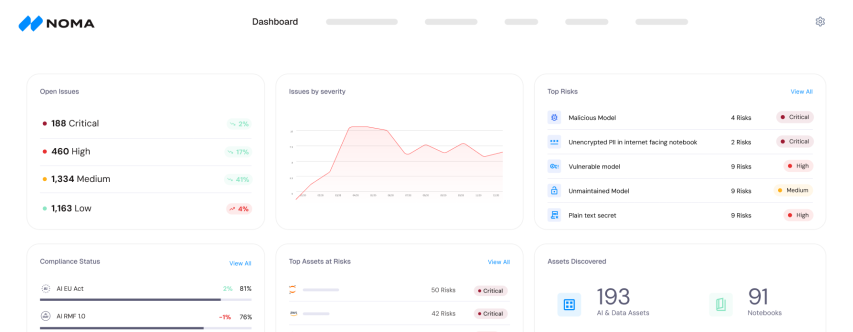
Noma Security is a unified AI security platform that covers discovery, AI security posture management, red teaming, and runtime protection across models, agents, data pipelines, and MCP servers. It integrates with 80-plus platforms and maps an agent's blast radius across its tools, identities, and data paths.
Its posture core is built on discovery and static assessment: it scans the environment to inventory AI assets, flags misconfigurations, over-permissioned identities, and supply-chain risks like malicious models and poisoned data. Its runtime protection is delivered differently, as a plugin on a third-party Kong gateway, plus SDK and IDE hooks, that enforces guardrails on tool calls and MCP connections. That runtime layer routes traffic, telemetry, enforcement decisions, and audit logs outbound to Noma's cloud, which places the record of your agent activity outside your perimeter by default and makes Noma a fit for organizations without hard data sovereignty requirements. It holds enterprise controls like SSO and MFA and is used by large enterprises, so it meets the enterprise bar. But it has no gateway of its own, its enforcement rides on someone else's, and your data leaves your perimeter to reach it.
Native AI Gateway Integration: A First-Party Gateway vs a Kong Plugin
The gateway is where posture and enforcement meet the traffic, and owning it or borrowing it changes everything downstream. A first-party gateway is built for this job and controlled end to end. A plugin on someone else's gateway inherits that gateway's limits and its operational footprint.
TrustLens is built on TrustGate, NeuralTrust's own AI gateway, which brokers every LLM, MCP, and tool call. The gateway and the posture layer are one platform, designed together, so the call that TrustGate brokers is the call TrustLens sees, and the enforcement point is NeuralTrust's own.
Noma has no gateway of its own. Its runtime enforcement is delivered as a plugin on a third-party Kong gateway, alongside SDK and IDE hooks. That means the enforcement point belongs to Kong, not Noma, and the runtime layer depends on standing up and running that third-party gateway. A plugin bolted onto someone else's gateway is not the same as a gateway built for AI posture and enforcement as one system. TrustLens owns the gateway, so it owns the call and the enforcement on it.
Flexible Deployment: Private and Cloud vs Cloud Service
Where a posture platform runs decides which environments it can cover and where your agent data goes. Some organizations need posture and observability running inside their own environment, not only as a service that reaches in.
TrustLens runs in your private environment or in the cloud, so posture and behavior tracking can live inside your perimeter, with agent traffic and its telemetry staying where you need them.
Noma is delivered as a cloud service, and its runtime layer routes traffic and telemetry out to Noma's cloud. It is positioned for organizations without hard data sovereignty constraints, which is a candid description of a platform that expects your data to leave your environment to reach it. For organizations that need their agent posture, observability, and enforcement running privately, inside their own infrastructure, a cloud service with outbound routing is not that. TrustLens gives you the private option.
Data Stays in Your Perimeter: Inside vs Routed to the Vendor's Cloud
For AI-SPM, the posture record is sensitive in its own right. It is the log of what your agents did, what data they touched, and what your enforcement decided. Where that record lives is a security question, not a detail.
TrustLens keeps it inside your perimeter. Because it runs in your private environment on a first-party gateway, the traffic, the observed behavior, the enforcement decisions, and the audit trail all stay where you control them. Nothing about your agent activity has to leave your environment for the platform to work.
Noma routes it out. Its runtime enforcement, delivered as a Kong gateway plugin, sends traffic, telemetry, enforcement decisions, and audit logs outbound to Noma's cloud, placing the record of your agent activity outside your perimeter by default. Noma itself is positioned for organizations without hard data sovereignty requirements, which is the honest consequence of that architecture. For a regulated enterprise, or any organization that treats its AI activity log as sensitive, enforcement decisions and audit trails leaving the perimeter is exactly the exposure AI-SPM is supposed to reduce. TrustLens keeps the record where it belongs.
Directly Integrated in the Interaction Path: First-Party vs a Third-Party Plugin
Being in the path is what lets a platform see and act on the call firsthand. The question is whether that path is the platform's own or borrowed from a third-party component it plugs into.
TrustLens is integrated directly in the interaction path on NeuralTrust's own gateway. The call flows through infrastructure NeuralTrust controls end to end, so observation and enforcement happen firsthand, on the platform's own path, inside your environment.
Noma reaches the path through a plugin on a third-party Kong gateway, plus SDK and IDE hooks. That does put enforcement near the traffic, but by way of a component Noma does not own and a set of hooks wired into individual tools, with the result routed out to Noma's cloud. Enforcement that lives in someone else's gateway and reports to an external service is a different posture than enforcement built into a first-party path that stays in your environment. TrustLens is on its own path, in your perimeter.
Observed Behavior, Not Static Posture: What Agents Do vs What Scans Find
This is the heart of AI-SPM. Static discovery and scanning describe the AI systems you have and the misconfigurations they carry. Observed behavior describes what those systems did. The gap between the two is where risk hides.
TrustLens builds posture from observed behavior. Because it sits on the call, it reports posture on what agents actually did: which tools they invoked, which data they touched, which services they reached, captured as the real interaction and mapped to the frameworks that matter. Posture reflects the live record, not a scan of the environment around the agent.
Noma's posture core is static. Its AI-SPM discovers and inventories assets, scores misconfigurations, flags over-permissioned identities, and assesses supply-chain risk, which describes the state of the environment. Noma does add runtime monitoring, but that runs through its Kong plugin and routes out to its cloud, separate from the static posture core, rather than posture being grounded in the observed call itself. Scanning the environment tells you what could go wrong. Observing the call tells you what did. TrustLens reports what did, and keeps it in your perimeter.
Final Verdict
AI-SPM comes down to whether posture is observed or static, and to where your agent data lives. A platform on its own path, in your environment, reports what agents did and keeps the record inside your perimeter. A platform that scans the environment and enforces through a third-party gateway plugin routed to its cloud reports the state of your assets and moves your activity log outside your control.
TrustLens is integrated directly in the path on NeuralTrust's own gateway. It builds posture from observed behavior, covers every agent's real activity firsthand, runs in your private environment or the cloud, and keeps traffic, enforcement decisions, and audit trails inside your perimeter. And because it shares a platform with NeuralTrust's runtime security enforcement, what it observes can be acted on in the same path, in your environment, so posture leads to prevention rather than to a report shipped elsewhere.
Noma Security is a unified platform with wide discovery reach, but its posture core is static scanning, it has no gateway of its own and enforces through a plugin on a third-party Kong gateway, and that runtime layer routes traffic, enforcement decisions, and audit logs out to Noma's cloud, placing your agent activity outside your perimeter by default. Noma itself is positioned for organizations without hard data sovereignty requirements.
Both clear the enterprise bar, so that is not the deciding factor. The decision is whether you want posture built on observed behavior, on a native gateway, in your own environment, with your data staying inside your perimeter, or posture built on static scanning, enforced through a third-party plugin, with your activity routed to a vendor's cloud. If your AI activity log belongs inside your perimeter, NeuralTrust is built for exactly that.
Frequently Asked Questions about NeuralTrust vs. Noma Security
1. What is the main difference between NeuralTrust and Noma Security for AI-SPM?
NeuralTrust TrustLens is integrated directly in the path on its own AI gateway, builds posture from observed behavior, and keeps your data inside your perimeter. Noma Security is a unified platform whose posture core is static discovery and scanning, whose runtime enforcement is a plugin on a third-party Kong gateway, and which routes traffic, enforcement decisions, and audit logs out to its cloud. One keeps the record in your environment, the other moves it out.
2. Does Noma keep agent data inside my perimeter?
By default, no. Noma's runtime enforcement is delivered as a Kong gateway plugin that routes traffic, telemetry, enforcement decisions, and audit logs outbound to Noma's cloud, placing your agent activity record outside your perimeter, and Noma is positioned for organizations without hard data sovereignty requirements. NeuralTrust TrustLens runs in your private environment and keeps that record inside your perimeter.
3. Does Noma have its own AI gateway?
No. Noma enforces at runtime through a plugin on a third-party Kong gateway, along with SDK and IDE hooks. NeuralTrust is built on TrustGate, its own native AI gateway, which brokers every LLM, MCP, and tool call and is both the enforcement point and the source of truth for posture.
4. Does Noma build posture from observed behavior?
Noma's AI-SPM core is static discovery and scanning, inventorying assets and flagging misconfigurations, over-permissioned identities, and supply-chain risks. It adds runtime monitoring, but that runs through its Kong plugin and out to its cloud, separate from the static posture core. NeuralTrust builds posture from the observed call itself, captured firsthand on its own gateway.
5. Are both platforms enterprise-ready?
Yes. Both NeuralTrust and Noma are enterprise-ready, with controls like SSO and MFA and adoption by large enterprises, so enterprise readiness is a point of parity. The meaningful differences are a native gateway versus a third-party Kong plugin, whether data stays in your perimeter, direct in-path integration, and observed behavior versus static posture.
Related AI-SPM Comparisons:
- The 8 Best AI-SPM Tools for Enterprise AI Security in 2026
- NeuralTrust vs. Zenity: AI-SPM Comparison 2026
- NeuralTrust vs. Wiz: AI-SPM Comparison 2026
- NeuralTrust vs. Pillar Security: AI-SPM Comparison 2026
- NeuralTrust vs. WitnessAI: AI-SPM Comparison 2026
- NeuralTrust vs. Reco: AI-SPM Comparison 2026
- NeuralTrust vs. Geordie: AI-SPM Comparison 2026
About the Author
Alessandro Pignati is Lead AI Security Researcher at NeuralTrust, where he leads research on AI and agentic security, advancing techniques to evaluate and secure large language models and autonomous AI systems. He specializes in adversarial machine learning, AI red teaming, LLM security, and AI safety, contributing to the development of secure and trustworthy AI.
NeuralTrust is an AI agent security platform, recognized in the Gartner 2025 Market Guide for AI Gateways and Guardian Agents, and the KuppingerCole 2025 Leadership Compass for Generative AI Defense. Headquartered in Barcelona with ISO 27001 certification.
)
)
)
)