Last updated: November 23, 2026
On November 21, 2026, Ars Technica reported that OpenRouter had emailed customers that some of their prompts may have been read. If you are weighing OpenRouter alternatives for an enterprise AI gateway, start with one question: who can read your prompt at each hop? Price and model count come second. This guide compares six gateways on where they run, how they bill, and what each fits best.
TL;DR: Key Takeaways
- The test was large: researchers sent nearly 2 million prompts with trackable secrets and found at least 3 compromised AI providers (Ars Technica, 2026).
- OpenRouter acted: it removed 3 providers and revoked zero data retention approval for 125 endpoints, partly as a precaution (The Decoder, 2026).
- Access controls lag: 92% of organizations with an AI-related breach lacked proper AI access controls (IBM, 2026).
- Every hop can be a sub-processor: under Article 28(2), a processor needs the controller's prior specific or general written authorization before engaging another processor (GDPR, 2016).
- Start free to test a route: TrustGate's Free plan includes 100,000 requests a month (TrustGate pricing, 2026).
At a glance: OpenRouter alternatives compared
Quick Answer
What are the best OpenRouter alternatives for enterprise?
The best OpenRouter alternatives for enterprise are gateways that sit in your control path: TrustGate, LiteLLM, Kong AI Gateway, TrueFoundry, Azure API Management, and Vercel AI Gateway. Choose by who reads the plaintext prompt, where the gateway runs, and how it bills. We list TrustGate first because we build it.
| Gateway | Type | Where it runs | Pricing model | Best for |
|---|---|---|---|---|
| TrustGate | AI gateway for models, MCP servers, tools, agents | SaaS, hybrid, on-premises | Free, Standard, Enterprise | Security and identity on the data path |
| LiteLLM | Gateway server, open-source core plus Enterprise | Self-hosted | Open-source core, custom Enterprise | Platform teams that run their own gateway |
| Kong AI Gateway | API gateway extended to AI traffic | Cloud, hybrid, self-hosted | From $25/month plus usage | Teams already on Kong |
| TrueFoundry | AI gateway with MCP gateway | Cloud, VPC, on-premises, air-gapped | Free, $25 per user/month, custom | Platform teams that want quotas and budgets |
| Azure API Management | API management with AI gateway capabilities | Azure, self-hosted gateway option | By service tier | Azure-centered organizations |
| Vercel AI Gateway | Hosted gateway API | Hosted by Vercel | Pay as you go, no token markup | App teams on Vercel |
How we compared
We read each vendor's official product, documentation, and pricing pages on November 23, 2026. We did not test products, benchmark performance, or rank them. Where a page did not state a price or feature, we write n/a. We left out Portkey, which Palo Alto Networks acquired in a deal that closed on May 29, 2026, and Helicone, which says it is now part of Experiential Labs.
Why a price-based router became a privacy question
A router that picks the cheapest provider also picks who reads your prompt. According to Ars Technica (2026), a Dragos canary-token study seeded nearly 2 million prompts with unique AWS keys, passwords, and URLs. At least three providers were compromised, and in two of the breaches some stolen requests were marked zero data retention.
According to The Decoder (2026), OpenRouter then removed three providers and revoked zero data retention approval for 125 endpoints. The lesson is architectural. Each hop decrypts the prompt, so a privacy flag only records what a hop promised. The gateways below differ mainly on who sits in that path.
The 6 best OpenRouter alternatives for enterprise
These six options cover the main architectures: a security-focused gateway, a self-hosted proxy, an API gateway with AI features, a platform gateway, a cloud-native option, and a hosted gateway. Each entry lists what it is, key features, best fit, and pricing, using only the vendor's own pages.
#1 - TrustGate (NeuralTrust)
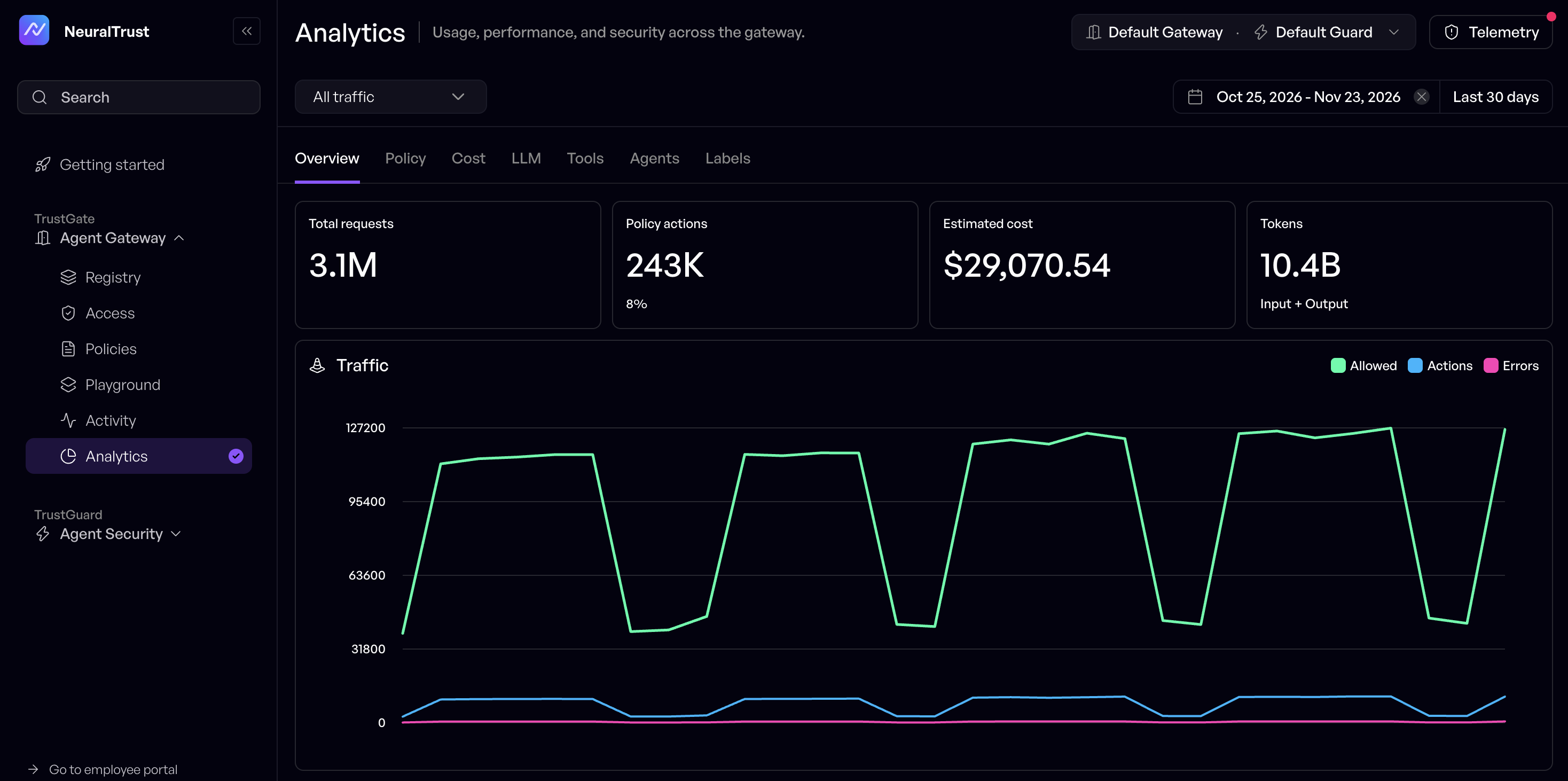
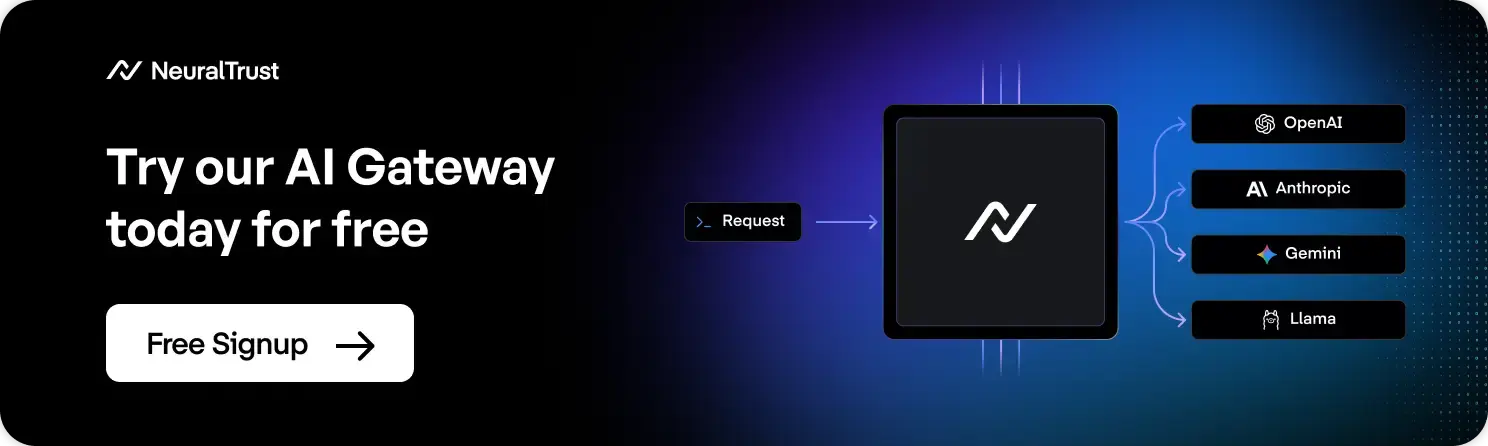
- What it is: Agent Gateway (TrustGate) is NeuralTrust's AI gateway. It gives agents one place to reach models, MCP servers, tools, and other agents, with calls routed through a layer you control and meter.
- Key features: routing to OpenAI, Anthropic, Azure OpenAI, and self-hosted vLLM. TrustGate applies PII redaction and data masking, so sensitive values are masked before a prompt reaches the upstream provider. Inline prompt inspection runs with Agent Runtime Security (TrustGuard). TrustGate also forwards end-user identity through every hop, with per-agent and per-tool access control, semantic caching, and cryptographic audit trails.
- Best for: enterprises that need policy, masking, and audit on the data path, not only model access.
- Deployment: SaaS to start fast, hybrid with a SaaS control plane and a privately hosted data plane, or on-premises and air-gapped.
- Pricing model: Free at $0 with 100,000 requests a month. Standard at $49 a month, which goes to your wallet as usage credit, then $0.0003 per request. Enterprise is custom, with private deployment and SSO. Model provider token costs are separate.
Where it fits less: a prototype that needs the cheapest model today, with no sensitive data. For regulated or agentic workloads, you can start for free and route a test workload through TrustGate.
#2 - LiteLLM
- What it is: According to LiteLLM (2026), its AI Gateway is a self-hosted server with one OpenAI-compatible endpoint for 100+ LLM providers, MCP tools, and A2A agents.
- Key features: virtual keys with per-key models, budgets, and rate limits, plus spend tracking, load balancing, fallbacks, and retries. It adds guardrails such as PII masking, an Admin UI, and logging to tools such as Datadog and Prometheus.
- Best for: platform teams that want to run the gateway in their own infrastructure.
- Pricing model: an open-source gateway (MIT-licensed core) that can be self-hosted, including in air-gapped environments, plus an Enterprise plan with SSO, SCIM, audit logs, and RBAC. Enterprise pricing is custom, and a 30-day trial key is offered.
#3 - Kong AI Gateway
- What it is: According to Kong (2026), its AI Gateway governs LLM, MCP, and agent-to-agent traffic, and extends the same platform that handles API traffic.
- Key features: PII sanitization, semantic prompt guards, semantic caching, routing and load balancing, user, model, and time-bound token quotas, and MCP server access control.
- Best for: teams that already run Kong for APIs and want AI traffic under one platform.
- Pricing model: Kong's pricing page lists a Plus plan from $25 a month plus usage, billed monthly. Fully self-hosted AI gateways fall under a separate Gateway Enterprise offering with custom pricing.
#4 - TrueFoundry
- What it is: According to TrueFoundry (2026), its AI gateway unifies model access with policy control and monitoring, and includes an MCP gateway on the same platform.
- Key features: routing with latency-based and weighted load balancing, fallbacks, rate limits, token and cost quotas, role-based access control, request logs, and support for self-hosted models.
- Best for: platform teams that want budgets, quotas, and routing rules managed as configuration.
- Pricing model: Developer is free for up to 3 users with 10K requests and tool calls per user each month. Pro is $25 per user a month with 20K per user, then $20 per additional 100K. Enterprise is custom and adds VPC, on-premises, air-gapped, and data residency options. TrueFoundry states it never marks up tokens.
#5 - Azure API Management (AI gateway)
- What it is: According to Microsoft (2026), the AI gateway is a set of capabilities in Azure API Management. It extends the API gateway and is not a separate offering.
- Key features: it manages language model APIs that use OpenAI Chat Completions or Responses schemas, plus Anthropic Messages on v2 tiers. It also covers remote MCP servers, A2A agent APIs, and self-hosted models. Capabilities include authentication, load balancing, token quotas, and logging.
- Best for: organizations that already standardize on Azure and API Management.
- Pricing model: priced by service tier, and capability availability varies by tier. The pricing page we read did not display price figures, so exact prices are n/a here.
#6 - Vercel AI Gateway
- What it is: According to Vercel (2026), AI Gateway is a managed, hosted API for calling models across providers, usable from any cloud without running your own proxy.
- Key features: provider routing and ordered fallbacks, request logs with latency, token usage, and cost, budgets by team, project, or key, bring-your-own-key, and optional zero data retention routing.
- Best for: application teams that want a hosted gateway with little to operate, especially if they already build on Vercel.
- Pricing model: pay as you go with no markup on provider list prices, including with your own key. A free tier covers a subset of models with lower rate limits. Per-request zero data retention has no additional cost, while team-wide zero data retention costs $0.10 per 1,000 requests. Both need a paid account.
What to ask any OpenRouter alternative you shortlist
Ask six questions before you sign anything, and get answers in writing. They separate a gateway that controls your data path from a router that only forwards it. Put the same questions to every vendor on your list, including us.
| Question | Why it matters | Evidence to request |
|---|---|---|
| Where is the prompt decrypted, and by whom? | Every hop reads plaintext | Data-flow diagram, hop list |
| Who chooses the upstream provider? | Defaults may send traffic to the cheapest pool | Provider pinning, allowlist settings |
| Is zero data retention enforced or only flagged? | Flags failed in the study | Contract terms, audit report |
| What is logged, and for how long? | Logs are a second copy | Retention schedule, deletion proof |
| Can sensitive data be masked before egress? | Secrets should not leave | Masking rules, test results |
| How would you detect a leak? | Silence proves nothing | Canary support, alert hooks |
Moore's own advice is practical. According to The Decoder (2026), control how your requests are routed, check privacy settings, and plant canary tokens, which are fake credentials that give themselves away when used. Our guide to zero data retention for AI agents covers contract terms and enforcement in depth. For head-to-head notes, see our comparisons with LiteLLM and Kong.
The GDPR adds a legal angle. Under Article 28(2), a processor may not engage another processor without the controller's prior specific or general written authorization (GDPR, 2016). If prompts hold personal data, every extra hop may be a sub-processor. Confirm with counsel.
Security and governance: risks a prompt router adds
A router adds three risks: prompt and secret exposure, supply chain trust in every hop, and weak access control over who may call what. They map to OWASP sensitive information disclosure and supply chain risks. Treat the routing layer as part of your attack surface.
OWASP (2025) states that sensitive information includes personal data, financial details, and other confidential content in LLM applications (LLM02). Its supply chain entry covers third-party components that affect model and deployment integrity. According to IBM (2026), 92% of organizations with an AI-related breach lacked proper AI access controls.
NeuralTrust approaches this by putting access control and audit in one clear layer. Route agent traffic through TrustGate, secure agent interactions with Agent Runtime Security (TrustGuard), and keep the data plane in your own infrastructure or on-premises. Keep tabs on every call, and test routes with canaries.
Which should you choose?
Match the option to your data, not your budget. Public prompts with no secrets can use a hosted gateway. Anything with customer data, source code, or credentials needs a short, known data path, with masking applied and logs that you own.
| If you... | Lean toward | Because |
|---|---|---|
| Need security and identity on every agent call | TrustGate | Masking, inspection with TrustGuard, and audit on the data path |
| Want to run your own gateway server | LiteLLM | Self-hosted, with an open-source core |
| Already run Kong for APIs | Kong AI Gateway | One platform for API and AI traffic |
| Need quotas and budgets as configuration | TrueFoundry | Rate limits, quotas, and routing rules |
| Standardize on Azure | Azure API Management | Extends your existing API gateway |
| Build apps on Vercel | Vercel AI Gateway | Hosted, with little to operate |
Conclusion
OpenRouter alternatives differ less on model count than on who sits in your data path. Shortlist by architecture, ask the six questions in writing, and test zero data retention with your own canary prompts instead of trusting a flag. If your prompts carry secrets or customer data, pick a short path you control, with masking and audit, and keep tabs on every hop.
Secure AI Gateways in Production with NeuralTrust
Route every model call through TrustGate: one clear layer for access, masking, and audit.
Related Comparisons
- Best AI Gateways for Enterprise in 2026
- Self-Hosted AI Gateway: Deploy in 7 Steps
- Zero Data Retention for AI Agents (2026)
- AI Gateway Security: Key Controls
FAQs about OpenRouter Alternatives
1. What are the best OpenRouter alternatives for enterprise?
There is no single best option. This guide compares TrustGate, LiteLLM, Kong AI Gateway, TrueFoundry, Azure API Management, and Vercel AI Gateway. Pick by who reads your prompts, where the gateway runs, how it bills, and whether you need security controls on the data path.
2. Is OpenRouter safe for enterprise data?
It depends on the data and the route. After the Dragos study, OpenRouter told customers that prompts sent to one China-based model provider may have been read, and it removed three providers. For secrets or customer data, use a short, known data path with masking and your own audit logs.
3. What is the difference between an AI router and an AI gateway?
A router sends each request to an available provider, often by price or fit. A gateway sits in your control path and applies identity, policy, masking, and logging before and after the model call. Some products blend both, so check who selects the upstream and who stores the logs.
4. Can I trust a zero data retention label?
Treat it as a claim to verify. In the Dragos test, some requests marked zero data retention were still accessed, according to Ars Technica. Ask for contract terms and audit evidence, limit the providers in the chain, and plant your own canary prompts to see whether the promise holds.
5. Is there a self-hosted OpenRouter alternative?
Yes. Several gateways in this guide run in your own infrastructure, and some offer on-premises or air-gapped options, so you control logging, provider choice, and patching. You still send prompts to whichever model provider you select. Check each vendor's documentation for the deployment modes it supports.
6. How do I stop secrets in prompts from leaking?
Keep secrets out of prompts first. Then mask sensitive values at the gateway before the prompt reaches the model provider, pin the providers that may receive traffic, and shorten the chain. Add canary tokens on each route, so a leaked key alerts you the moment someone uses it.
7. Do OpenRouter alternatives support compliance needs?
Some do, but verify each claim. If prompts contain personal data, GDPR Article 28 requires the controller's prior written authorization before a processor engages another processor, so every hop matters. Request a hop list, retention terms, and hosting regions in writing, and confirm scope with counsel.
About the Author
Roger Howroyd is Head of Global SEO and AI at NeuralTrust, where he leads the company's search strategy across SEO, AEO, GEO, and LLM optimization. He specializes in AI-powered search, content strategy, and SEM. Connect on LinkedIn.
NeuralTrust is the leading platform for securing and scaling AI agents. Named a Pioneer in the Gartner Emerging Market Quadrant for AI Application Security 2026, recognized across four Gartner Hype Cycle reports in 2026, and featured in the Gartner Market Guide for Guardian Agents 2026, the Gartner Market Guide for AI Gateways 2025 and the KuppingerCole Leadership Compass for Generative AI Defense 2025. Headquartered in Barcelona with offices in London and New York. ISO 27001 certified.
Sources
- Ars Technica, Dan Goodin, "Researcher plants 2m canaries into the AI supply chain. A privacy disaster surfaced," November 20, 2026, updated November 21, 2026. https://arstechnica.com/security/2026/11/a-leaky-ai-supply-chain-is-exposing-secret-user-data-at-an-alarming-rate/
- The Decoder, "Security researchers show how cheap AI inference providers steal keys and snoop on users," November 22, 2026. https://the-decoder.com/security-researchers-show-how-cheap-ai-inference-providers-steal-keys-and-snoop-on-users/
- IBM and Ponemon Institute, "Cost of a Data Breach Report 2026," July 29, 2026. https://assets.ibm.com/adobe/assets/urn:aaid:aem:21111142-1251-4369-86fb-57b82f5bb108/original/as/Cost%20of%20a%20Data%20Breach%20Report%202026.pdf
- OWASP GenAI Security Project, "LLM02:2025 Sensitive Information Disclosure," 2025. https://genai.owasp.org/llmrisk/llm022025-sensitive-information-disclosure/
- OWASP GenAI Security Project, "LLM03:2025 Supply Chain," 2025. https://genai.owasp.org/llmrisk/llm032025-supply-chain/
- Regulation (EU) 2016/679 (GDPR), Article 28, "Processor," 2016. https://gdpr-info.eu/art-28-gdpr/
- NeuralTrust, AI Gateway and pricing pages, accessed November 23, 2026. https://neuraltrust.ai/ai-gateway and https://neuraltrust.ai/pricing
- Vendor pages accessed November 23, 2026. LiteLLM website FAQ and Enterprise documentation. Kong pricing and AI Gateway pages. TrueFoundry pricing and AI Gateway pages. Microsoft Learn, "AI gateway capabilities in Azure API Management," and the Azure API Management pricing page. Vercel AI Gateway pricing and Zero Data Retention documentation.