Last updated: October 2026
What is the best AI Gateway for enterprise in 2026?
The best AI gateways for enterprise in 2026 are NeuralTrust TrustGate, Solo.io, Portkey, LiteLLM, Kong AI Gateway, TrueFoundry, Apache APISIX, MLflow AI Gateway, HAProxy AI Gateway and Google Agent Gateway. TrustGate is the best choice for securing and governing AI agents and MCP traffic, while Portkey and LiteLLM lead on multi-model routing and cost control.
This guide compares each gateway on security, MCP and agent support, routing, cost controls, observability and deployment, so platform and security leaders can pick the right fit.
TL;DR
- What an AI gateway does: it is the control layer between your apps or agents and the AI services they call, centralising routing, security, cost control and observability.
- The ten gateways in this guide occupy very different niches. Most solve one or two dimensions well and assemble the rest. The right choice depends on which gaps you can afford to carry.
- NeuralTrust TrustGate: best for securing and governing AI agents, with LLM and MCP traffic under one policy model. It adds under 100 ms at p95 with PromptGuard and Data Masking enabled, handles 20k+ requests per second per node, and detects jailbreaks, injections and policy violations with 99% multilingual accuracy. Split-plane data residency keeps sensitive data inside your perimeter. Start on the Free plan (100,000 requests/month).
- Solo.io agentgateway: best for open source, Kubernetes-native agent and MCP traffic.
- Portkey: best for observability and developer experience across many models.
- LiteLLM: best for teams that want a self-hosted, open source proxy to many LLM providers.
- Kong AI Gateway: best for teams already running Kong for API management.
- TrueFoundry: best for a managed platform that combines model serving and gateway.
- Apache APISIX and HAProxy: best for high-performance, infrastructure-first routing with security added through plugins.
- MLflow AI Gateway: best for teams already using MLflow for their ML lifecycle.
- Google Agent Gateway: best for organisations standardised on Google Cloud.
- How to choose: start from your main gap (security, open infrastructure, observability or a managed platform), then check MCP support and deployment options.
What Is an AI Gateway?
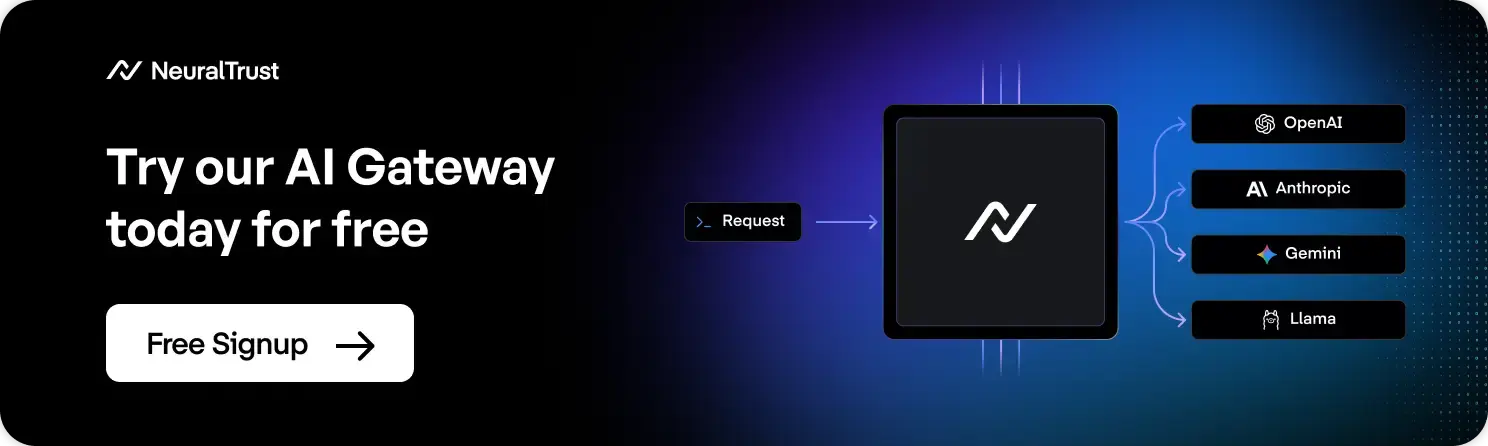
An AI gateway is a specialized control layer that sits between your applications and agents on one side and the AI services they consume on the other, most commonly LLM providers such as OpenAI, Anthropic, and Google, but increasingly also MCP tool servers and other agents. Conceptually it is the AI-native cousin of the API gateway: where an API gateway is the checkpoint for ordinary service traffic, an AI gateway is the checkpoint for AI traffic, which behaves differently (token-based costs, non-deterministic outputs, prompt-level risks, and multi-step agent workflows) and therefore needs its own control point.
A capable AI gateway typically does four things. It makes AI delivery reliable, by centralizing provider connections, routing, failover, retries, and caching so individual applications do not each re-implement them. It controls cost, through token-based rate limiting, budgets, and usage attribution by team or key. It provides observability, by logging and tracing every request so cost, latency, and behavior are visible in one place. And, most important for this guide, it gives security and compliance somewhere to attach, a single point where policy is enforced and where what an agent actually did can be audited.
The gateways in this comparison differ most in that last dimension. Some treat security enforcement as the reason the gateway exists; others focus on routing, observability, or platform breadth and treat security as an integration or an add-on. Understanding that difference is the key to choosing well, and it is the lens this guide uses throughout.
AI Gateway Comparison at a Glance
NeuralTrust TrustGate is the only gateway in this comparison with a first-party security engine attached inline to every route, while most alternatives rely on external guardrail integrations or plugins.
| Gateway | Category | Runtime AI security | MCP governance | Licensing / model | Best for |
|---|---|---|---|---|---|
| NeuralTrust TrustGate | Security-first AI control plane | First-party Security Engine (TrustGuard) attaches to every route; multi-turn analysis | LLM + MCP traffic under one policy model; per-agent, per-tool controls | Free SaaS plan + Standard and Enterprise (Apache 2.0 core) | Security-led buyers wanting a first-party enforcement substrate |
| Solo.io agentgateway | Kubernetes-native infrastructure gateway | External guardrail integrations + regex; MCP tool RBAC via policy engine | Strong MCP tool RBAC | Apache 2.0 (Linux Foundation project) | Platform teams standardized on Kubernetes and service mesh |
| Portkey | LLM-observability + gateway | Via Prisma AIRS (Palo Alto) | MCP Gateway with OAuth 2.1 | MIT gateway core + commercial (now part of Palo Alto Networks) | Teams wanting a hosted enterprise gateway with guardrails |
| LiteLLM | Open-source provider-unification gateway | Guardrails framework wrapping external services (Enterprise for top integrations) | MCP gateway with per-key/team tool permissions | MIT core + Enterprise | Developers wanting the simplest path to 100+ providers |
| Kong AI Gateway | AI plugins on an API gateway | AI Prompt Guard (regex), PII sanitizer, guardrail integrations (Enterprise) | MCP from Kong-managed APIs; registry in Konnect | Apache 2.0 core; AI security features Enterprise | Enterprises already running Kong for API management |
| TrueFoundry | Broad Kubernetes-native AI platform | Configurable guardrails (built-in + external + custom) | Strong MCP gateway | Commercial platform (integrates OSS; acquired Seldon) | Kubernetes-native enterprises consolidating models, agents, tools |
| Apache APISIX | AI plugins on an API gateway | ai-prompt-guard (regex) + external moderation; all AI plugins open | MCP-to-HTTP proxy, per-consumer MCP tool ACL | Apache 2.0 (ASF project); commercial API7 | Teams wanting a high-performance, fully open, vendor-neutral gateway |
| MLflow AI Gateway | Gateway inside an ML/GenAI platform | Emerging guardrails; not a dedicated engine | MCP access emerging | Apache 2.0 (LF Projects) | Teams standardized on MLflow for the ML/GenAI lifecycle |
| HAProxy AI Gateway | AI use case on a load balancer / ADC | WAF-based prompt inspection (Enterprise WAF) | MCP not documented gateway features | OSS community edition; AI gateway via HAProxy Enterprise | Organizations standardized on HAProxy wanting proven performance |
| Google Agent Gateway | Managed cloud-native agent gateway | Model Armor (per-request prompt injection, jailbreak, DLP); no multi-turn analysis | Agent Registry governs registered MCP servers | Proprietary managed service (Google Cloud only) | Teams running entirely on Google Cloud |
The 10 Best AI Gateways in 2026
1. NeuralTrust TrustGate

Most gateways in this list make you choose: open source or security. Performance or compliance. Developer speed or enterprise control. TrustGate is built on the premise that an architect deploying agents at scale should not have to choose.
Protocol coverage is where most competing gateways break down. TrustGate governs LLM traffic and MCP tool calls in a single unified policy model. That matters not because of today's deployment, it matters because the gateway you pick now is the one you will be migrating away from in 18 months.
Deployment runs wherever your data has to live: SaaS for speed, hybrid cloud (SaaS control plane, private data plane) for GDPR and HIPAA, fully air-gapped on-premises for defence, government, and financial sector. 100% split-plane data residency, sensitive data never leaves your perimeter.
The security layer TrustGuard, NeuralTrust's first-party detection engine) is the one dimension where TrustGate has no equivalent in this list. 99% multilingual accuracy across jailbreaks, injections, and policy violations, attached inline to every route, with multi-turn conversation analysis rather than per-request filtering.
But for the architect evaluating this list, security is the baseline. The differentiator is that everything else is also there.
- Get started: Free SaaS plan with 100,000 requests/month, no setup required.
- Performance: under 100ms p95 latency with security enabled; 20k+ rps/node
- Protocol coverage: LLM + MCP in one policy model
- Deployment: SaaS, hybrid cloud, air-gapped on-premises
- Security: TrustGuard inline, 99% multilingual accuracy, multi-turn analysis
- Compliance: EU AI Act, HIPAA, GDPR, FedRAMP/IL4 pathway
- Analyst recognition: Gartner AI Gateways + Guardian Agents; KuppingerCole Leadership Compass
- Limitations: focused on security and governance, so teams that only need lightweight multi-provider routing may not need its full feature set.
Best for: Security-led platform teams that need to secure and govern AI agents, LLM and MCP traffic from one control plane.
2. Solo.io agentgateway

Solo.io's agentgateway is a Kubernetes-native, high-performance data plane written in Rust, and it is now a Linux Foundation project with broad industry backing. It is the most technically rigorous multi-protocol open-source competitor, built for platform engineers who own the deployment layer and want AI traffic governed with the same rigor as service-mesh traffic.
Its standout capability for security teams is MCP tool governance: a CEL-based policy engine that enforces tool-level access control keyed on JWT claims, plus tool-list filtering so an agent only sees the tools it is authorized to use. Content security, by contrast, is delivered through external integrations (OpenAI Moderation, AWS Bedrock Guardrails, Google Model Armor) and regex rather than a first-party engine.
- Runtime security: External guardrail integrations plus regex; no first-party detection engine.
- Protocol coverage: Strong MCP tool RBAC.
- Foundation: Apache 2.0, Linux Foundation project with wide backing.
- Best for: Kubernetes-native platform teams that value open governance and infrastructure rigor.
- Limitations: No first-party detection engine; content security relies on external integrations and regex.
Related article: NeuralTrust vs Solo.io agentgateway: AI Gateway Comparison 2026
3. Portkey

Portkey is a widely adopted LLM gateway and observability platform positioned as a control plane for AI, with guardrails, PII redaction, and audit trails built into the gateway layer. It routes to a very large catalog of models (it cites 1,600+ models across 40+ providers), and its gateway core is open source under the MIT licence.
The defining fact for enterprise buyers is corporate: Portkey was acquired by Palo Alto Networks, with the deal closing in May 2026, and it now serves as the AI Gateway for Prisma AIRS. Its runtime security today centers on guardrails and PII redaction, with deeper security capabilities converging into Palo Alto's platform.
- Runtime security: Comes from Palo Alto's Prisma AIRS platform rather than the open source gateway, and the roadmap now follows Palo Alto.
- Protocol coverage: MCP Gateway with OAuth 2.1.
- Licensing: MIT gateway core plus commercial platform, now part of Palo Alto Networks.
- Best for: Teams wanting a hosted, enterprise gateway with built-in guardrails, especially Palo Alto customers.
- Limitations: Deeper security is moving into Prisma AIRS, which ties advanced protection to the Palo Alto platform.
Related article: NeuralTrust vs Portkey: AI Gateway Comparison 2026
4. LiteLLM

LiteLLM is one of the most popular open-source AI gateways, beloved for wrapping 100+ providers behind a single OpenAI-compatible endpoint with minimal friction. It is MIT-licensed at the core, has a large community, and processes enormous request volumes, making it a default choice for developers who want provider unification fast.
For security and governance, LiteLLM offers a guardrails framework that wraps external services (LLM Guard, Llama Guard, Lakera, Aporia, and the OpenAI and Google moderation APIs), along with a real MCP gateway that supports per-key, per-team, and tool-level permissions. Several of the strongest integrations and enterprise controls (SSO beyond a small user count, audit-log retention, Prometheus metrics) require the Enterprise license.
- Runtime security: Guardrails framework wrapping external services; top integrations are Enterprise.
- Protocol coverage: MCP gateway with per-key/team and tool-level permissions.
- Licensing: MIT core plus Enterprise tier.
- Best for: Developers who want the simplest path to many providers and will layer security on top.
- Limitations: Top guardrail integrations, SSO and audit-log retention require the Enterprise licence.
Related article: NeuralTrust vs LiteLLM: AI Gateway Comparison 2026
5. Kong AI Gateway

Kong AI Gateway is not a standalone product but a set of AI plugins on Kong Gateway, the mature, high-performance API gateway built on Nginx/OpenResty. For organizations already running Kong, adding AI routing and governance is a plugin install rather than a new platform, which is its central appeal.
Its AI plugins include AI Proxy and AI Proxy Advanced, semantic caching, a RAG injector, prompt decoration and compression, advanced rate limiting, and a PII sanitizer. Security-oriented plugins such as AI Prompt Guard (regex), semantic prompt and response guards, and the PII sanitizer, along with audit logging and guardrail integrations (AWS Guardrails, Google Model Armor, Lakera, Mistral), are largely Enterprise or Konnect features, while the base AI Proxy and logging are open source.
- Runtime security: AI Prompt Guard (regex), PII sanitizer, and guardrail integrations, mostly Enterprise.
- Protocol coverage: Can generate MCP tools from Kong-managed APIs; MCP Registry in Konnect.
- Licensing: Apache 2.0 core; AI security features require Enterprise/Konnect.
- Best for: Enterprises already invested in Kong for API management.
- Limitations: Most AI security plugins are Enterprise or Konnect features; best value only if you already run Kong.
Related article: NeuralTrust vs Kong AI Gateway: AI Gateway Comparison 2026
6. TrueFoundry

TrueFoundry is a broad, Kubernetes-native enterprise AI platform in which the AI gateway is one component among model serving (vLLM, SGLang, Triton, KServe), an MCP gateway, an agent gateway, and prompt management. It recently acquired the open-source MLOps platform Seldon AI, adding a mature real-time ML serving foundation. Its model catalog is very large (the platform cites 1,000+ to 1,600+ models).
Its strongest dimension is deployment and data sovereignty: fully self-hosted, cloud-agnostic, Kubernetes-native, with tenant isolation physically backed by Kubernetes namespaces. Runtime security is a configurable guardrails framework combining built-in PII and toxicity checks with external integrations (OpenAI Moderation, AWS Guardrails, Azure Content Safety) and custom rules, rather than a dedicated first-party detection engine. Its MCP gateway (registry, tool-level RBAC, OAuth 2.0, federated identity, prebuilt connectors) is a genuine strength.
- Runtime security: Configurable guardrails (built-in plus external plus custom code).
- Protocol coverage: Strong MCP gateway.
- Deployment: Kubernetes-native; VPC, on-prem, air-gapped; physical namespace isolation.
- Best for: Kubernetes-native enterprises consolidating models, agents, and tools on one platform.
- Limitations: No dedicated first-party detection engine; runtime security relies on configurable guardrails and external integrations, and the gateway is one part of a broader platform.
Related article: NeuralTrust vs TrueFoundry: AI Gateway Comparison 2026
7. Apache APISIX

Apache APISIX is a high-performance, fully open-source API gateway and a top-level project of the Apache Software Foundation, built on Nginx/OpenResty with etcd for dynamic configuration. Its AI Gateway is a set of AI plugins that let teams manage AI traffic alongside traditional API traffic on the same platform. A notable differentiator is that all of its AI plugins, including the security-oriented ones, are open source, with no feature gate.
Its plugins include ai-proxy and ai-proxy-multi for multi-LLM routing, ai-rate-limiting, ai-prompt-guard (regex allow/deny that can scan full history), prompt decorators and templates, ai-rag, and content moderation via AWS Comprehend or Alibaba Cloud. For MCP, it offers MCP-to-HTTP bridging over Streamable HTTP, an openapi-to-mcp plugin, and per-consumer MCP tool access control. The commercial company API7.ai provides enterprise distributions and support.
- Runtime security: Regex prompt guarding plus external moderation; all AI plugins open source.
- Protocol coverage: MCP-to-HTTP proxy and per-consumer MCP tool ACL.
- Licensing: Apache 2.0 (ASF project); commercial support via API7.
- Best for: Teams wanting a high-performance, vendor-neutral, fully open gateway.
- Limitations: Prompt guarding is regex-based with external moderation; enterprise distributions and support come through API7.
Related article: NeuralTrust vs Apache APISIX: AI Gateway Comparison 2026
8. MLflow AI Gateway

The MLflow AI Gateway is a component of MLflow, the widely adopted open-source platform for the machine learning and GenAI lifecycle (experiment tracking, model registry, prompt registry, evaluation, tracing). It provides unified access to 50+ providers, centralized encrypted API-key management, per-endpoint rate limiting, traffic splitting and fallbacks, and usage tracking where every request becomes an MLflow trace. It added RBAC over gateway resources in version 3.13.0.
The key context is that its center of gravity is the ML/GenAI engineering lifecycle, not runtime security. Content-level guardrails are described as an emerging area rather than a dedicated engine, and MLflow's own guidance recommends a reverse proxy plus an external auth layer for production. Observability is its genuine strength, because gateway traffic lives alongside evaluations, experiments, and model lineage in one system.
- Runtime security: Emerging guardrails; credential management, rate limiting, RBAC, and audit logging.
- Protocol coverage: MCP access emerging.
- Licensing: Apache 2.0 (LF Projects); managed on Databricks and AWS. Does not run on Windows.
- Best for: Teams standardized on MLflow that mainly need governed model access and unified observability.
- Limitations: Content guardrails and MCP access are still emerging, and production use needs a reverse proxy plus an external auth layer.
Related article: NeuralTrust vs MLflow: AI Gateway Comparison 2026
9. HAProxy AI Gateway

HAProxy is one of the world's fastest and most widely used software load balancers and security ADCs, and its AI Gateway is a capability of the HAProxy One platform (HAProxy Enterprise as the data plane, HAProxy Fusion as the control plane) rather than a separate AI-native product. For teams already running HAProxy, extending it to AI traffic keeps the same proven performance, configurability, and observability.
Its documented AI capabilities center on cost control and WAF-based security: token-based rate limiting enforced consistently across clusters via the Global Profiling Engine, prompt-based routing where the HAProxy Enterprise WAF inspects each prompt for safety and data loss, strong API-key protection (hashing, intermediate keys, instant revocation), and 150+ metrics in HAProxy Fusion. Security is WAF-grounded rather than a first-party AI detection engine, and MCP are not documented AI gateway features today.
- Runtime security: HAProxy Enterprise WAF inspects each prompt; no first-party AI detection engine.
- Protocol coverage: MCP not documented AI gateway features.
- Licensing: Open-source community edition; AI gateway capabilities via HAProxy Enterprise.
- Best for: Organizations standardized on HAProxy that prize performance and deploy-anywhere flexibility.
- Limitations: Security is WAF-based rather than AI-native, MCP is not a documented feature, and AI gateway capabilities require HAProxy Enterprise.
Related article: NeuralTrust vs HAProxy: AI Gateway Comparison 2026
10. Google Agent Gateway

Google Agent Gateway is the networking component of the Gemini Enterprise Agent Platform (formerly Vertex AI Agent Builder), a managed service that governs agent connectivity inside Google Cloud. It sits at the entry and exit point for agent traffic, mediates protocols, terminates mTLS, and delegates authorization to Google Cloud services. For organizations already all-in on Google Cloud, it integrates tightly with the surrounding platform.
Its clear strength is identity: agent identities are secured with mTLS and DPoP, and access decisions run through Identity-Aware Proxy and IAM. Runtime security is delivered by Model Armor, a separate Google Cloud service integrated as an optional layer that inspects prompts and responses one request at a time for prompt injection, jailbreaks, sensitive data, and malicious URLs, without a session-level, multi-turn view. It governs MCP access through an Agent Registry, where each server must be registered before traffic is allowed. The defining constraint is portability: the gateway is proprietary, has no self-hosted or on-premises option, runs only inside Google Cloud, and is regional and scoped to a Google Cloud project.
- Runtime security: Model Armor (per-request prompt injection, jailbreak, DLP, malicious URLs); no multi-turn analysis.
- Protocol coverage: Agent Registry governs registered MCP servers; strong agent identity (mTLS, DPoP, IAP).
- Licensing: Proprietary managed service, Google Cloud only; no self-hosting or multi-cloud.
- Best for: Teams running entirely on Google Cloud that want tight platform integration.
- Limitations: Google Cloud only, with no self-hosted, on-premises or multi-cloud option; Model Armor inspects one request at a time without multi-turn analysis.
Related article: NeuralTrust vs Google Agent Gateway: AI Gateway Comparison 2026
LiteLLM & Portkey Alternatives
If you are looking for LiteLLM or Portkey alternatives, the right pick depends on why you are switching.
| Why you are switching | Best alternative |
|---|---|
| You need first-party runtime security for AI agents | NeuralTrust TrustGate |
| You want a Kubernetes-native, open source gateway | Solo.io agentgateway |
| You already run Kong for API management | Kong AI Gateway |
| You want models, agents and tools on one platform | TrueFoundry |
| You run entirely on Google Cloud | Google Agent Gateway |
Best AI Gateways of 2026: The Final Overview
| Feature | NeuralTrust | Other AI Gateways |
|---|---|---|
| Coverage | ✅ One gateway for both LLMs and MCP traffic, under one policy and one deployment | ❌ Often split in two pieces (LLM gateway and MCP gateway) |
| Security | ✅ Secures the full agent: tool calls, loops, and multi-turn behavior, not just the prompt | ❌ Usually delivered via plugins or third-party integrations, often limited to prompt and response checks |
| Tool Governance | ✅ 205 MCP servers shipped with the gateway | ❌ MCP servers maintained manually |
| Identity & Access | ✅ IdP groups control model and tool access. Identity flows to every tool call | ❌ IdP authentication stops at the gateway. Access configured manually |
| Data Residency | ✅ One control plane across every region and environment | ❌ Often one deployment per region, with no single control plane |
| Enterprise readiness | ✅ SSO, domain verification, audit trails, and SIEM, standard | ❌ SSO, audit logs and SIEM often reserved for paid tiers or added separately |
How to Choose the Right AI Gateway
Most buyers approach this decision by driver: "I need open source", "I need observability", "I need security". That framing makes sense when the products on the list are single-purpose tools. It breaks down when one of them covers all five dimensions without a trade-off.
The honest question to ask about every gateway in this list is: what does it not do well, and is that something I will need?
-
TrustGate performs at 20k+ rps/node with security enabled, covers LLM and MCP traffic under one policy model, adds under 100 ms at p95 with PromptGuard and Data Masking on, and ships with a first-party detection engine. If you need all of that (and most enterprise agentic deployments eventually will), it is the only gateway in this list that does not require assembly. You can start on the Free SaaS plan.
-
Solo.io agentgateway is the right choice if your team is Kubernetes-native and the Linux Foundation governance model matters to your procurement process. Its MCP tool RBAC is technically rigorous. Content security requires external integrations.
-
LiteLLM is the fastest path to 100+ providers for a development team. It is not an enterprise control plane.
-
Kong and Apache APISIX are the right answer if you already run one of them and want to extend it to AI traffic rather than introduce a new platform. Security is plugin-assembled.
-
Portkey was acquired by Palo Alto Networks and its technology now powers Prisma AIRS AI Gateway. If you are a Palo Alto customer, evaluate it in that context; if not, expect its roadmap to follow Palo Alto's platform.
-
TrueFoundry and MLflow are platform choices, not gateway choices. If you need the broader lifecycle platform, they belong in that evaluation.
-
Google Agent Gateway fits if your organization runs entirely on Google Cloud and wants tight platform integration and strong agent identity. It is not portable: no self-hosting, no multi-cloud.
The one dimension every team underweights: MCP governance. If your roadmap includes agents that use tools or delegate to other agents (and in 2026, most serious agentic deployments do) check specifically whether those protocols are first-class or footnotes. By the time that matters to you, you will be mid-migration.
FAQs about Choosing the Best AI Gateway
1. What is the best AI gateway for enterprise in 2026?
NeuralTrust TrustGate is the best AI gateway for enterprises that need runtime security for AI agents, with built-in prompt injection and jailbreak detection, data masking and MCP controls. Portkey and LiteLLM are strong choices for multi-provider routing, and Kong suits teams already running Kong for API management.
2. What is the difference between an AI gateway and an API gateway?
An API gateway manages generic HTTP traffic. An AI gateway understands LLM and agent traffic: it routes between model providers, tracks tokens and costs, and inspects prompts and responses for security threats such as prompt injection and data leakage.
3. Is there a free AI gateway?
Yes. TrustGate offers a Free SaaS plan with 100,000 requests per month, 7-day logs and up to 5 members, with no credit card needed. LiteLLM, Portkey's gateway, Solo.io agentgateway and Apache APISIX are also available as open source.
4. How much latency does an AI gateway add?
It depends on the gateway and the checks enabled. TrustGate adds under 100 ms at p95 with PromptGuard and Data Masking enabled, and handles over 20,000 requests per second per node.
5. Do AI gateways support MCP?
Some do. TrustGate, Solo.io agentgateway and Google Agent Gateway include controls for Model Context Protocol (MCP) traffic between agents and tools. Check each tool's MCP support in the comparison table above.
6. What is the best alternative to LiteLLM or Portkey?
If you need security built into the gateway rather than added through third-party plugins, NeuralTrust TrustGate is the strongest alternative. For a Kubernetes-native open source option, consider Solo.io agentgateway.
About the Author
Alessandro Pignati is Lead AI Security Researcher at NeuralTrust, where he leads research on AI and agentic security, advancing techniques to evaluate and secure large language models and autonomous AI systems. He specializes in adversarial machine learning, AI red teaming, LLM security, and AI safety, contributing to the development of secure and trustworthy AI.
NeuralTrust is an AI agent security platform, recognized in the Gartner 2025 Market Guide for AI Gateways. Headquartered in Barcelona with ISO 27001 certification.